
Wondering how cyclones get their names? Read here
The World Meteorological Organisation (WMO) maintains rotating lists of names that are appropriate for each Tropical Cyclone basin.
- Science News
- 4 min read

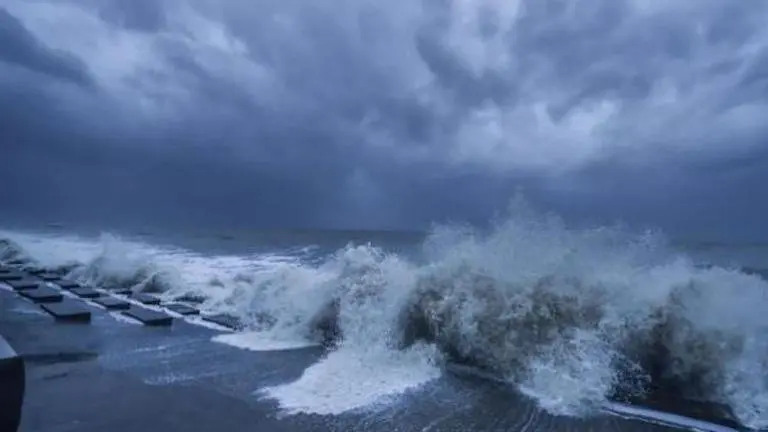
The World Meteorological Organisation said that there can be more than one cyclone at a time in one particular location, hence, each tropical storm is given a name to avoid any confusion. Notably, the practice of naming storms (tropical cyclones) began years ago in order to help in the quick identification of storms in warning messages as names are presumed to be far easier to remember than numbers and technical terms.
How are cyclones named?
Cyclones are usually given short names which are easy to pronounce and remember. According to the World Meteorological Organisation, Tropical Cyclones are named according to the rules at the regional level. There are 6 Regional Specialised Meteorological Centres in the world and 4 regional Tropical Cyclone Warning Centres.
Regional Specialised Meteorological Centres
- South-West Pacific Ocean
- South-West Indian Ocean
- Bay of Bengal and the Arabian Sea
- Western North Pacific Ocean and South China Sea
- Central North Pacific Ocean
- Caribbean Sea, Gulf of Mexico, North Atlantic and eastern North Pacific Oceans
The World Meteorological Organisation maintains rotating lists of names which are appropriate for each Tropical Cyclone basin. If a cyclone is particularly deadly or costly, then its name is retired and replaced by another one.
Nations in the Northern Indian Ocean began using a new system for naming tropical cyclones in 2000, the names are listed alphabetically country-wise and are neutral gender-wise. The World Meteorological Organisation revealed that the common rule is that the name list is proposed by the National Meteorological and Hydrological Services (NMHSs) of WMO Members of a specific region, and approved by the respective tropical cyclone regional bodies at their annual/biannual sessions.
Advertisement
Procedure of Naming Tropical Cyclones
World Meteorological Organisation follows a strict procedure to determine a list of tropical cyclone names in an ocean basin by the Tropical Cyclone Regional Body responsible for that basin at its annual/biennial meeting.
There are five tropical cyclone regional bodies
Advertisement
- ESCAP/WMO Typhoon Committee
- WMO/ESCAP Panel on Tropical Cyclones
- RA I Tropical Cyclone Committee
- RA IV Hurricane Committee
- RA V Tropical Cyclone Committee
For instance, Hurricane Committee determines a pre-designated list of hurricane names for six years separately at its annual session. The pre-designated list of hurricane names is proposed by its Members which include National Meteorological and Hydrological Services in North/Central America and the Caribbean.
Naming procedures in other regions are almost similar to those in the Caribbean. In some of the regions, the lists are established by alphabetical order of the names. In other regions, the lists are established following the alphabetical order of the country names.
Notably, tropical cyclones/hurricanes/typhoons are not named after any particular person. The names selected are those that are familiar to the people in each region. Storms are named for people to easily understand and remember the tropical cyclone/hurricane/typhoon in their region, thus facilitating disaster risk awareness, preparedness, management and reduction.
Naming of Cyclones: Historical Background
Initially, storms were named arbitrarily. An Atlantic storm that ripped off the mast of a boat named Antje became known as Antje's hurricane. Then the mid-1900s saw the start of the practice of using feminine names for storms. In the pursuit of a more organized and efficient naming system, meteorologists decided to identify storms using names from a list arranged alphabetically.
Thus, a storm with a name that begins with A, like Anne, would be the first storm to occur in the year. Before the end of the 1900s, forecasters started using male names for those forming in the Southern Hemisphere.
Since 1953, Atlantic tropical storms have been named from lists originated by the National Hurricane Center. They are now maintained and updated by an international committee of the World Meteorological Organization. The original name lists featured only women's names. In 1979, men's names were introduced and they alternate with women's names. Six lists are used in rotation. Thus, the 2019 list will be used again in 2025.
The only time that there is a change in the list is if a storm is so deadly or costly that the future use of its name on a different storm would be inappropriate for reasons of sensitivity. If that occurs, then at an annual meeting by the WMO Tropical Cyclone Committees (called primarily to discuss many other issues) the offending name is stricken from the list and another name is selected to replace it.
A few examples of infamous storms are Mangkhut (Philippines, 2018), Irma and Maria (Caribbean, 2017), Haiyan (Philippines, 2013), Sandy (USA, 2012), Katrina (USA, 2005), Mitch (Honduras, 1998) and Tracy (Darwin, 1974).