
‘Like Backyard Moon Click’: Artemis II Astronaut’s Remark On Surreal Earth View From Deep Space Goes VIRAL
The four astronauts of NASA's Artemis II mission have a few different devices on board to take photos of space from inside their Orion capsule throughout the flight. They include a small GoPro action camera and iPhones, as well as professional Nikon camera.
- Science News
- 4 min read

;'%3e%3cpath%20d='m8,15.99c4.41,0,7.99-3.58,7.99-7.99S12.41,0,8,0,0,3.59,0,8s3.58,7.99,7.99,7.99Z'%20style='stroke:%23fff;%20stroke-miterlimit:10;%20stroke-width:.02px;'/%3e%3cpath%20d='m3.08,3.37l3.82,5.11-3.84,4.15h.87l3.37-3.64,2.72,3.64h2.94l-4.04-5.39,3.58-3.87h-.86l-3.1,3.35-2.5-3.35h-2.94Zm1.27.64h1.35l5.97,7.99h-1.35l-5.97-7.99Z'%20style='fill:%23fff;'/%3e%3c/g%3e%3c/svg%3e)


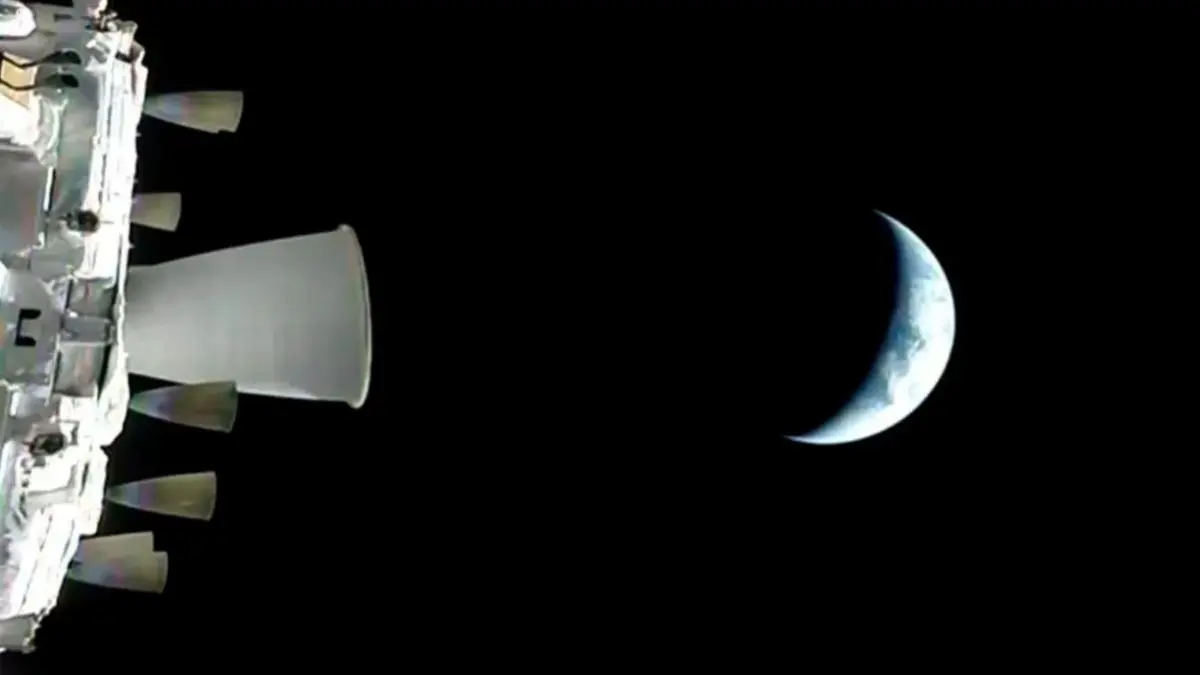
The Orion capsule carrying four astronauts in NASA's Artemis II mission executed a key thruster firing on Thursday that will kick the crew out of Earth's orbit and on a path toward the moon, committing them to reaching the farthest distance humans have ever traveled in space.
The successful maneuver put the crew on a path to enter the moon's sphere of gravitational influence by Sunday morning, as they prepare to beat the distance record set by Apollo 13 in 1970.
"We are getting just a beautiful view of the dark side of the Earth lit by the moon right now. Phenomenal," Canadian astronaut Jeremy Hansen told mission control some 10 minutes after the thruster firing.
Since launching 26 hours earlier from Florida, the astronauts spent their first day in space testing cameras, steering their Orion spacecraft and dealing with small toilet and email issues that were later fixed.
Advertisement
They had been in a highly elliptical Earth orbit swinging them as far as 43,000 miles (64,000 km) away on one end and about 100 miles close on the other, from where the key thruster firing to the moon began, known as the translunar injection burn.
The maneuver, which began at 7:49 p.m. ET (2349 GMT), is an orbital exit ramp slinging them out of Earth's orbit and onto a figure-eight-shaped trajectory toward the moon. It's the final major thruster firing of the mission, leaving the Orion capsule largely under the influence of orbital mechanics for the remainder of the mission.
Advertisement
Commander Reid Wiseman, testing cameras as the crew flew roughly 40,000 miles away from Earth earlier on Thursday, saw the planet as a shrinking sunlit globe, and said taking photos from that distance made it difficult to adjust exposure settings.
"It's like walking out back at your house, trying to take a picture of the moon. That's what it feels like right now trying to take a picture of Earth," he told mission control in Houston as he snapped photos of his home planet with an iPhone.
Wiseman earlier faced a minor tech issue when his initial attempts to use Microsoft Outlook to check emails failed, but that was fixed quickly with help from mission control.
Astronauts Use GoPros And IPhones To Document Trip
The four astronauts of NASA's Artemis II mission, which launched from Florida on Wednesday, have a few different devices on board to take photos of space from inside their Orion capsule throughout the flight.
They include a small GoPro action camera and iPhones, as well as professional Nikon cameras that have been used by NASA astronauts on the International Space Station for years.
The decision to equip the crew with iPhones was made under NASA Administrator Jared Isaacman, a billionaire astronaut who flew on two private SpaceX Dragon missions and used the devices during his own flights, NASA officials have said.
NASA has yet to release any images captured by the crew so far, but expects to do so later in the mission after more climactic moments. Among them is an anticipated "Earthrise" image, echoing the famous photo taken by Apollo 8 astronaut William Anders in 1968 as his spacecraft looped around the moon.
On day six, the astronauts are expected to reach roughly 252,000 miles from Earth, the most distant point ever flown by humans, when the planet will appear no larger than a basketball beyond the moon’s shadowed far side.
Toilet Malfunction
Not long after the successful launch, astronaut Christina Koch alerted mission control in Houston to a red blinking light signaling a problem with Orion’s toilet, housed in a small compartment within the crew cabin, itself only slightly larger than a minivan’s interior. Mission engineers implemented a fix after a proximity operations test, NASA said.
Spacecraft toilets are often awkward to use but are essential for long-duration missions, with designs varying widely.
On the ISS and Orion, astronauts use a $24 million Universal Waste Management System, which uses suction to collect waste, recycles urine into water and seals solid waste in bags that are eventually jettisoned.
The toilet includes a specially shaped funnel and hose for urine and a seat for bowel movements. The funnel and seat can be used simultaneously, reflecting feedback from female astronauts, NASA's website shows.
By contrast, astronauts on the Apollo missions of the 1960s and 1970s used rudimentary bags attached to their bodies, storing them in onboard compartments or leaving them on the moon.
Orion’s toilet more closely resembles a conventional design and is shielded from the rest of the cabin by a small door.
It's "the one place we can go during the mission where we can actually feel like we're alone for a moment," Artemis II astronaut Jeremy Hansen of the Canadian Space Agency said in a video last year.