
Groundbreaking: In a First, Scientists Discover Water on Asteroid Surface
In a first, a team of scientists discovered water molecules on asteroids which will now help them know how water reached Earth.
- Science News
- 2 min read

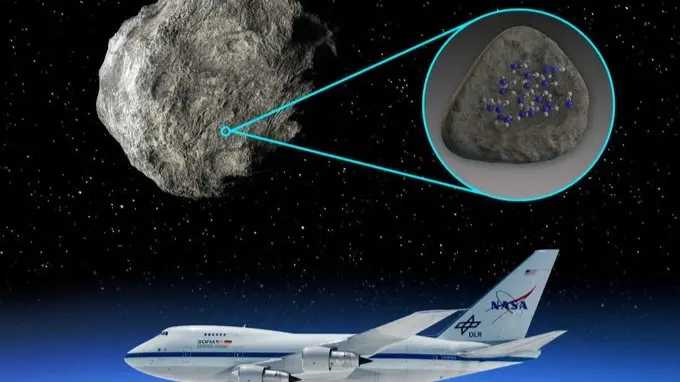
In a significant breakthrough, water molecules were discovered on the surfaces of two asteroids, marking the first instance of such a discovery. Published in The Planetary Science Journal, this finding offers fresh insights into the dispersion of water within the solar system. The discovery is based on the data analysis collected by the Stratospheric Observatory for Infrared Astronomy (SOFIA), a telescope, now operated by the National Aeronautics and Space Administration (NASA) and the German Aerospace Centre.
This discovery will help scientists to understand how water reached Earth.
These asteroids studied are Iris and Massalia. Both were found to be high in Silicates, minerals containing silicon and oxygen. Iris (with a diametre of 199 km) and Massalia (with a diameter of 135 km) have similar orbits with an average distance of 2.39 astronomical units (AU)
Dr Anicia Arredondo, one of the lead authors and asteroid researcher taking to microblogging platform X said, "New paper! We have detected molecular water on asteroids using SOFIA."
Advertisement
The scientist in a statement said, "We based our research on the success of the team that found molecular water on the sunlit surface of the moon. We thought we could use SOFIA to find this spectral signature on other bodies."
Arrendondo along with her team looked at 4 asteroids that included Parthenope and Melpomene. Out of the 4, 3 asteroids showed absorption at a wavelength of 3 micrometres, however, Iris and Massalia also showed absorption at 6 micrometres, a signature only attributable to water.
Advertisement
SOFIA, the instrument that was used in the research, previously helped in detecting water in the Moon's southern part.