
Why Did January 3 Have The Brightest Moon Of 2026 And The Largest Sun?
Earth hit perihelion on Jan 3, 2026, its closest point to the Sun, coinciding with the Wolf Supermoon. The Sun appeared slightly larger, but the change was subtle and undetectable to the naked eye, with no impact on Earth's temperature.
- Science News
- 2 min read

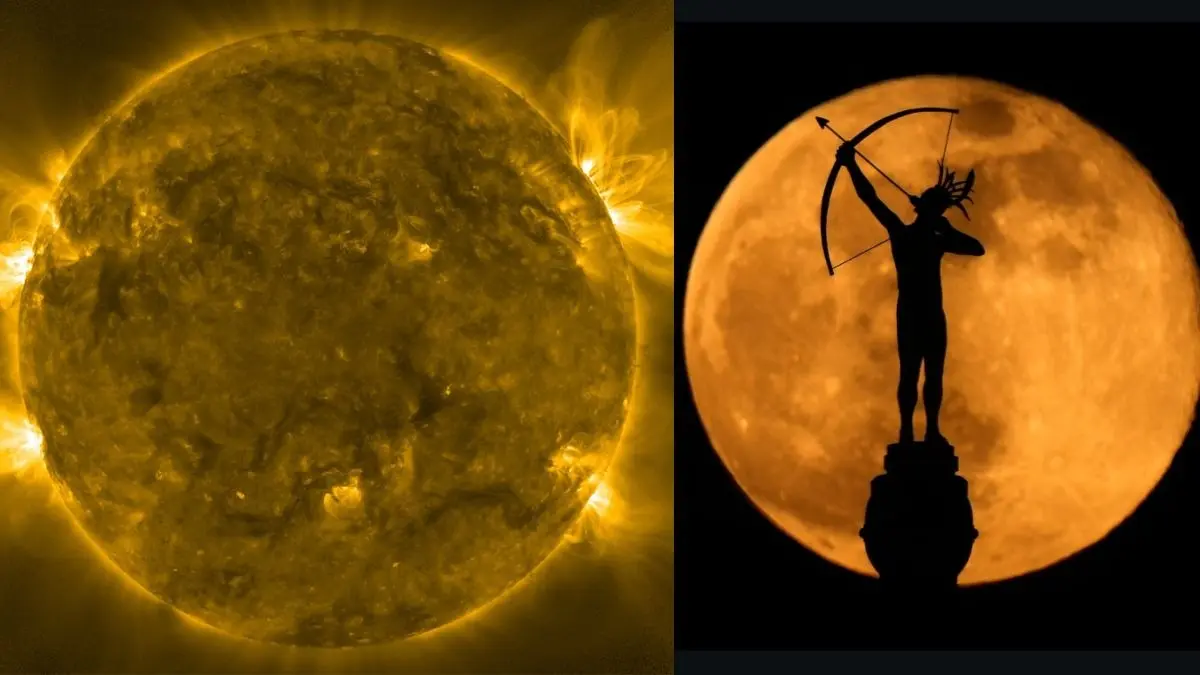
A rare coincidence occurred on January 3, 2026, as the Earth witnessed two unique celestial events, perihelion and Wolf Supermoon. The Earth made its annual closest approach to the Sun on the third day of the New Year as our planet reached a point in its elliptical orbit known as perihelion.
At approximately 10:45 pm (IST), Earth was about 91.5 million miles (147.3 million km) from the Sun, roughly 3 million miles closer than average. As a result, the Sun appeared fractionally larger in the sky than at other times of the year. The Sun was roughly five million kilometres closer than it is at its farthest point, which is known as aphelion.
While it could be called the “largest Sun” of 2026, the change in the appearance of the celestial body from Earth was subtle. The change cannot be detected by the naked eye. It can only be observed with scientific instruments and telescopes. The event also does not affect Earth’s temperature.

Both perihelion and aphelion are annual occurrences. In 2027, Earth will reach perihelion on 3 January at 08.02 am (IST), when it will be about 147,104,592 kilometres away from the Sun, and will then move to its farthest point, aphelion, on 5 July at 10:35 am, when the distance between the Earth and the Sun will increase to around 152,100,481 kilometres. In 2028, Earth will reach perihelion on 5 January at 05:58 pm (IST), coming to a distance of about 147,100,687 kilometres from the Sun, before reaching aphelion on 4 July at 03:48 am, when it will be approximately 152,093,129 kilometres away from the Sun.
Advertisement
Wolf Moon
Another notable celestial occurrence seen on January 3 was the 'Wolf Moon', which is the first full moon of January. This year’s Wolf Moon was a supermoon, which occurs when the full moon aligns closely with the Moon’s closest point to Earth (perigee). During this event, the Moon appears brighter and larger than usual.
The name ‘Wolf Moon’ has cultural roots, historically referring to midwinter nights when wolves were thought to howl more often.