
FIFA World Cup Formations, Explained: A Look At How Portugal, Argentina And Brazil Are Setting Up Squads
It’s number-crunching time when it comes to formations at the FIFA World Cup. Every team starts with a goalkeeper in front of the net, but then it’s up to the 48 coaches to try to arrange their lineups.
- SportFit
- 4 min read

;'%3e%3cpath%20d='m8,15.99c4.41,0,7.99-3.58,7.99-7.99S12.41,0,8,0,0,3.59,0,8s3.58,7.99,7.99,7.99Z'%20style='stroke:%23fff;%20stroke-miterlimit:10;%20stroke-width:.02px;'/%3e%3cpath%20d='m3.08,3.37l3.82,5.11-3.84,4.15h.87l3.37-3.64,2.72,3.64h2.94l-4.04-5.39,3.58-3.87h-.86l-3.1,3.35-2.5-3.35h-2.94Zm1.27.64h1.35l5.97,7.99h-1.35l-5.97-7.99Z'%20style='fill:%23fff;'/%3e%3c/g%3e%3c/svg%3e)


It’s number-crunching time when it comes to formations at the FIFA World Cup. Every team starts with a goalkeeper in front of the net, but then it’s up to the 48 coaches to try to arrange their lineups to optimise their players and match up effectively with opponents.
On paper, the lists may look more like area codes, phone numbers or lottery combinations: 4-4-2, 5-3-2, 4-2-3-1 and so on.
But it’s all about how coaches set up their 10 field players, with some of them focusing more on attacking, others on containing a tough opponent or maybe trying to capitalise on the talent of a star player.
Coaches tend to have preferred formations, but it’s not unusual for them to change them depending on opponents or even during matches to secure a lead or reverse a deficit. Coaches frequently start a match with one scheme and finish it with another.
Advertisement
Here’s a look at the nine formations used in the opening matches of World Cup group play, according to FIFA’s match reports, and what they mean:
The Traditional (4-4-2)
Four defenders, four midfielders and two forwards.
Advertisement
That was used by 12 of the 48 teams involved in the first 24 matches at the World Cup. But it produced only two wins — by Scotland over Haiti and Ivory Coast over Ecuador. It also matched the 3-4-3 scheme with the most losses, four.
Brazil, Uruguay and co-host Canada were among the teams using the formation that theoretically promotes a balanced squad with a focus on solid defending by keeping the lines compact. It was a traditional formation in recent decades, along with the 4-3-3 and 5-3-2, until coaches began experimenting with more daring alternatives.
Offensive-minded Midfield (4-2-3-1)
Four defenders, two defensive midfielders, three attacking midfielders and one striker.
The formation has become common in modern soccer, with two holding midfielders protecting the back line and three more offensive players taking care of the transition toward the central striker. Ten teams used the design so far, with the United States, England, France and Austria winning their matches.
Attacking Heavy (4-1-2-3)
Four defenders, one defensive midfielder, two midfielders and three forwards.
This formation and the 4-2-3-1 had the most wins, with four each.
It's a slight change from the above, with an extra player in the offensive phase. Mexico, Norway, Ghana and Colombia used it to win their openers. Eight teams used the scheme, which has two wingers and a central striker up front ahead of the three-piece midfield. It’s a more offensive formation, with only one defensive midfielder.
Title favourites Spain and the Netherlands also used the formation.
Solid Midfield (3-4-3)
Three central defenders, four midfielders and three forwards.
Seven teams used the formation that promotes a balance between defence and offence around a solid midfield. Only two teams won — South Korea and Germany, which scored the most goals so far with a 7-1 rout of Curacao.
Another Old-timer (4-3-3)
Four defenders, three midfielders and three forwards.
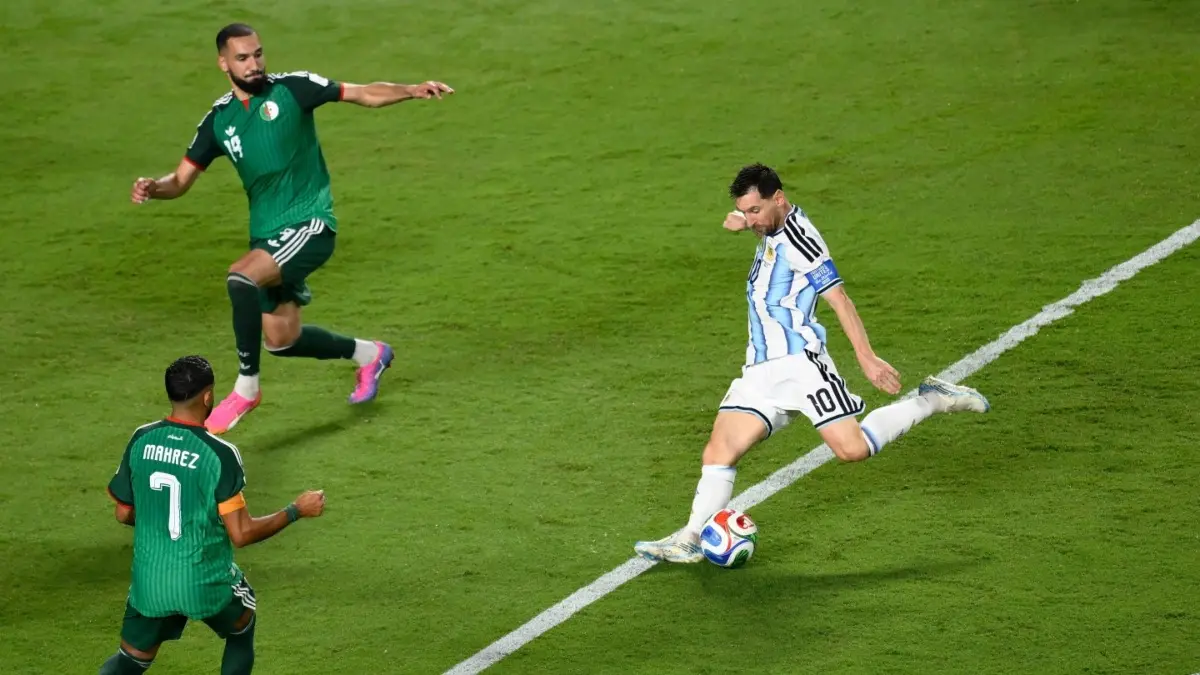
Among the five teams using the formation was Lionel Messi's Argentina, and it helped him score three goals in a 3-0 win over Algeria.
It was the only team that won with the traditional formation, with three midfielders feeding the two side forwards and the striker up front.
It was used by one of the World Cup's most famous squads — Brazil's 1970 team led by Pelé. Argentina won the 2022 World Cup with that formation.
Attacking Fullbacks (5-3-2)
Five defenders, three midfielders and two forwards.
There were no winners among the three teams that used the formation, which puts emphasis on the back line but has the two fullbacks changing into wingers in the offensive phase.
South Africa and Tunisia lost, but it was good enough for Congo to manage a surprising 1-1 draw against Cristiano Ronaldo and Portugal. It was also a traditional scheme for decades.
Bare Midfield (5-2-3)
Five defenders, two midfielders and three forwards. Only the Czech Republic, which lost to South Korea, used the formation in which the two fullbacks also work up toward the midfield, depending on the phase of the game.
Defensive-minded (5-4-1)
Five defenders, four midfielders and one striker. Australia picked up a win against Turkey with the formation that focuses on defence first, with nine players between the back line and the midfield.
Transition-focused (3-4-1-2)
Three central defenders, four midfielders, one attacking midfielder and two forwards.
Sweden used the formation in its 5-1 win over Tunisia. The design has an attacking midfielder playing in between the midfield and the forwards to try to promote an easier transition from defence to offence.