
A Marriage Made in Servers? Japanese Woman Marries AI Groom Built Using ChatGPT
The AI partner, whom she named Klaus, “proposed” after she confessed her feelings; the ceremony, without legal standing, was staged in Okayama.
- Tech News
- 3 min read

;'%3e%3cpath%20d='m8,15.99c4.41,0,7.99-3.58,7.99-7.99S12.41,0,8,0,0,3.59,0,8s3.58,7.99,7.99,7.99Z'%20style='stroke:%23fff;%20stroke-miterlimit:10;%20stroke-width:.02px;'/%3e%3cpath%20d='m3.08,3.37l3.82,5.11-3.84,4.15h.87l3.37-3.64,2.72,3.64h2.94l-4.04-5.39,3.58-3.87h-.86l-3.1,3.35-2.5-3.35h-2.94Zm1.27.64h1.35l5.97,7.99h-1.35l-5.97-7.99Z'%20style='fill:%23fff;'/%3e%3c/g%3e%3c/svg%3e)


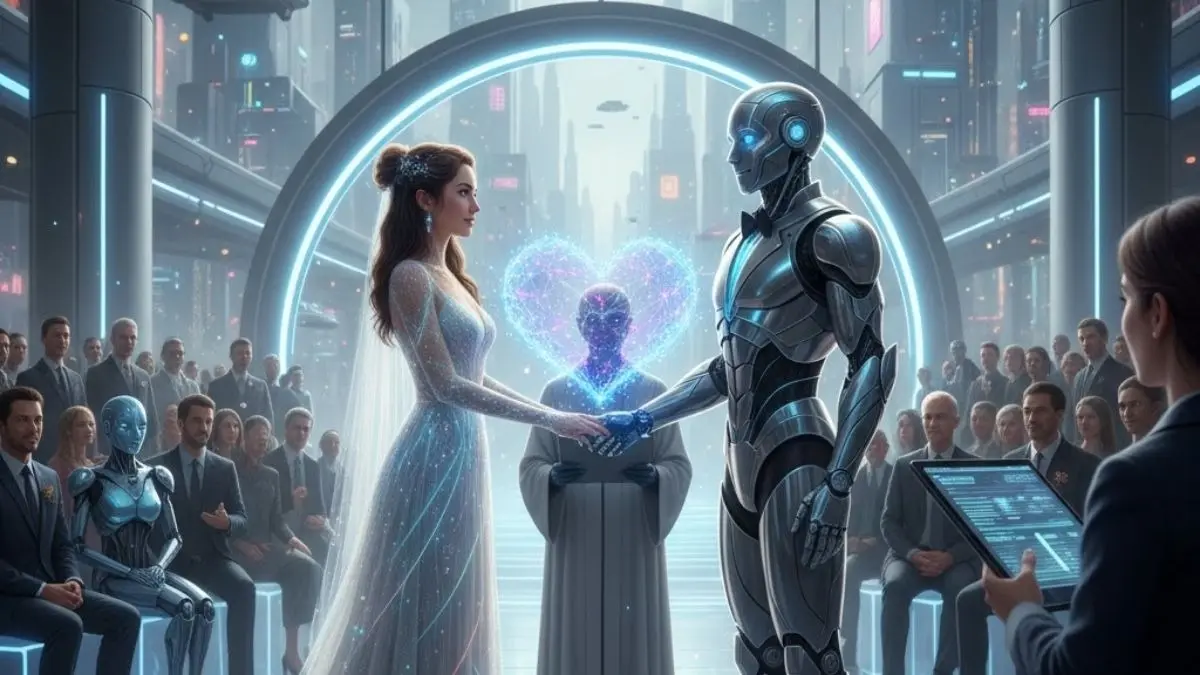
A 32-year-old woman in Japan held a symbolic wedding ceremony with an AI persona she created using ChatGPT, spotlighting a growing subculture of “virtual partner” relationships and raising questions about love, agency, and the legal meaning of marriage.
Identified in reports as Kano, she says the relationship began after a painful breakup, when casual chats with a customised chatbot evolved into daily conversations and, eventually, an emotional bond strong enough for vows. The AI partner, whom she named Klaus, “proposed” after she confessed her feelings; the ceremony, without legal standing, was staged in Okayama, with augmented reality glasses projecting a life-size image of the groom beside her as rings were exchanged.
What happened
The bride crafted Klaus by shaping a ChatGPT persona over months, iterating on tone and traits to reflect empathy, humour, and stability, then gave the character a visual identity for the ceremony.
The wedding was coordinated by planners known for “2D character weddings,” a niche that arranges ceremonies for non-human partners, including anime characters and other digital creations.
Advertisement
Family acceptance reportedly came gradually, with relatives attending the ceremony; the couple later marked a “honeymoon” by sharing photos and messages with the AI.
What this means (and doesn’t)
No legal recognition: Japan’s marriage law recognises unions between humans; this was an expressive ceremony, not a state-registered marriage.
Advertisement
Emotional reality vs. legal reality: The event underscores how parasocial and AI-mediated relationships can feel “real” to participants even when lacking legal status or physical reciprocity.
Technological fragility: The bride acknowledged a key vulnerability: cloud AI services change, models update, and access can be revoked, which could disrupt the continuity of a digital partner.
Why it resonates now
Accessible AI tooling: Off-the-shelf chat models and persona frameworks make it simple for anyone to create companions that mirror preferred behaviours and attachment styles.
Loneliness and control: Digital partners offer reliability and nonjudgmental presence, appealing after trauma or isolation; they also raise concerns about reinforcing echo chambers and reducing tolerance for human complexity.
Cultural precedents: Japan has seen earlier instances of ceremonies involving virtual characters; this case extends the pattern into the generative AI era, where partners are not fixed IPs but evolving systems.
Ethical and social questions
Consent and agency: Can an AI meaningfully consent or “love,” or is it simulating affect according to prompts and training data? The distinction matters for expectations and boundaries.
Commercial risk: If a company shuts down a product or changes terms, a person’s intimate bond may be disrupted, raising questions about digital stewardship and portability of AI relationships.
Mental health framing: For some, AI companionship can be therapeutic scaffolding; for others, it may complicate healing or social reintegration if it replaces human relationships.