
Apple Has Finally Fixed iPhone to Android Texting. It Now Needs to Improve iOS Notifications
Apple worked closely with Google to not just implement RCS into iOS but also add end-to-end encryption to it, but it failed to be inspired by how streamlined notifications are on Android.
- Tech News
- 5 min read

;'%3e%3cpath%20d='m8,15.99c4.41,0,7.99-3.58,7.99-7.99S12.41,0,8,0,0,3.59,0,8s3.58,7.99,7.99,7.99Z'%20style='stroke:%23fff;%20stroke-miterlimit:10;%20stroke-width:.02px;'/%3e%3cpath%20d='m3.08,3.37l3.82,5.11-3.84,4.15h.87l3.37-3.64,2.72,3.64h2.94l-4.04-5.39,3.58-3.87h-.86l-3.1,3.35-2.5-3.35h-2.94Zm1.27.64h1.35l5.97,7.99h-1.35l-5.97-7.99Z'%20style='fill:%23fff;'/%3e%3c/g%3e%3c/svg%3e)


Apple spent years treating RCS (rich communication services) support as a concession it was not willing to make. When it finally arrived with iOS 18, the reaction was predictably split: Android users celebrated the end of green bubbles degrading their group chats, while Apple loyalists largely shrugged, unmoved by a feature they had never needed. But the significance of RCS adoption was never really about green bubbles. It was about Apple acknowledging, for the first time in a meaningful way, that the iPhone does not exist in a vacuum. People who use iPhones communicate with people who do not, and that experience matters.
With RCS now live, cross-platform texting was no longer the embarrassment it once was. High-resolution media transfers without compression artefacts, read receipts, typing indicators, and better group messaging functionality were all now available when an iPhone user texted an Android counterpart. It was not iMessage, but it was no longer the functional equivalent of a fax machine, either.
And then iOS 26.5 arrived and made the picture significantly more complete.-1778677850852.webp)
Starting this week, iPhone users running iOS 26.5 began seeing a new lock icon in RCS chats, indicating that messages in those conversations are end-to-end encrypted. This is not small. Until now, the most significant criticism of RCS — even after Apple adopted it — was that cross-platform messages lacked the encryption that iMessage has offered since 2011. An unencrypted RCS conversation between an iPhone and an Android device was more secure than SMS, but it was still readable in transit by carriers and, theoretically, bad actors. That gap has now been addressed.
Advertisement
What makes this development particularly notable is who Apple chose to work with to get there. Apple collaborated directly with Google, leading a cross-industry effort alongside the GSMA to bring E2EE to RCS, with the feature built on the Messaging Layer Security protocol and formalised as part of the RCS Universal Profile 3.0.
For two companies whose ecosystems are defined in large part by their rivalry, that is a meaningful act of pragmatism. Apple looked at what the broader Android ecosystem had built around secure messaging infrastructure, recognised the value in it, and chose collaboration over competition.
Advertisement
Taken together, RCS with E2EE represents the most substantive improvement to cross-platform communication that either company has delivered in years. Apple has shown it can look across the aisle, learn from what Android does well, and act on it. The willingness to work with Google on encryption — rather than use the absence of it as a quiet argument for staying within iMessage — reflects a maturity in Apple's platform thinking that deserves acknowledgement.
Which is precisely why the notification system is so difficult to defend.
If Apple could sit across the table from Google to architect a shared encryption standard, it clearly has studied the Android ecosystem closely enough to understand how it works. And anyone who has used a modern Android device knows that notifications are one of the things it does demonstrably better. Android treats notifications as first-class citizens: granular per-app controls, priority channels, and visibility settings that the user, not the operating system, dictates. The experience is not perfect, but it is built around the assumption that the person holding the phone is capable of deciding what deserves their attention.
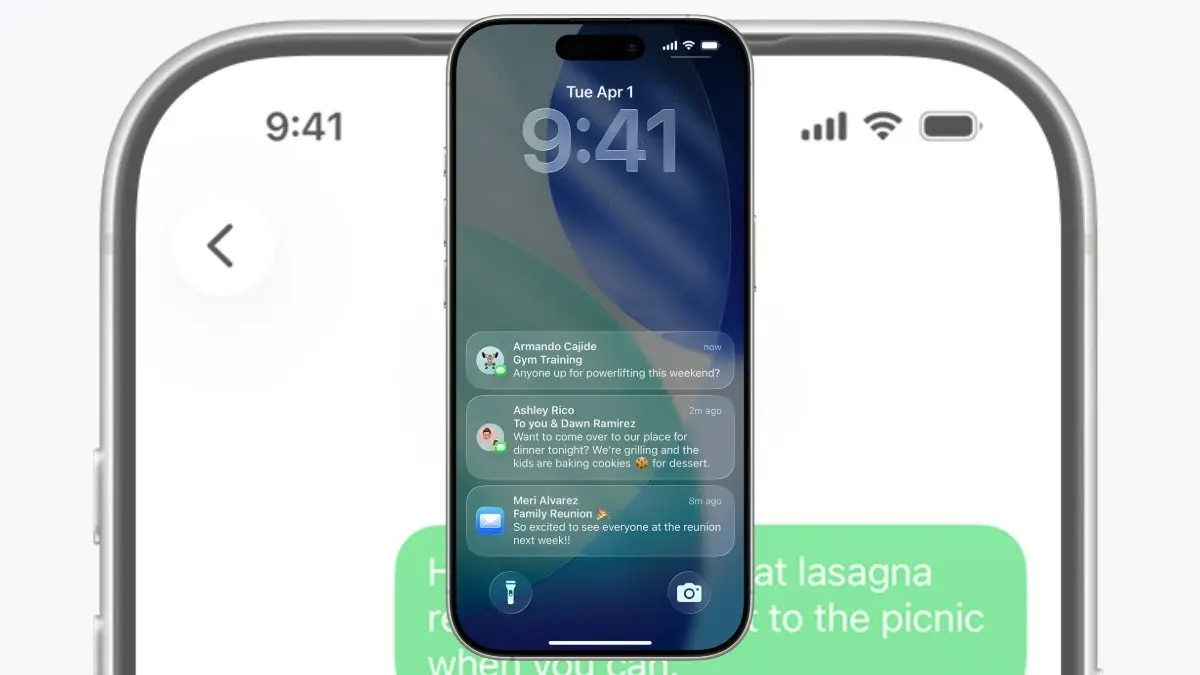
iOS operates on the opposite assumption. Its notification philosophy prioritises visual tidiness over functional clarity, grouping alerts by app, collapsing them into summaries, and suppressing interruptions with an efficiency that occasionally crosses into paternalism. Apple has incrementally improved this over successive versions — Focus modes, notification scheduling, summary controls — but the underlying architecture has not fundamentally changed. The system still reflects a design orthodoxy that equates fewer interruptions with a better experience, regardless of whether the user agrees.
The problems are specific enough to name. Notification summaries, introduced with Apple Intelligence, have already generated controversy for misrepresenting news headlines and alert content, compressing nuanced information into inaccurate one-liners. Time-sensitive notifications, which are supposed to break through Focus modes, do not always behave consistently. And for users who rely on their phones for professional communications across multiple platforms, the absence of a genuinely robust priority system remains a real limitation — one that Android solved years ago.
Apple was not too proud to learn from Google on encryption. It should not be too proud to learn from Google on notifications. The two problems are obviously different in nature, but the principle is the same: look at what works, set aside the instinct to protect existing design decisions, and build something better. A ground-up rethinking of how iOS surfaces, prioritises, and hands control of alerts back to the user would not diminish the platform. It would strengthen it.
Apple has shown it can evolve when the case is clear enough. On notifications, the case has been clear for years. The question is no longer whether Apple knows what better looks like. It is about whether it is willing to build it.