
‘I Miss You So Much’: China Mother Speaks to AI Clone of Son Killed in Accident
In Shandong province, China, an elderly mother in her 80s, suffering from heart disease, lost her only son in a car accident last year. To protect her from the devastating truth, the family turned to artificial intelligence. With the help of AI developer Zhang Zewei, they created a digital replica of the son using photos, videos, and audio recordings.
- Tech News
- 3 min read

;'%3e%3cpath%20d='m8,15.99c4.41,0,7.99-3.58,7.99-7.99S12.41,0,8,0,0,3.59,0,8s3.58,7.99,7.99,7.99Z'%20style='stroke:%23fff;%20stroke-miterlimit:10;%20stroke-width:.02px;'/%3e%3cpath%20d='m3.08,3.37l3.82,5.11-3.84,4.15h.87l3.37-3.64,2.72,3.64h2.94l-4.04-5.39,3.58-3.87h-.86l-3.1,3.35-2.5-3.35h-2.94Zm1.27.64h1.35l5.97,7.99h-1.35l-5.97-7.99Z'%20style='fill:%23fff;'/%3e%3c/g%3e%3c/svg%3e)


New Delhi: Technology today is reshaping human life in ways that are both inspiring and unsettling. A recent case from China has sparked widespread debate online, showing how artificial intelligence can be used to comfort grief but also how it can blur the line between reality and illusion.
In Shandong province, an elderly mother in her 80s, who suffers from heart disease, lost her only son in a car accident last year. Fearing that the shock of his death would be too much for her fragile health, the family decided not to tell her the truth. Instead, they turned to technology. With the help of an AI development team led by Zhang Zewei from Jiangsu province, they created a digital clone of the son.
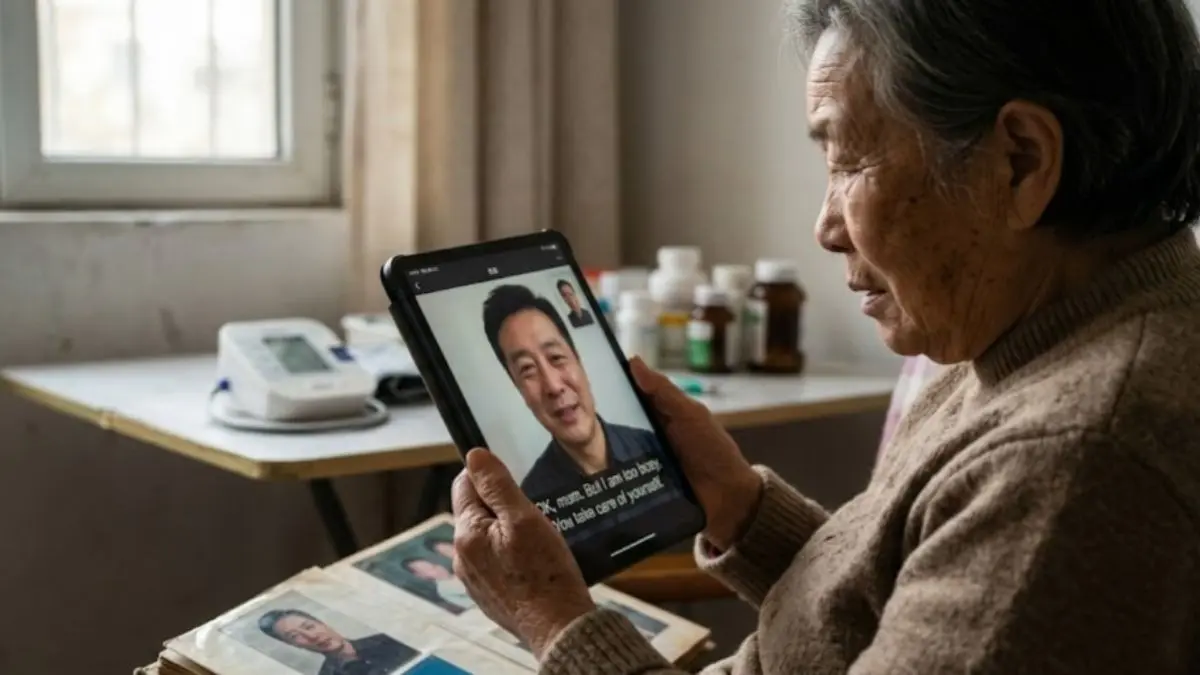
This AI “son” now calls her every day through video chats, speaking in her son’s dialect, mimicking his gestures, and responding to her concerns just as he once did, a South China Morning Post report details. The replica was built using hundreds of photos, videos, and audio recordings provided by the family. The result is a virtual version that looks, sounds, and even moves like the real man.
The conversations between mother and son are deeply emotional. She often urges him to eat well, wear warm clothes, and stay safe when going out. The AI replies with promises to follow her advice, explaining that he is working in another city and cannot return home yet. In one exchange, the mother says: “You should call me more often so that I know whether you live well or not in another city. I am missing you so much. I feel so sorry that I cannot see you in person.” The AI responds gently: “OK, mum. But I am too busy. You take care of yourself. When I have made enough money, I will return home to pay my filial piety to you.”
Advertisement
For now, the mother remains unaware that her son is gone. The family believes this “gentle lie” is the only way to protect her health and keep her spirits alive. Zhang, who has been offering such AI services for three years, admits the work is controversial. He even jokes that he is “deceiving people’s emotions,” but insists his goal is to comfort the living.
The story has triggered a storm of reactions on Chinese social media. Some users praised the family’s decision, calling the AI son a touching invention and a way to ease grief. Others said they would want to resurrect their own parents using similar technology. But critics warned that the deception could backfire, arguing that once the truth comes out, the mother may suffer even greater harm.
Advertisement
This case highlights the growing intersection of technology and human emotion. While AI is often celebrated for its ability to solve practical problems, here it has been used to preserve a bond between a mother and her child. Whether this is an act of compassion or a dangerous illusion remains a matter of debate.