
Brake Ahead, Fog Alert, Keep Distance - Government to Launch Vehicle‑to‑Vehicle Tech to Let Cars Talk on Roads
The Indian government is set to launch Vehicle‑to‑Vehicle (V2V) communication technology, enabling cars to talk directly and share real‑time safety alerts without relying on mobile networks or the internet.
- Tech News
- 2 min read

;'%3e%3cpath%20d='m8,15.99c4.41,0,7.99-3.58,7.99-7.99S12.41,0,8,0,0,3.59,0,8s3.58,7.99,7.99,7.99Z'%20style='stroke:%23fff;%20stroke-miterlimit:10;%20stroke-width:.02px;'/%3e%3cpath%20d='m3.08,3.37l3.82,5.11-3.84,4.15h.87l3.37-3.64,2.72,3.64h2.94l-4.04-5.39,3.58-3.87h-.86l-3.1,3.35-2.5-3.35h-2.94Zm1.27.64h1.35l5.97,7.99h-1.35l-5.97-7.99Z'%20style='fill:%23fff;'/%3e%3c/g%3e%3c/svg%3e)


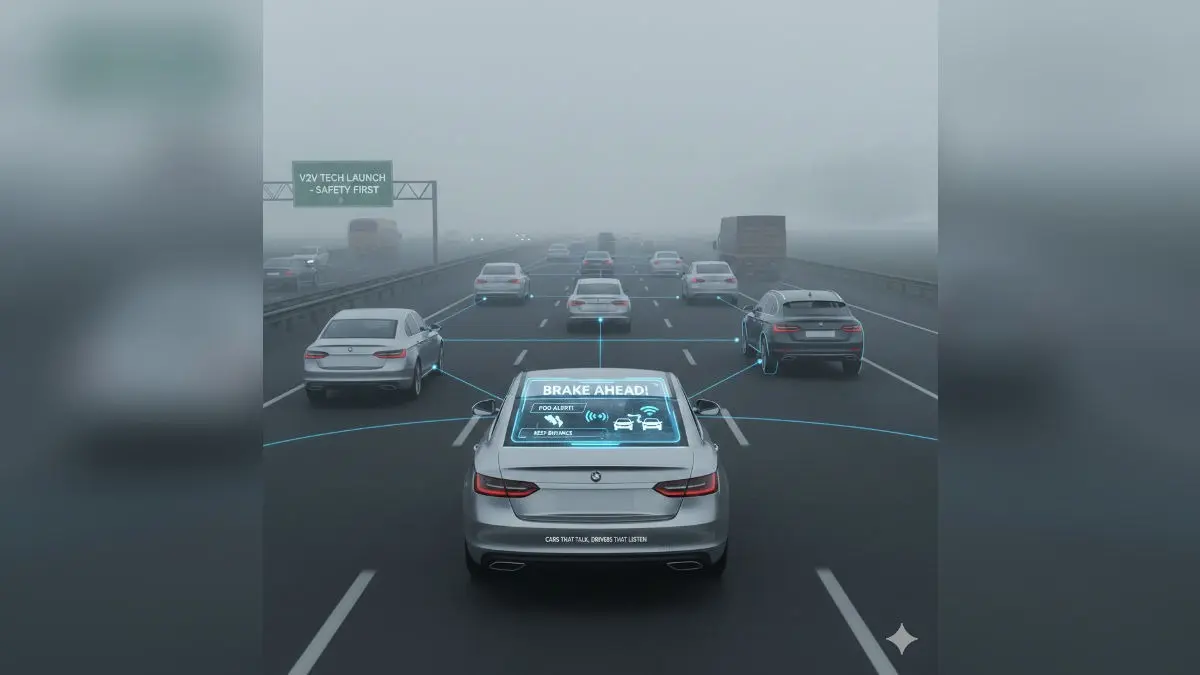
New Delhi: Cars on Indian roads may soon be talking to each other. Union Minister for Road Transport and Highways Nitin Gadkari announced on Thursday that the government is preparing to roll out Vehicle‑to‑Vehicle (V2V) communication technology across the country – a unique system designed to make driving safer by letting vehicles exchange information in real time.
Cars That Talk, Drivers That Listen
The new technology will allow vehicles to send signals directly to one another without relying on mobile networks or the internet. Drivers will get instant alerts about speed, braking, acceleration, and even cars hidden in blind spots. Imagine your car warning you: “Brake ahead!” or “Fog alert!” - giving you those extra seconds to react and avoid danger.
How It Works
At the heart of the system is a small Onboard Unit (OBU) installed inside vehicles. This wireless device will constantly share and receive data such as speed, location, and braking patterns with nearby cars. Gadkari explained that the system works much like the technology used to land airplanes in fog, guiding drivers even in poor visibility.
Safety First
The biggest benefit is early warnings. If a car ahead brakes suddenly, your vehicle will know instantly and alert you. If there’s a stationary vehicle hidden in the dark or in heavy smog, the system will flag it before you get too close. By reducing blind spots and reaction delays, the government hopes to cut down thousands of accidents on Indian roads.
Advertisement
Backed by Telecom
To make this possible, a joint task force has been set up with the telecom department. The government has agreed in principle to allocate 30 MHz spectrum (5.875 to 5.905 GHz) for V2V communication. This dedicated frequency will ensure smooth, uninterrupted signals between vehicles nationwide.
From foggy highways to crowded city streets, V2V technology promises to be a game‑changer for road safety. As Gadkari put it, “If there is a collision, it will stop. If there is darkness, it will stop.” Soon, Indian drivers may find themselves guided not just by traffic lights and road signs, but by cars talking directly to each other.