
China Reportedly Begins Mass-Producing Humanoid Robots As Elon Musk Watches
Beijing’s near-term focus is less about consumer robots and more about getting bipedal machines to reliably perform repetitive tasks in structured industrial settings.
- Tech News
- 4 min read

;'%3e%3cpath%20d='m8,15.99c4.41,0,7.99-3.58,7.99-7.99S12.41,0,8,0,0,3.59,0,8s3.58,7.99,7.99,7.99Z'%20style='stroke:%23fff;%20stroke-miterlimit:10;%20stroke-width:.02px;'/%3e%3cpath%20d='m3.08,3.37l3.82,5.11-3.84,4.15h.87l3.37-3.64,2.72,3.64h2.94l-4.04-5.39,3.58-3.87h-.86l-3.1,3.35-2.5-3.35h-2.94Zm1.27.64h1.35l5.97,7.99h-1.35l-5.97-7.99Z'%20style='fill:%23fff;'/%3e%3c/g%3e%3c/svg%3e)


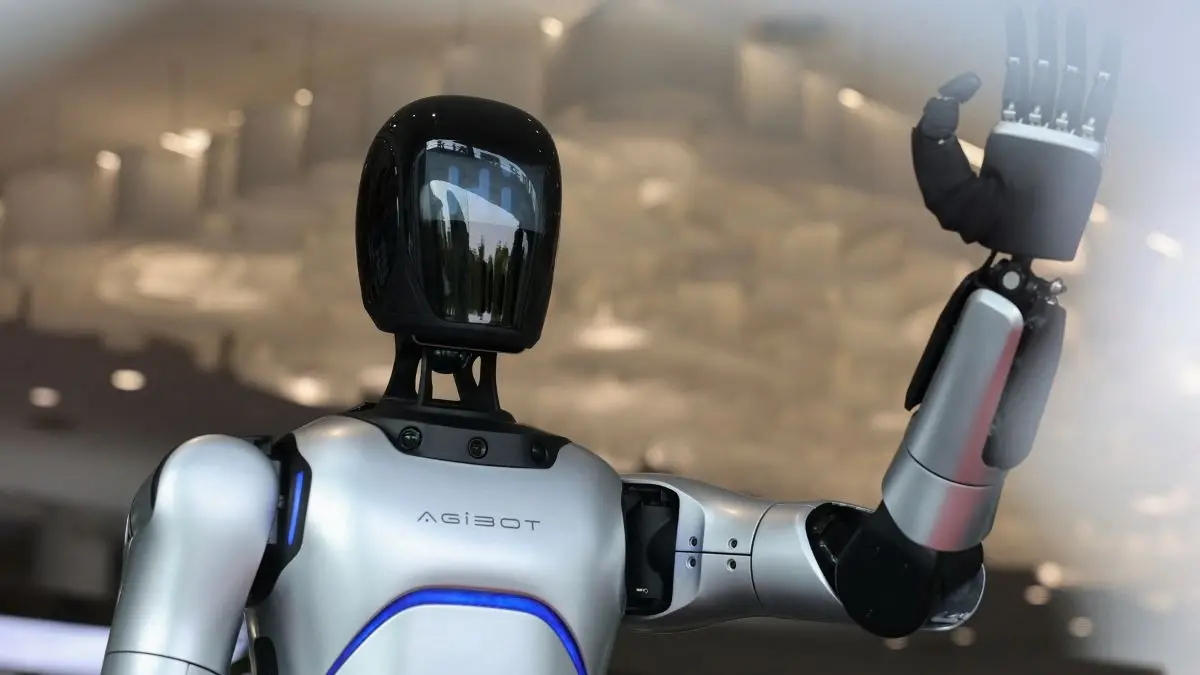
Elon Musk has envisioned putting a humanoid robot into each household, placing huge bets on Tesla’s flagship humanoid robot, Optimus. But he has yet to make it commercially available. On the other hand, China is pushing humanoid robots from flashy demos into factory floors, with national-level targets pointing to mass production by 2025 and an acceleration toward broader industrial adoption by 2027.
Chinese President Xi Jinping met with the Central Committee, a group of the country’s top leaders, in October to release the “15th five-year plan,” which puts a spotlight on “embodied artificial intelligence.” That is another phrase for AI-powered hardware like robots, or better humanoids.
Beijing’s near-term focus is less about consumer robots and more about getting bipedal machines to reliably perform repetitive tasks in structured industrial settings, where economics, safety controls, and process discipline can be tightly managed.
A policy clock starts ticking
The country’s roadmap is explicit: achieve mass production by 2025, strengthen an innovation system around humanoids, and secure key breakthroughs and supply-chain capabilities. It also sets a longer horizon by 2027, humanoid robots are positioned as a new driver of economic growth, reinforcing why 2025 is widely discussed as the “scale-up” inflexion point rather than a distant aspiration.
Advertisement
From prototypes to purchase orders
Chinese firms are increasingly framing 2025 as a delivery year, with companies such as UBTech, Unitree, and AgiBot moving beyond lab prototypes toward commercial production and deployments. The most credible early demand is coming from industrial customers, particularly automotive manufacturing, because it offers repeatable environments and measurable ROI targets compared with open-ended household use cases.

Why factories come first
Factories provide predictable lighting, defined work cells, standardised parts bins, and consistent task loops, which make them ideal for training humanoids on basics like walking stability, pick-and-place motions, and simple handling routines. These deployments also generate the real-world interaction data needed to improve “embodied intelligence,” which is still a bottleneck for general-purpose performance.
Advertisement
The hard part: economics and reliability
Even in China, the main limiter is whether humanoids can beat cheaper alternatives, such as human labour, traditional industrial robots, or cobots, on cost and throughput for specific tasks.
Reports this year have cited unit costs on the order of hundreds of thousands of yuan for some systems, and noted that multiple robots may be required to match one human worker in certain roles, stretching payback periods unless pricing falls and uptime rises. That reality is why the next wave of progress will likely be measured less by viral videos and more by metrics that factories care about: mean time between failures, safety incidents, cycle time, and total cost of ownership.
Another reason why robotics is Beijing’s key priority is its shrinking population and declining birthrates. Estimates suggest the population graph in China is tanking gradually, leading to a lower number of people in the workforce and rising labour costs. With humanoid robots, China hopes to address the demographic pressure, while reinstating its plan for tech supremacy.
Is Elon Musk behind?
China’s accelerated programme to deploy humanoid robots is part of its strategy to one-up the US in the ongoing tech race. It is also an indirect challenge to Musk, who has been showing us what a future with humanoid robots looks like. At the centre of it is Optimus, the recent prototypes of which have amazed people through their playful yet humanlike behaviour.
Announced in 2021, the general-purpose humanoid robot has made several appearances, where it has performed tasks such as lifting a glass of water, shaking a hand, or even dancing. But to the dismay of both Musk and the enthusiasts, Optimus has yet to become commercially available.
An early mass production of humanoid robots is expected to give China an upper hand. Still, the question of whether society is ready for robots to take over their daily lives remains.