
Delhi Airport Boosts Winter Readiness With AI, Predictive Analytics
By integrating real-time data, predictive weather models, and airside operational inputs into a single command environment, the APOC enables faster decision-making and more accurate resource deployment during fog.
- Tech News
- 3 min read

;'%3e%3cpath%20d='m8,15.99c4.41,0,7.99-3.58,7.99-7.99S12.41,0,8,0,0,3.59,0,8s3.58,7.99,7.99,7.99Z'%20style='stroke:%23fff;%20stroke-miterlimit:10;%20stroke-width:.02px;'/%3e%3cpath%20d='m3.08,3.37l3.82,5.11-3.84,4.15h.87l3.37-3.64,2.72,3.64h2.94l-4.04-5.39,3.58-3.87h-.86l-3.1,3.35-2.5-3.35h-2.94Zm1.27.64h1.35l5.97,7.99h-1.35l-5.97-7.99Z'%20style='fill:%23fff;'/%3e%3c/g%3e%3c/svg%3e)


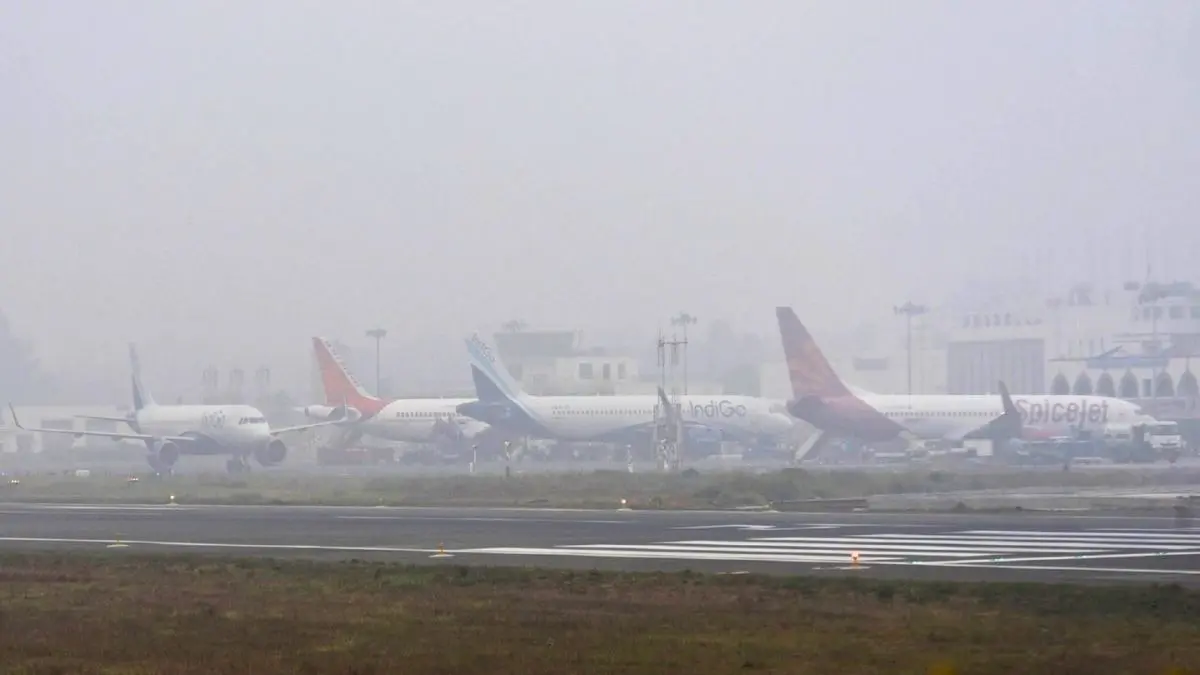
GMR Aero-led Delhi International Airport Limited (DIAL), operator of India's busiest airport, has significantly strengthened its winter readiness with next-generation AI systems, advanced predictive analytics, and enhanced runway capabilities, ensuring safer, more efficient flight operations and minimal passenger disruption during low-visibility conditions.
In these, Delhi Airport's "Airport Predictive Operations Centre (APOC)" plays a central role. By integrating real-time data, predictive weather models, and airside operational inputs into a single command environment, the APOC enables faster decision-making and more accurate resource deployment during fog.
It helps optimise runway utilisation, improve gate and stand allocation, prioritise aircraft sequencing, and ensure timely communication with all partners. This coordinated, data-driven approach significantly enhances the Airport's ability to maintain operational continuity even during rapid fluctuations in visibility.
In addition, as a pilot project, DIAL will use the Winter Fog Experiment (WiFEX) fog data, which claims 85% fog prediction accuracy. It is expected to help in anticipating fog well in advance. This early insight will enable proactive operational planning and seamless coordination between airlines, Air Traffic Control, and ground teams -- ultimately leading to fewer delays and a far more reliable travel experience for passengers.
Advertisement
Pune-based Indian Institute of Tropical Meteorology (IITM), in collaboration with the India Meteorological Department (IMD) and DIAL, launched a decade-long collaborative research program on fog - “Winter Fog Experiment (WiFEX).”
Data related to temperature, humidity, wind profiles, aerosols, pollution particles, radiation, microphysics of fog droplets, and visibility changes are collected through sophisticated instruments like LIDARs, ceilometers, radiation sensors, aerosol counters, and remote sensing towers.
Advertisement
This will help in building advanced fog prediction models (1 to 36 hours in advance), understand local meteorology behind dense fog, improve airport operations and safety through accurate visibility forecasts, and create long-term datasets for fog research.
Adding to these technological advances, the Airport has also completed a significant airside upgrade in association with the Airports Authority of India (AAI): the Dwarka end of Runway 10/28 (the second runway) has now been equipped with a CAT III Instrument Landing System. With this enhancement, three runways (10/28, 11L/29R, and 11R/29L) at Delhi Airport are now CAT-III compliant at both ends, enabling safe landings even in dense fog. The newly upgraded runway, along with the existing runway, enables around 30 landings per hour during low-visibility conditions.
This milestone is expected to cut fog-related recovery time by nearly four hours -- from six hours to two hours -- helping protect flight schedules, reduce passenger inconvenience, and keep winter travel moving smoothly even when visibility drops.
"Fog is a natural and unavoidable part of Delhi's winter, but at DIAL, we are committed to ensuring that its impact on passengers is minimised as much as possible. This year, we have strengthened our preparedness with next-generation AI tools, advanced predictive analytics and data from the Winter Fog Experiment (WiFEX), which allows us to predict fog well in advance.
We have also enhanced airside capability by making all three runways CAT-III compliant at both ends, including the recent upgrade of the Dwarka side of Runway 10/28. This will enable safe landings during low-visibility conditions and help maintain smoother operations even during dense fog," said Videh Kumar Jaipuriar, CEO-DIAL.
"While weather-related disruptions cannot be eliminated completely, these upgrades will greatly improve our ability to plan, respond, and recover quickly. Our focus remains firmly on ensuring a reliable, safe, and comfortable travel experience for all passengers throughout the winter season," Jaipuriar added.
With these cutting-edge technological upgrades and enhanced runway capability, Delhi Airport has further strengthened its position as India's most prepared and future-ready aviation hub, ensuring safe, predictable, and passenger-friendly operations throughout the challenging winter fog season.