
Earth's inner core could exist in 'superionic state,' filled with unusual matter: Study
The latest study reveals that the inner core of Earth may be filled with a mysterious material that can neither be considered solid nor liquid
- Tech News
- 3 min read

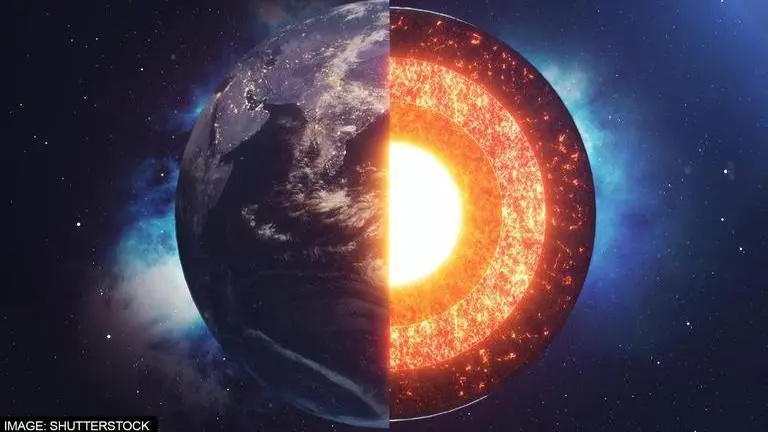
A recent study revealed that the inner core of Earth may be filled with a mysterious material that can neither be considered solid nor liquid. It is speculated that the inner core could exist in a "superionic state". According to Sputnik, the findings of the latest study would help to unfold why Earth's inner core composition "seems to change so much overtime" and how convection currents that form Earth's magnetic field are generated. However, this theory is yet to be validated.
Scientists had believed for over a half-century that Earth's deepest regions were made up of a molten outer core encasing a highly compacted ball of solid iron alloy. However, the latest study, which has been published in the journal Nature on February 9, provides a rare glimpse into the planet's interior structure, Live Science reported.
According to the recent computer simulations conducted by the authors who coined the latest study, Earth's heated and highly compressed inner core might be in a "superionic state", with a spinning mix of hydrogen, oxygen, as well as carbon molecules continually sloshing over an iron grid.
'Inner core can be in a superionic state rather than normal solid-state'
Elaborating the process, the researchers mentioned in their paper, “We find that hydrogen, oxygen and carbon in hexagonal close-packed iron transform to a superionic state under the inner core conditions, showing high diffusion coefficients like a liquid. This suggests that the inner core can be in a superionic state rather than a normal solid-state," Live Science reported.
Since sending a probe into Earth's inner core would be challenging, with severe pressures and high temperatures, the researchers used a computer program to reconstruct the core's conditions using elements that are likely to be present there – including iron, hydrogen, oxygen, and carbon – and supplied the program with seismic data.
Advertisement
Furthermore, the simulations revealed that atoms in Earth's core would be changed into a 'superionic alloy', which is "a framework of iron atoms around which the other elements”, pushed by enormous convection currents, are able to swim freely, Sputnik reported.
In addition to this, Yu He, a geophysicist at the Chinese Academy of Sciences and the study's first author, said, "It is quite abnormal." He went on to describe that the mobility of these light elements is not affected by the solidification of iron at the inner core border, and “light element convection is continuous in the inner core."
Advertisement
Meanwhile, in an email to Live Science, Hrvoje Tkalčić, the chief of seismology and mathematical geophysics at Australia's National University in Canberra, who was not involved in the study, said, “We will have to wait until the experimental setting becomes ripe to replicate the inner core conditions and scrutinise the proposed models.”