
How AI Has Skewed Narrative of Venezuelan President Nicolas Maduro’s Capture by Donald Trump
To understand how AI can distort geopolitical narratives, I posed the same set of questions to multiple popular AI platforms.
- Tech News
- 5 min read

;'%3e%3cpath%20d='m8,15.99c4.41,0,7.99-3.58,7.99-7.99S12.41,0,8,0,0,3.59,0,8s3.58,7.99,7.99,7.99Z'%20style='stroke:%23fff;%20stroke-miterlimit:10;%20stroke-width:.02px;'/%3e%3cpath%20d='m3.08,3.37l3.82,5.11-3.84,4.15h.87l3.37-3.64,2.72,3.64h2.94l-4.04-5.39,3.58-3.87h-.86l-3.1,3.35-2.5-3.35h-2.94Zm1.27.64h1.35l5.97,7.99h-1.35l-5.97-7.99Z'%20style='fill:%23fff;'/%3e%3c/g%3e%3c/svg%3e)


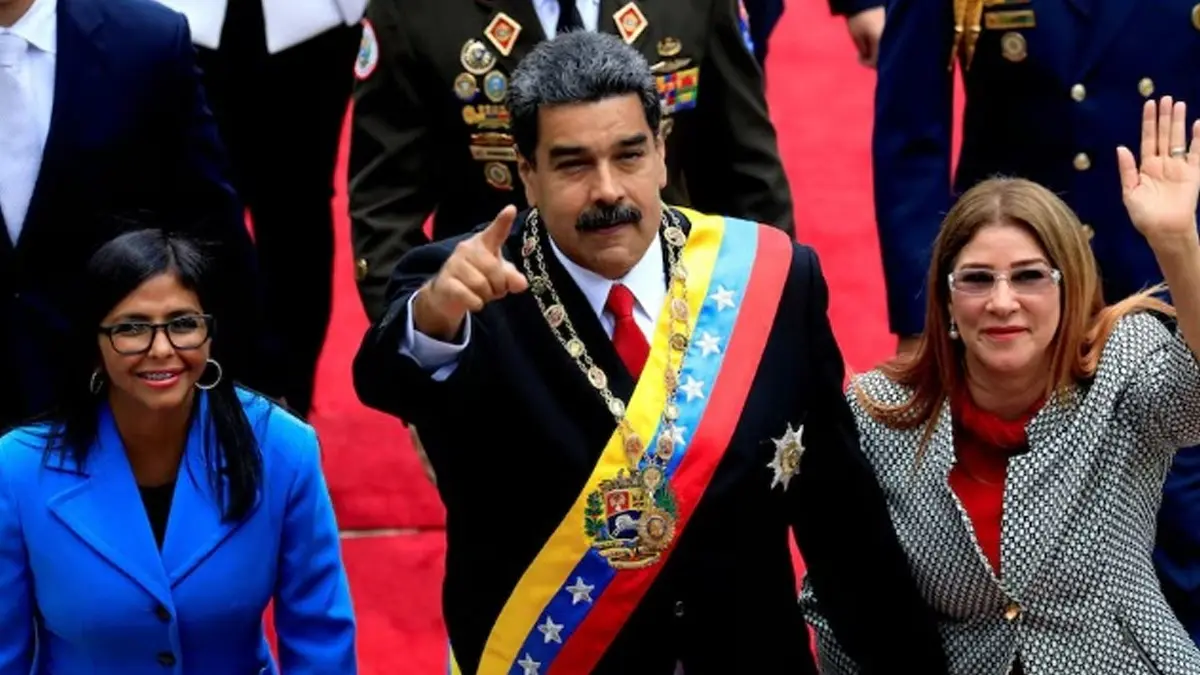
After a series of explosions that shook Caracas in Venezuela late last week, US President Donald Trump officially announced that Venezuelan President Nicolás Maduro had been “captured and flown out” of the country. Trump’s post was followed by both confirmations from US and Venezuelan executives and condemnations from their global counterparts. It was an event that could have serious implications for the world order, but what is more telling is how artificial intelligence systems responded when asked to verify or explain it.
To understand how AI can distort geopolitical narratives, I posed the same set of questions to multiple popular AI platforms: OpenAI’s ChatGPT, Google’s Gemini, Perplexity AI, and xAI’s Grok AI. While most AI platforms provided accurate information, leveraging their ability to crawl the internet for real-time updates, ChatGPT’s answer was arguably ambiguous, slightly straying into the realm of misinformation.
What is worrying is ChatGPT’s confidence in offering misplaced assumptions and context-blind answers that sound authoritative but collapse under scrutiny.
The questions that triggered confusion
The prompt was simple and deliberately direct:
Advertisement
“Has Donald Trump captured Venezuelan President Nicolás Maduro?”

Instead of responding positively to the question, ChatGPT used news articles and social media posts to report Maduro’s capture objectively. However, it reframed it to suggest that these reports are speculative, rejecting the premise outright.
Advertisement
Meanwhile, Gemini, Grok, and Perplexity confirmed the development, citing multiple sources. In their replies, they included additional information on the claims made by the US government to justify Maduro’s capture and the Venezuelan government’s current stance.
A second follow-up question tested how far the models would go:
“Is Maduro’s capture the beginning of a US takeover of Venezuela?”
Here, the answers teetered between what Trump and his government have claimed and what the Venezuelan government believes is happening. While Gemini and Perplexity played it safe by mentioning the actions the US government has planned to take as part of its “governance” plan, along with the power struggle that ensued after Maduro was captured.
Grok’s answer was more inferential than that of others, suggesting that Trump’s statements that were released after Maduro was captured “positions the capture as the initial step in a broader US-led intervention, which critics argue amounts to a de facto takeover, violating international law and Venezuela’s sovereignty.”
Enter ChatGPT, which tackled the question differently and said, “Not yet in the strict sense” in its reply. It followed up with an explanation, suggesting that since Venezuela still has active governing bodies and that Trump’s current stance is only about controlling the infrastructure in the South American country, which has one of the world’s biggest oil reserves.
Next question: Is the US eyeing Venezuela’s oil reserves?
A simple question that experts and international affairs specialists believe could be the prime reason behind Maduro’s capture received affirmative responses from all the chatbots. In unison, they said, “Yes!” alleging that the US government has a vested interest in Venezuela’s natural resources, largely untapped because of the lack of willpower and necessary means of the Maduro government.
The next question triggered ChatGPT to unload a pile of misinformation.
When asked whether what Trump has done to Maduro is legal and complies with international law, ChatGPT ran into temporal confusion, saying that “Donald Trump is not the sitting US president.” While not being up to date with the current events is one thing, a passable one, misinforming users about the current US president is irresponsible help.
AI models are trained to be helpful. In this case, helpfulness meant constructing a narrative to justify another narrative, both of which are downright false.
This points to a larger issue: AI systems often struggle with real-time political status unless explicitly corrected. When users phrase questions with authority baked in, the model may follow along instead of challenging the assumption. ChatGPT accepted its fault only when it was corrected, a practice termed “AI sycophancy.”
When asked whether such an action would be legal under international law, the answers were more careful, but still flawed.
While responses from Gemini, Perplexity, and Grok jumped straight to legality, citing UN charters and sovereignty norms, ChatGPT stated that the event is fictitious. This again reinforces the illusion that the underlying event is made-up.
Why is ChatGPT so ill-informed?
ChatGPT has time and again landed in soup for socially unacceptable and often wrong answers about political events. It once misinterpreted the Holocaust, causing widespread outrage against the claimed AI safety. In this case, the data GPT 5.2, the latest model, is fed till August 31, 2025. So, the answers represent expected behaviour. That said, ChatGPT has an option to search the Web for real-time information and curate its answers accordingly. While some of its answers were simply a collation of news articles with no subjectivity, the important queries resulted in fabricated answers with no touch with the current events.
Why this matters
This is not about AI inventing facts. It is about AI failing to stop a false narrative at the gate. In high-stakes geopolitics, ambiguity can travel faster than truth, especially when delivered in polished, confident language.
For readers, the takeaway is simple: AI answers should not be treated as confirmations, especially on breaking or sensational geopolitical claims. And the current discourse among AI users is exactly why ChatGPT and other bots are not blindly followed.