
How Elon Musk's Starlink Will Help India Become $1 Trillion Digital Economy
Satellite communication is key to bridging the gap between the internet available in urban areas and the internet — or its lack — in spotty locations.
- Tech News
- 5 min read

;'%3e%3cpath%20d='m8,15.99c4.41,0,7.99-3.58,7.99-7.99S12.41,0,8,0,0,3.59,0,8s3.58,7.99,7.99,7.99Z'%20style='stroke:%23fff;%20stroke-miterlimit:10;%20stroke-width:.02px;'/%3e%3cpath%20d='m3.08,3.37l3.82,5.11-3.84,4.15h.87l3.37-3.64,2.72,3.64h2.94l-4.04-5.39,3.58-3.87h-.86l-3.1,3.35-2.5-3.35h-2.94Zm1.27.64h1.35l5.97,7.99h-1.35l-5.97-7.99Z'%20style='fill:%23fff;'/%3e%3c/g%3e%3c/svg%3e)


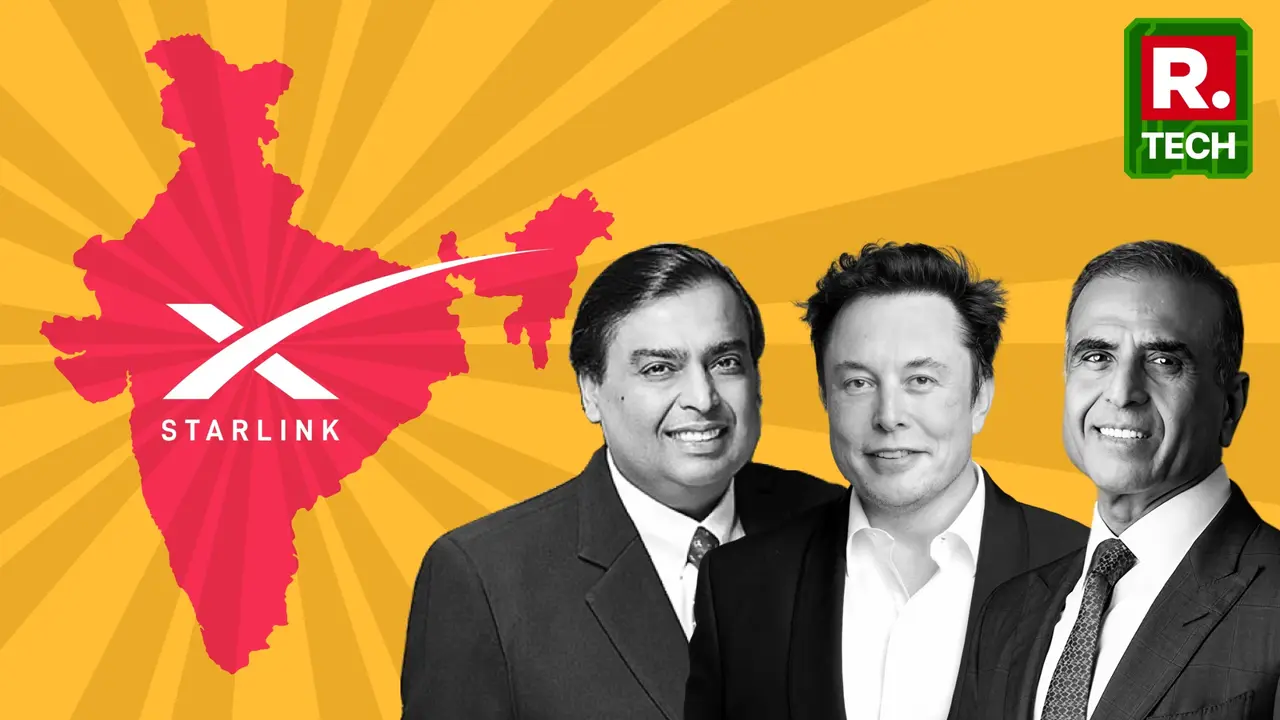
Starlink, a satellite internet company owned by Elon Musk’s SpaceX, appears to have made significant inroads into India — a market it has long waited to tap but so far struggled due to regulatory hurdles — with new partnerships with Bharti Airtel and Jio Platforms. As part of its agreements with India’s largest and second-largest wireless carriers, SpaceX can sell its satellite communication equipment to users in India through Jio and Airtel’s retail outlets and online storefronts.
Is Starlink's entry a game-changer?
While the tie-ups are subject to regulatory approval, it is a major step in Musk’s plan to widen the company’s satellite internet business. They also represent a huge shift in the stance of the owners of both carriers — Sunil Bharti Mittal and Mukesh Ambani — on how the players in the satellite communication industry can use the spectrum. Jio and Airtel had urged the government to auction spectrum, but the government sided with Musk to announce that it would allocate satellite spectrum, in line with global practices. The government’s decision also relies heavily on its ambition to connect every nook and corner of India with the internet.
“With the internet becoming progressively more prominent, and the next 400 million internet users very likely from the semi-urban and rural areas, it becomes crucial to ensure access to the internet without any disadvantage or discrimination,” said Rajeev Chandrasekhar, who headed the Ministry of Electronics and Information Technology in Prime Minister Narendra Modi ’s cabinet in 2021. These users, the minister said, will drive the digital economy in India, expanding opportunities and fostering strategic capabilities across technologies.
The $1 trillion milestone
India’s digital economy is expected to grow to 20 per cent of the gross domestic product ( GDP ) by 2029-30, touching an estimated $1 trillion, according to industry experts. Musk’s Starlink could boost the vision through its groundbreaking satellite internet services, which make providing internet to the remotest and far-flung areas possible. The existing terrestrial ecosystem, which includes wireless cellular and broadband services through mobile towers and optical fibres, is rarely feasible in such areas, including deserts, oceans, and mountains. Whatever locations are serviceable experience poor network, low internet connectivity, and disturbances in wireless communication.
Advertisement
“In India, though our cellular subscribers are over a billion, there is still a lot of area that isn't in the coverage. Also, as we travel further away from cities and towns, the cellular networks degrade. This is where satellite connectivity could complement and ensure we get end-to-end coverage,” Faisal Kawoosa, Chief Analyst at market analytics and research firm, TechArc.
Satellite communication is key to bridging the gap between the internet available in urban areas and the internet — or its lack — in spotty locations. “Satellite communication (SATCOM), projected to reach $14.8 billion by 2033, will play a critical role in expanding digital connectivity, particularly in rural and underserved regions,” said Pankaj Khurana, Partner of Consulting at EY. Satellite communication could boost the government’s “BharatNet” and “Digital India” missions to deploy internet to every village, and Starlink could play a pivotal role in this bid. “By leveraging LEO and MEO satellite constellations, India can accelerate broadband penetration, enhance financial inclusion and strengthen digital infrastructure, supporting flagship initiatives such as Digital India and BharatNet,” he added.
Advertisement
New possibilities
Starlink, which uses low-earth orbit satellites (below 2,000km), can transfer fast internet and data connections on multiple devices for real-time communication. It already provides its internet services in over 113 countries, including the US, Malaysia, Kenya, and Bhutan, promoting wireless connectivity in remote areas of these locations by enabling digital access across sectors, such as education, healthcare, mining, and e-commerce. Experts believe Starlink’s arrival in India could catalyse the government’s vision to make India a global digital economy and accelerate the delivery of e-governance services. The government had previously said it would be “more than happy” to issue the license to Starlink once all conditions are met. After PM Modi’s meeting with Musk in Washington last month and endorsements from Airtel and Jio, Starlink appears to be in a better position to negotiate with the government on launching its services in India.
“Of course, this [SATCOM] opens up new use cases and makes ground for some emerging tech,” added Kawoosa, highlighting how Starlink’s internet services, which will be available through Reliance Jio and Airtel, will broaden use cases and spur new industries. “For instance connected autonomous cars. Now we can't afford to have autonomous vehicles that can only work in cities and towns. They should be able to move across the length and breadth of the country. That's where satellite comes in handy. Beyond this in several industries like logistics, offshore refinery, etc., satellite connectivity can ensure seamless connectivity opening up possibilities for IoT and industrial automation.”
The road ahead
Satellite communication is an upcoming industry in India, and even though the government is in the process of finalising the do’s and don’ts of it, the Indian Space Policy 2023 urges private players to participate in space activities to offer space-based communication and broadband services. Airtel and Jio said their SATCOM ecosystems have been developed in line with the space policy, which could help Starlink avoid compliance concerns and deliver services.
The end-to-end delivery of Starlink’s services would also require hardware support, meaning phones are required to be ready for satellite internet. Apple ’s iPhone — which now covers a major chunk of India’s premium smartphone market — comes pre-installed with the functionality to receive satellite services. Starlink last month expanded its partnership with T-Mobile to provide satellite services on iPhones in the US. Airtel and Jio could use a similar strategy to offer Starlink’s services in India, charging users on their existing mobile connections. While the costs for the service are unclear yet, the pricing could decide the appeal of Starlink’s services, which are significantly more expensive than traditional broadband and mobile networks globally. The right pricing in a price-sensitive market like India will be key to Starlink’s success and ultimately, India’s vision of becoming a $1 trillion digital economy.