
How Nvidia's New DLSS 5 Model Could Unlock the Next Chapter for Hyper-Realistic Gaming
Nvidia is calling DLSS 5 the biggest breakthrough in computer graphics since real-time ray tracing debuted in 2018.
- Tech News
- 4 min read

;'%3e%3cpath%20d='m8,15.99c4.41,0,7.99-3.58,7.99-7.99S12.41,0,8,0,0,3.59,0,8s3.58,7.99,7.99,7.99Z'%20style='stroke:%23fff;%20stroke-miterlimit:10;%20stroke-width:.02px;'/%3e%3cpath%20d='m3.08,3.37l3.82,5.11-3.84,4.15h.87l3.37-3.64,2.72,3.64h2.94l-4.04-5.39,3.58-3.87h-.86l-3.1,3.35-2.5-3.35h-2.94Zm1.27.64h1.35l5.97,7.99h-1.35l-5.97-7.99Z'%20style='fill:%23fff;'/%3e%3c/g%3e%3c/svg%3e)


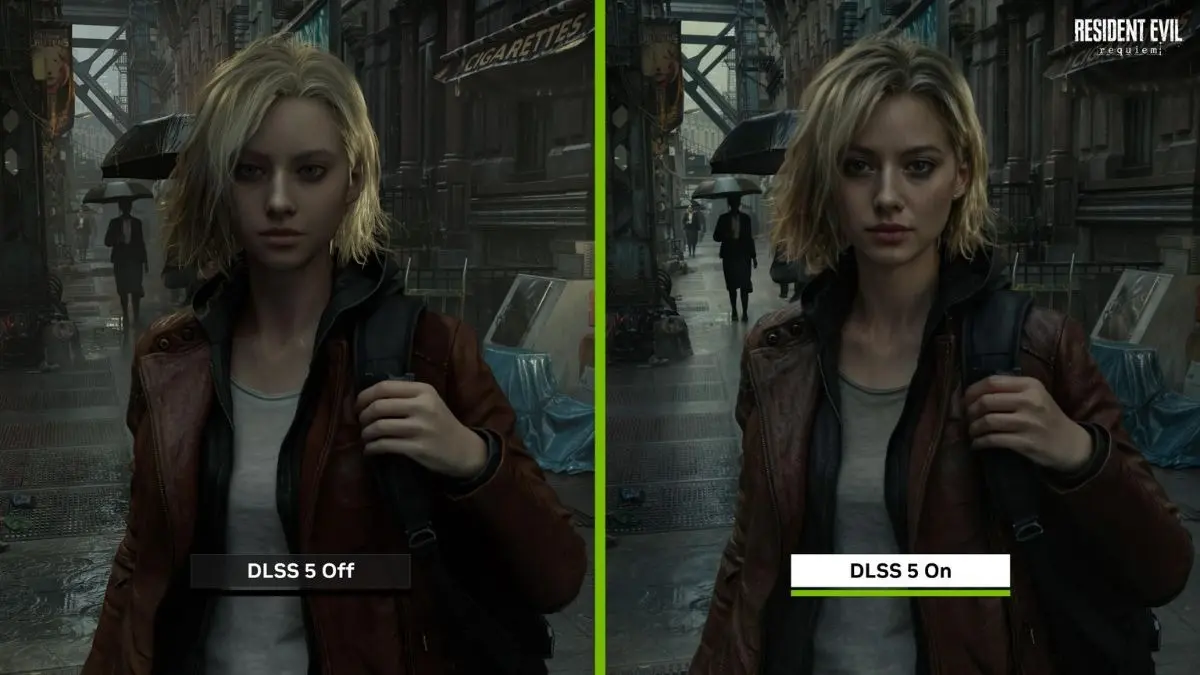
At GTC 2026, Nvidia unveiled DLSS 5, and if the company’s claims hold up, this is not just another iteration in its AI upscaling pipeline. It is a structural shift in how graphics are created, moving from rendering pixels to generating reality-like imagery in real time.
Nvidia is calling it the biggest breakthrough in computer graphics since real-time ray tracing debuted in 2018. That is a bold claim, but the underlying technology suggests this is less marketing exaggeration and more a reflection of where the industry is heading.
From Performance Tool to Visual Engine
DLSS began in 2018 as a performance solution. It upscaled lower-resolution images to higher resolutions, helping GPUs deliver better frame rates without proportionally increasing compute load. Over time, it evolved to include frame generation, effectively creating entirely new frames using AI.
The adoption has been significant. DLSS is now integrated into over 750 games, making it one of the most widely deployed graphics technologies in modern gaming.
Advertisement
With DLSS 4.5, announced earlier this year, Nvidia had already pushed the envelope by using AI to generate 23 out of every 24 pixels on screen. DLSS 5 builds directly on that foundation, but shifts the goalpost from efficiency to realism.
Neural Rendering Changes the Equation
The core of DLSS 5 is a real-time neural rendering model. Instead of simply enhancing existing frames, the system takes inputs such as colour and motion vectors and reconstructs scenes with photoreal lighting and material properties.
Advertisement
In effect, the GPU is no longer just rendering geometry and textures. It is interpreting scene data and using AI to “fill in” the visual world with cinematic-level detail.
This is a critical distinction. Traditional rendering pipelines are deterministic. DLSS 5 introduces a generative layer that blends handcrafted assets with AI-driven output, anchored to the original 3D scene but no longer limited by it.
The result, at least in theory, is a level of visual fidelity previously associated with pre-rendered Hollywood visual effects, now delivered in real time at up to 4K resolution.
Bridging Games and Film-Grade Visuals
Nvidia’s positioning of DLSS 5 as a bridge between real-time graphics and film production is not accidental. For decades, games and cinema have operated on fundamentally different pipelines, with real-time constraints limiting what games could achieve visually.
DLSS 5 attempts to collapse that gap.
Jensen Huang described it as a “GPT moment for graphics,” highlighting the transition from traditional rendering to generative AI-assisted visuals. The analogy is deliberate. Just as generative AI models changed how text and images are created, DLSS 5 aims to do the same for interactive graphics.
Early partner reactions suggest that developers see this as more than incremental. Bethesda, for instance, noted that integrating DLSS 5 into Starfield significantly enhanced visual immersion, while CAPCOM emphasised its impact on cinematic realism in franchises like Resident Evil.
Industry-Wide Adoption Signals Momentum
DLSS 5 is not launching in isolation. Nvidia has already secured support from major publishers and studios, including Bethesda, Ubisoft, CAPCOM, Warner Bros. Games, Tencent, and NetEase.
The list of supported titles spans both existing and upcoming games, including Assassin’s Creed Shadows, Starfield, Hogwarts Legacy, NARAKA: BLADEPOINT, and The Elder Scrolls IV: Oblivion Remastered.
This level of early adoption is critical. Technologies like DLSS only become meaningful when they scale across the ecosystem, and Nvidia appears to be leveraging its existing footprint to accelerate that transition.
The Bigger Shift: Rendering Becomes Optional
What DLSS 5 ultimately represents is a philosophical shift. For decades, graphics improvements were tied to more powerful hardware and more detailed assets. DLSS 5 suggests a different path, where AI increasingly takes over the heavy lifting.
Instead of rendering every pixel accurately, the system predicts what the scene should look like and generates it accordingly. If executed well, this approach could significantly reduce the computational burden while simultaneously improving visual quality.
That is the paradox Nvidia is betting on. Less traditional rendering, more realism.
What Comes Next
DLSS 5 is set to roll out this fall, and its real impact will only become clear once it is deployed across a broader set of games and hardware configurations. There are still open questions around consistency, artistic control, and how developers balance AI-generated visuals with intentional design choices. But the direction is evident.
DLSS is no longer just about making games run faster. It is about redefining what “rendering” even means. And if Nvidia is right, the next leap in gaming realism will not come from more polygons or higher resolutions, but from machines that can convincingly imagine the world in between.