
India’s Own Tech Revolution: From PM Modi’s Call for Self-Reliance to Swadeshi Apps Taking on Big Tech
India's push for tech self-reliance (Aatmanirbhar Bharat) is gaining ground. Here is how homegrown apps like Zoho (vs Microsoft), Arattai (vs WhatsApp), and Mappls (vs Google Maps) are challenging global giants with government support.
- Tech News
- 4 min read

;'%3e%3cpath%20d='m8,15.99c4.41,0,7.99-3.58,7.99-7.99S12.41,0,8,0,0,3.59,0,8s3.58,7.99,7.99,7.99Z'%20style='stroke:%23fff;%20stroke-miterlimit:10;%20stroke-width:.02px;'/%3e%3cpath%20d='m3.08,3.37l3.82,5.11-3.84,4.15h.87l3.37-3.64,2.72,3.64h2.94l-4.04-5.39,3.58-3.87h-.86l-3.1,3.35-2.5-3.35h-2.94Zm1.27.64h1.35l5.97,7.99h-1.35l-5.97-7.99Z'%20style='fill:%23fff;'/%3e%3c/g%3e%3c/svg%3e)


When Prime Minister Narendra Modi spoke on Independence Day this year, his message was loud and clear - India must build its own technology and stop depending on foreign platforms. “Be it the creative world or social media, I urge all young people of the country to come forward to develop our own platforms. Why should India’s wealth go overseas?” he said.
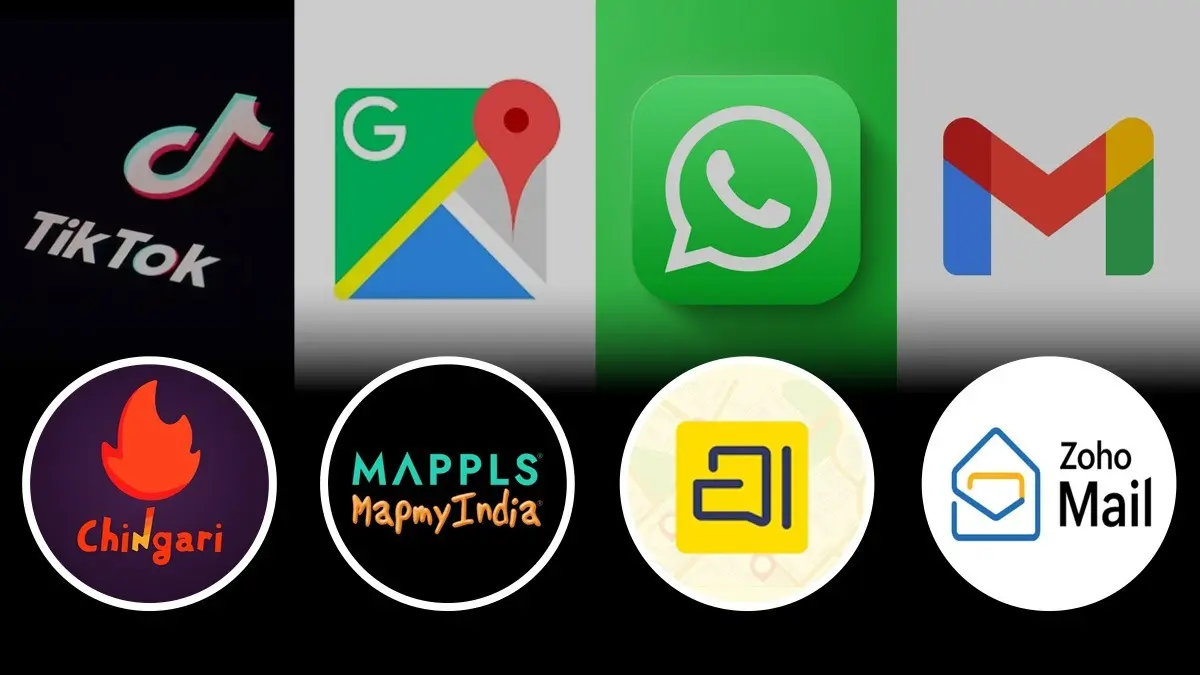
That call for Aatmanirbhar Bharat (self-reliant India) in tech is already turning into a movement. Over the past few years and especially in these last few months, several Indian-made apps and platforms have started challenging global giants like Google, Microsoft, WhatsApp, and Amazon, and they’re finally finding success.
Leaders Backing the Shift
Union ministers have become the new brand ambassadors for homegrown tech. Ashwini Vaishnaw, Minister for Electronics and IT, announced he was moving to Zoho- India’s own suite for documents, spreadsheets, and presentations.
Piyush Goyal, Commerce Minister, said he’s proud to be using Arattai, a made-in-India messaging app. And Amit Shah, the Home Minister, switched to Zoho Mail, a desi alternative to Gmail and Outlook.
Advertisement
These switches are more than symbolic- they show that even the government is ready to walk the talk when it comes to using Indian technology.
Zoho: India’s Microsoft Alternative
Zoho, based in Tamil Nadu, is quietly becoming one of India’s biggest global tech success stories. The company offers tools for emails, documents, CRM, and business management much like Microsoft Office 365 or Google Workspace but with Indian roots.
Advertisement
Zoho’s Office Suite, priced at Rs 99 per user per month, is already competing head-on with global rivals. And with ministers and government officials switching to it, Zoho’s “Made in India” push looks stronger than ever.
Arattai: Taking on WhatsApp
Zoho’s messaging app Arattai, which means “chat” in Tamil, is another rising star. It promises privacy, regional language support, and a simple interface for everyday users.
After government leaders began endorsing it, downloads skyrocketed, jumping from just 10,000 in August 2025 to around 4 lakhs in September, according to Sensor Tower data.
WhatsApp still rules India’s messaging world with nearly 59% market share, but Arattai’s growth shows that Indians are ready to try local options when they get the right push.
Mappls: India’s Own Google Maps
Another quiet but powerful player is MapmyIndia, the company behind the Mappls app. Founded back in 1995, long before Google Maps arrived, it’s now enjoying a well-deserved comeback.
Mappls offers 3D navigation, real-time traffic, and lane guidance, and it even integrates DIGIPIN, India’s digital addressing system that gives every 4x4 meter block a unique code. It’s a desi mapping solution built for Indian roads, potholes, and all. Most of the school buses in India today use Mappls for GPS navigation.
India’s Growing App Ecosystem
The wave doesn’t stop there. Across categories, Indian startups are offering smart, homegrown alternatives.
• DigiBoxx – India’s answer to Google Drive for cloud storage
• Indus Appstore – PhonePe’s new app marketplace competing with Google Play, already on 100 million phones
• BOSS Linux – India’s open-source operating system developed by C-DAC
• Maya OS – Defence Ministry’s secure system for government computers
• QMamu – A Gujarat-based search engine challenging Google
• JioMart – India’s version of Amazon
• Bhuvan – ISRO’s take on Google Earth for Indian mapping and urban planning
• Kuku FM – A regional audio platform taking on Spotify and Audible
• Kaagaz Scanner – An offline-friendly alternative to Adobe Scanner.
The Big Story
India’s tech independence story isn’t just about apps. It’s also about hardware and infrastructure. Modi announced that made-in-India semiconductor chips will be in the market by the end of this year- a milestone that could truly make India a global tech powerhouse.
“The 21st century is technology-driven. Countries that mastered technology became economic superpowers,” PM Modi said in his speech.
From Zoho and Arattai to Mappls and DigiBoxx, India’s own tech ecosystem is no longer just catching up, it’s competing. The shift from “Made in Silicon Valley” to “Made in India” has officially begun. And this time, it’s not just about apps, it’s about national pride, privacy, and power in the digital age.