
LPG Shortage, PNG Uncertainty and Induction Cooking: What the Israel-Iran War Means for Indian Kitchens
Recent energy studies suggest electric cooking using induction can be cheaper than LPG in many scenarios. In India, e-cooking has been estimated to be 37 percent cheaper than non-subsidised LPG and about 14 percent cheaper than PNG in recent years.
- Tech News
- 4 min read

;'%3e%3cpath%20d='m8,15.99c4.41,0,7.99-3.58,7.99-7.99S12.41,0,8,0,0,3.59,0,8s3.58,7.99,7.99,7.99Z'%20style='stroke:%23fff;%20stroke-miterlimit:10;%20stroke-width:.02px;'/%3e%3cpath%20d='m3.08,3.37l3.82,5.11-3.84,4.15h.87l3.37-3.64,2.72,3.64h2.94l-4.04-5.39,3.58-3.87h-.86l-3.1,3.35-2.5-3.35h-2.94Zm1.27.64h1.35l5.97,7.99h-1.35l-5.97-7.99Z'%20style='fill:%23fff;'/%3e%3c/g%3e%3c/svg%3e)


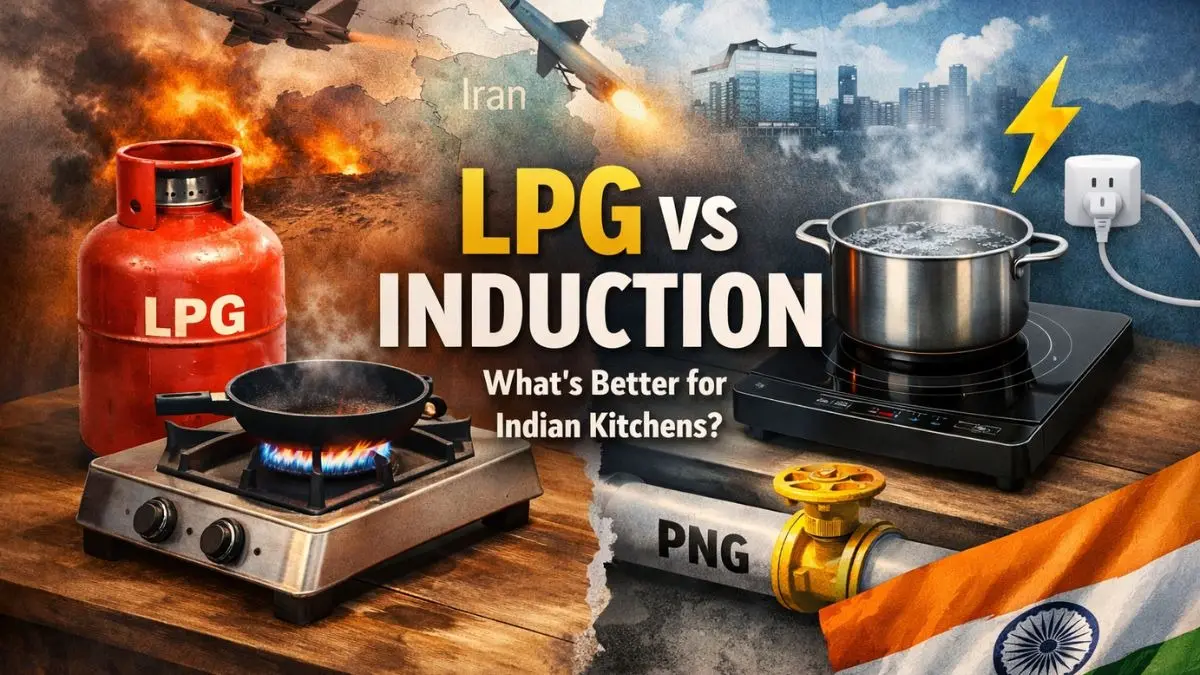
The war in West Asia has triggered anxiety in an unlikely place: Indian kitchens. What began as a geopolitical conflict between Israel and Iran is now rippling through global energy markets, affecting the availability and price of fuels that millions of Indians rely on daily to cook their food.
The immediate concern is not crude oil or petrol, but cooking gas. India’s dependence on imported energy means every disruption in the Middle East eventually shows up in LPG cylinders and PNG pipelines.
Why the Israel-Iran war is affecting cooking gas in India
India imports a significant portion of the LPG and natural gas it consumes. More than half of the country’s LPG demand is met through imports, much of it sourced from West Asia.
When tensions escalate around the Strait of Hormuz, one of the world’s most important shipping routes for energy supplies, global LPG and LNG shipments can slow down or become more expensive due to higher freight, insurance, and security costs.
Advertisement
The current conflict has already begun to show visible effects. Across several Indian cities, residents have reported long queues outside LPG agencies, triggered by fears of shortages as global supply chains tighten.
Restaurants and small eateries, which rely heavily on commercial cylinders, are already facing delays in LPG deliveries and uncertain supply. In response, the government has asked refineries to increase domestic LPG production and prioritise supply for households.
Advertisement
Some organisations are even exploring alternatives. Indian Railways, for example, has asked its food vendors to consider electric cooking methods such as induction or microwave ovens to cope with potential gas shortages.
All of this highlights a structural vulnerability in India’s energy system: cooking fuel depends heavily on global geopolitics.
The LPG vs induction question
Whenever cooking gas becomes expensive or scarce, the same question resurfaces: is LPG actually the cheapest way to cook?
For decades, LPG has been the default choice for Indian kitchens because it offers instant heat and works with almost any utensil. LPG also has a high calorific value, meaning it can deliver more energy quickly for cooking tasks such as boiling or frying.
But the economics have quietly started shifting.
Recent energy studies suggest electric cooking using induction can be cheaper than LPG in many scenarios. In India, e-cooking has been estimated to be 37 percent cheaper than non-subsidised LPG and about 14 percent cheaper than PNG in recent years.
The reason is efficiency.
Traditional LPG stoves convert only a portion of the heat into usable cooking energy, while induction cooktops transfer heat directly to the vessel, making them significantly more efficient.
Depending on electricity tariffs, switching to induction cooking can save households ₹2,000 to ₹13,000 annually compared with LPG.
Where PNG fits in
In cities like Delhi, Mumbai, and Ahmedabad, some households rely on piped natural gas (PNG) instead of LPG cylinders.
PNG offers the advantage of continuous supply through pipelines, eliminating the need to book cylinders. However, PNG is also linked to imported LNG prices, which means it is not immune to global supply disruptions.
In fact, LNG imports also rely heavily on Middle Eastern shipping routes, meaning prolonged instability could affect PNG prices as well.
Should Indian households switch to induction?
The answer is not straightforward. Each option has trade-offs.
LPG advantages
- Works during power cuts
- Compatible with all utensils
- Better for high-flame cooking
Induction advantages
- Higher energy efficiency
- Lower operating costs in many regions
- No dependence on imported gas
For many households, the most practical approach may not be a complete switch but a hybrid kitchen. LPG can be used for heavy cooking such as frying or pressure cooking, while induction cooktops can handle tasks like boiling milk, making tea, or reheating food.
This combination reduces LPG consumption while keeping cooking flexible.
The bigger energy question for India
The current crisis also highlights a broader issue: India’s heavy dependence on imported cooking fuels.
More than 57 percent of LPG consumption in India comes from imports, exposing the country to global price shocks and geopolitical disruptions. Electric cooking, on the other hand, relies on domestic electricity generation, which is increasingly shifting toward renewable energy.
That is why policymakers have begun exploring electric cooking as a long-term strategy to reduce fuel imports and improve energy security.
The bottom line
The Israel-Iran conflict may or may not trigger a full-blown LPG crisis in India. The government has already moved to boost domestic supply and calm fears of shortages.
But the episode reveals how fragile India’s cooking fuel ecosystem still is.
For households, the lesson is simple: relying on a single fuel source can become risky when global geopolitics enters the kitchen. A mix of LPG and induction cooking may soon become the most practical solution for Indian homes navigating an increasingly uncertain energy landscape.