
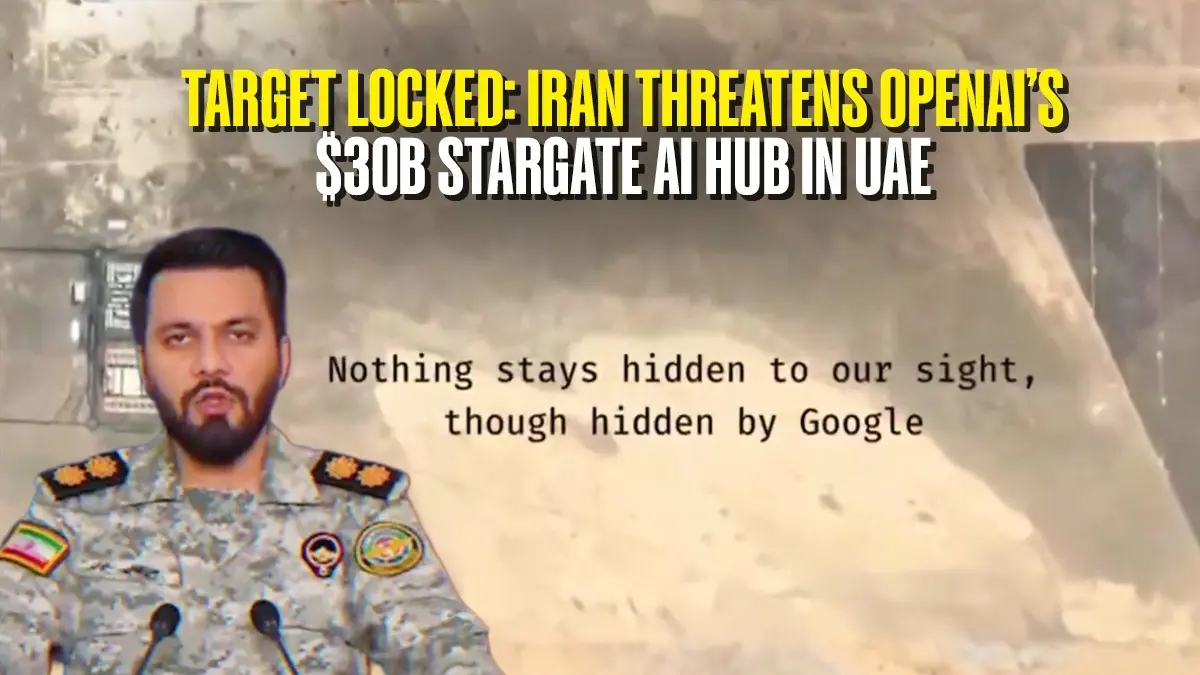
'Nothing stays hidden to our sight, though hidden by Google': Iran Threatens OpenAI’s $30B Stargate AI Hub in UAE
The ongoing Iran-Israel-US conflict is shifting from military bases to economic engines like energy systems and AI data centers. Iran released a video threatening OpenAI’s $30B Stargate facility in Abu Dhabi, showing Google Maps imagery and simulated night‑vision views of the 1GW hub. Brigadier General Ebrahim Zolfaghari warned of retaliation against power plants, ICT firms, and cloud networks tied to American interests, promising “complete and utter annihilation.”
- Tech News
- 3 min read

;'%3e%3cpath%20d='m8,15.99c4.41,0,7.99-3.58,7.99-7.99S12.41,0,8,0,0,3.59,0,8s3.58,7.99,7.99,7.99Z'%20style='stroke:%23fff;%20stroke-miterlimit:10;%20stroke-width:.02px;'/%3e%3cpath%20d='m3.08,3.37l3.82,5.11-3.84,4.15h.87l3.37-3.64,2.72,3.64h2.94l-4.04-5.39,3.58-3.87h-.86l-3.1,3.35-2.5-3.35h-2.94Zm1.27.64h1.35l5.97,7.99h-1.35l-5.97-7.99Z'%20style='fill:%23fff;'/%3e%3c/g%3e%3c/svg%3e)


New Delhi: The ongoing war between Iran- Israel- United States, along with its regional allies, is entering a new and more dangerous phase. This is no longer just about military bases or troop movements. Both sides are increasingly signalling that the real targets are the economic engines that keep countries running - energy systems, cloud networks, and the massive data centers powering the digital world. In simple terms, the battlefield is shifting from borders to business infrastructure.
Iran’s Video Sends a Direct Warning
In a newly released video shared by Tehran Times, Iran has openly threatened to strike a $30 billion “Stargate” AI data center believed to be located in Abu Dhabi. The footage, attributed to Iran’s Khatam al-Anbiya Headquarters, is designed to do more than warn - it tries to prove that even hidden infrastructure can be tracked.
The video uses Google Maps to zoom into what appears to be a barren desert area near the UAE coast. At first glance, nothing unusual is visible. But a message appears on screen saying, “Nothing stays hidden to our sight, though hidden by Google.” The clip then shifts into a simulated night-vision view, where the same patch of land suddenly reveals what is claimed to be the full layout of the Stargate AI facility.
“Complete and Utter Annihilation” Threat
The warning is delivered by Brigadier General Ebrahim Zolfaghari, who lays out a sweeping retaliation plan if Iran’s own infrastructure is targeted. His statement makes it clear that the scope goes far beyond military assets. According to him, power plants, energy companies, and information and communications technology firms across the region could all be considered legitimate targets, especially those with links to American interests.
Advertisement
The language used is aggressive and unusually direct, with references to “complete and utter annihilation” of such facilities. The message signals a shift where private tech infrastructure is no longer seen as neutral but as part of a broader strategic network.
Why This AI Data Center Matters
The Stargate project, though not officially detailed, is believed to be tied to major US tech players, including OpenAI. A data center of this scale -reportedly around 1 gigawatt - would rank among the largest AI compute hubs in the world.
Advertisement
Facilities like these are critical for training advanced AI models, running cloud platforms, and supporting everything from startups to government systems. In today’s economy, they are as important as oil fields or power grids, which is exactly why they are now being pulled into geopolitical tensions. There are also claims that Iranian strikes have already caused damage to infrastructure linked to Amazon Web Services, allegedly leading to shutdowns. However, there is currently no independent confirmation to support widespread AWS disruptions from such attacks, making this part of the narrative difficult to verify.
A New Kind of Target in Modern Conflict
What makes this development stand out is the clear shift in what is being targeted. Data centers, cloud systems, and energy networks are no longer just background infrastructure, they are becoming central to how conflicts are fought and escalated. If these threats translate into real-world action, the impact would not stay limited to one country or region. It could ripple across global internet services, businesses, and everyday users, marking a major turning point in how modern conflicts affect the digital world.