
Nvidia GeForce Now in India: A Cloud Gaming Bet That Finally Feels Timed Right
Nvidia, the chipmaking behemoth, also has a small software portfolio, with a standout service called GeForce Now. It is a cloud gaming service powered by the company’s powerful GPUs, rivalling Microsoft’s Xbox Cloud Gaming and Sony PlayStation’s cloud streaming, both of which are still nascent for a market like India.
- Tech News
- 5 min read

;'%3e%3cpath%20d='m8,15.99c4.41,0,7.99-3.58,7.99-7.99S12.41,0,8,0,0,3.59,0,8s3.58,7.99,7.99,7.99Z'%20style='stroke:%23fff;%20stroke-miterlimit:10;%20stroke-width:.02px;'/%3e%3cpath%20d='m3.08,3.37l3.82,5.11-3.84,4.15h.87l3.37-3.64,2.72,3.64h2.94l-4.04-5.39,3.58-3.87h-.86l-3.1,3.35-2.5-3.35h-2.94Zm1.27.64h1.35l5.97,7.99h-1.35l-5.97-7.99Z'%20style='fill:%23fff;'/%3e%3c/g%3e%3c/svg%3e)


Nvidia, the chipmaking behemoth, also has a small software portfolio, with a standout service called GeForce Now. It is a cloud gaming service powered by the company’s powerful GPUs, rivalling Microsoft’s Xbox Cloud Gaming and Sony PlayStation’s cloud streaming, both of which are still nascent for a market like India. Nvidia’s endeavours, thus, are bold, culminating into an exclusive showcase for enthusiasts last week.
When Nvidia officially unveiled GeForce Now for India last week, the announcement was deliberately light on the two things most consumers obsess over: pricing and launch timelines. Instead, the focus stayed firmly on the service itself and after spending time with it at the launch event, that choice felt intentional rather than evasive.
After spending time with GeForce Now at the event, it is clear Nvidia believes India has finally reached a threshold where cloud gaming is no longer aspirational, but practical.
Why Nvidia thinks India is ready now
The company’s argument rests on infrastructure finally aligning with ambition. Nvidia cited internal and industry data showing that average broadband speeds across most urban Indian markets now hover between 40 and 50Mbps. For cloud gaming, that is the difference between novelty and viability.
Advertisement
Latency, long the bigger problem, has also dropped meaningfully in metro cities. However, it remains inconsistent across regions, something Nvidia openly acknowledged. The company believes its proprietary stack including Cloud G-Sync, NVIDIA Reflex, and DLSS can mask many of these fluctuations in real-world use. My experience with the version of GeForce Now showcased stood true to the company’s claims on negligible latency.

Crucially, GeForce Now in India will be hosted on local servers in Mumbai. That single decision changes the experience far more than any software tweak. Cloud gaming does not survive long round trips to overseas data centres. Domestic hosting gives Nvidia a fighting chance to deliver something usable, not just impressive on slides.
Advertisement
A service built for device diversity, not ownership
Unlike traditional gaming platforms, GeForce Now does not sell you games. It sells you access to Nvidia’s hardware in the cloud. You stream titles you already own across storefronts like Steam, Epic Games Store, Ubisoft, and others.
At the event, Nvidia highlighted support for over 4,000 titles, spanning AAA releases, free-to-play games, and more than 180 Xbox Game Pass titles where licensing permits. The larger pitch, however, was device flexibility.
GeForce Now runs across smartphones, handheld consoles, laptops, desktops, smart TVs, Macs, and even Linux systems through a native client. That matters in India, where gaming hardware ownership is uneven, but screens are everywhere.
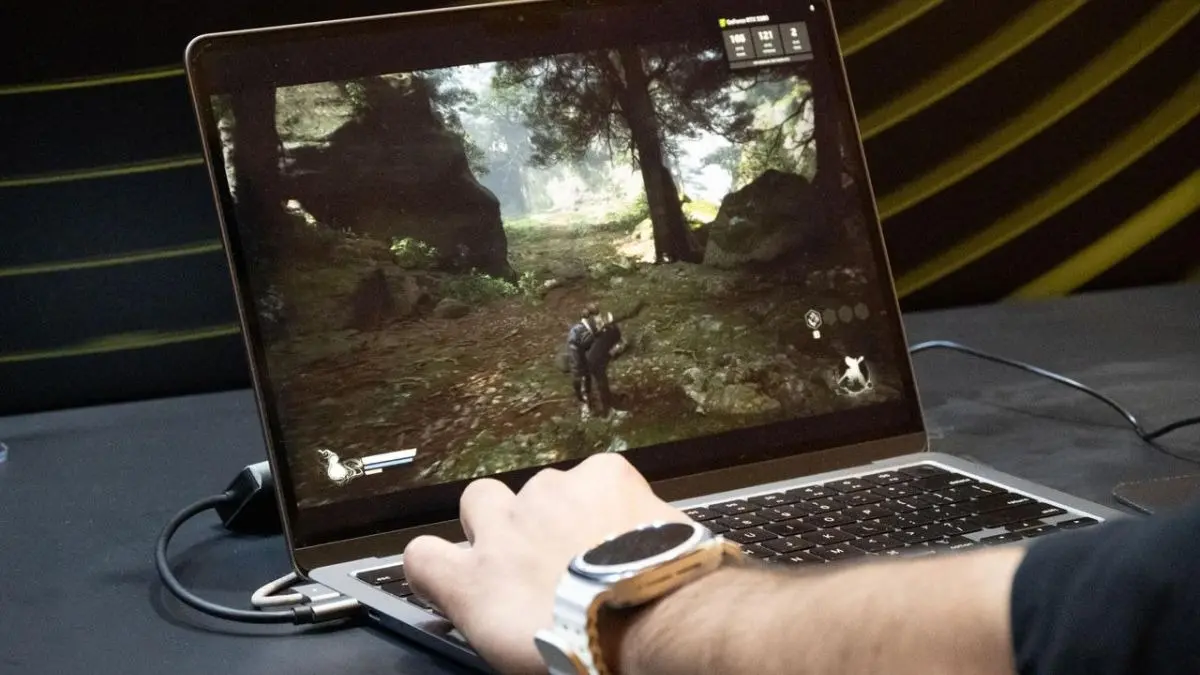
During my demos, I played Hogwarts Legacy on a TV with a standard 60Hz panel, Forza Horizon 5 on a OnePlus 10T, ARC Raiders on a gaming monitor with a 300Hz refresh rate, and Black Myth: Wukong on a MacBook Air. The takeaway was not visual parity across devices, but functional consistency. The experience scaled up or down without breaking.
Competing in a market that does not like paying to play
India is now one of the world’s fastest-growing gaming markets, but it is also brutally price-sensitive. The industry here has grown largely through performance-linked rewards, free-to-play mechanics, and low-friction entry points. Users are accustomed to not paying much, if anything, upfront to play games.
That reality makes GeForce Now’s entry particularly interesting.
Unlike Xbox Cloud Gaming and PlayStation Plus Cloud Streaming, both of which are now officially available in India and tied closely to subscription-based content libraries, GeForce Now positions itself differently.
Xbox Cloud Gaming works best if you live inside the Game Pass ecosystem. PlayStation’s cloud offering is effectively an extension of PlayStation Plus. Nvidia, by contrast, is betting on users who already own games but lack the hardware to run them well.
In a price-sensitive market, that distinction could matter. Paying to access powerful hardware for a limited time may feel more palatable than buying expensive consoles or PCs outright.
Built with mobile-first India in mind
On the sidelines of the event, I spoke with John Gillooly, Senior Technical Marketing Manager, APAC South, at NVIDIA, to understand how the company is adapting GeForce Now for India’s mobile-first audience.
Gillooly confirmed that the service has been optimised with mobile gamers as a priority. The idea is not to turn smartphones into novelty displays, but into legitimate gaming endpoints. According to Nvidia, users will be able to access high-end PC games on phones costing as little as ₹5,000, provided network conditions are adequate.
The service also deliberately removes platform silos. GeForce Now will be available on both Android and iOS, breaking the long-standing divide that often leaves iPhone users with fewer gaming options. In a market where smartphones are the primary computing device for millions, that platform neutrality is strategic.
The bigger picture
GeForce Now’s India unveiling felt measured. Nvidia is not pretending cloud gaming will replace consoles or PCs overnight. Instead, it is positioning the service as an equaliser, a way to flatten hardware disparities in a market where demand for games has outpaced the ability to buy powerful machines.
Pricing will ultimately decide how far this goes. Indian gamers are unforgiving when value feels misaligned. But if Nvidia can strike the right balance between cost, performance, and accessibility, GeForce Now could find a niche that neither consoles nor subscriptions fully address.