
This AI-powered backpack could help visually impaired people navigate; here's how it works
A team of researchers at Intel have designed an AI-powered backpack that can help the visually impaired navigate and perceive the world around them.
- Tech News
- 2 min read

;'%3e%3cpath%20d='m8,15.99c4.41,0,7.99-3.58,7.99-7.99S12.41,0,8,0,0,3.59,0,8s3.58,7.99,7.99,7.99Z'%20style='stroke:%23fff;%20stroke-miterlimit:10;%20stroke-width:.02px;'/%3e%3cpath%20d='m3.08,3.37l3.82,5.11-3.84,4.15h.87l3.37-3.64,2.72,3.64h2.94l-4.04-5.39,3.58-3.87h-.86l-3.1,3.35-2.5-3.35h-2.94Zm1.27.64h1.35l5.97,7.99h-1.35l-5.97-7.99Z'%20style='fill:%23fff;'/%3e%3c/g%3e%3c/svg%3e)


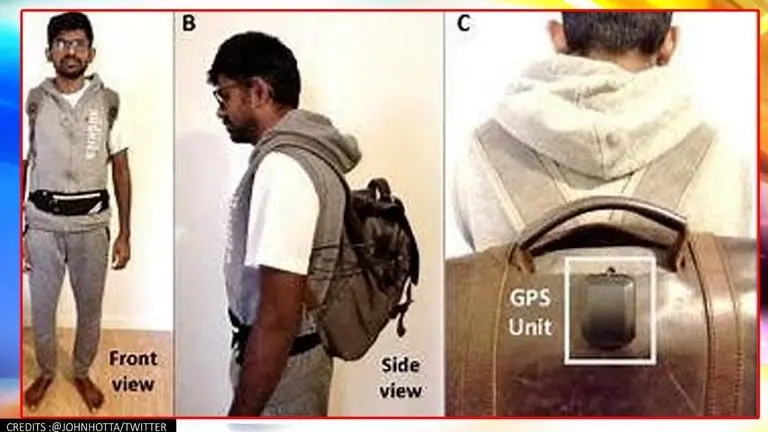
A team of researchers at Intel have designed an Artificial intelligence (AI) powered backpack that can help the visually impaired navigate and perceive the world around them. According to a press note, the backpack, designed by AI developer Jagadish K. Mahendran and his team, helps detect common challenges such as traffic signs, hanging obstacles, crosswalks, moving objects and changing elevations, all while running on a low-power, interactive device. Embedded in a simple backpack, the system helps the person to move forward and even warns them of possible dangers to avoid by simple vocal indications.
Mahendran said, “Last year when I met up with a visually impaired friend, I was struck by the irony that while I have been teaching robots to see, there are many people who cannot see and need help. This motivated me to build the visual assistance system with OpenCV’s Artificial Intelligence Kit with Depth (OAK-D), powered by Intel”.
How AI-powered backpack operates?
As per the press note, the backpack comprises a camera, sensors and GPS. The equipment also takes charge of analysing in real-time the environment and indicating to the visually impaired person, via a vocal assistant, how to move. The system can recognise obstacles on the route, objects and people in movement, as well as road signs. The Bluetooth headsets also allow the user to interact with the system via simple voice commands and requests.
The system also tells the users whether they should stop, deviate, turn right or left, etc. It even tells them if there are stairs or pedestrian crossings ahead. Mahendran informed that to achieve this, a Luxonis OAK-D mini camera is attached to a vest or fanny pack and connected to the computer unit in the backpack. As it is analysed in real-time, these images provide precise information on the depth of field and the various elements that make up the pedestrian’s environment.
This AI-powered backpack could offer incredible possibilities for many blind or visually impaired people who wish to be able to move around independently one day. As per the press release, the WHO estimates that there are more than 258 million visually impaired people in the world. Intel even noted that visual assistance systems for navigation are fairly limited and range from Global Positioning System-based, voice-assisted smartphone apps to camera-enabled smart walking stick solutions.