
'Will Spend Time With Aging Parents In India': Srinivas Narayanan, The IIT Graduate Behind ChatGPT Rise Quits OpenAI | Who Is He?
Srinivas Narayanan, the CTO of OpenAI's B2B Applications, has announced his decision to resign from the company next week. Notably, the executive, who is based in San Francisco, is looking forward to spend time with his aging parents in India.
- Tech News
- 4 min read

;'%3e%3cpath%20d='m8,15.99c4.41,0,7.99-3.58,7.99-7.99S12.41,0,8,0,0,3.59,0,8s3.58,7.99,7.99,7.99Z'%20style='stroke:%23fff;%20stroke-miterlimit:10;%20stroke-width:.02px;'/%3e%3cpath%20d='m3.08,3.37l3.82,5.11-3.84,4.15h.87l3.37-3.64,2.72,3.64h2.94l-4.04-5.39,3.58-3.87h-.86l-3.1,3.35-2.5-3.35h-2.94Zm1.27.64h1.35l5.97,7.99h-1.35l-5.97-7.99Z'%20style='fill:%23fff;'/%3e%3c/g%3e%3c/svg%3e)


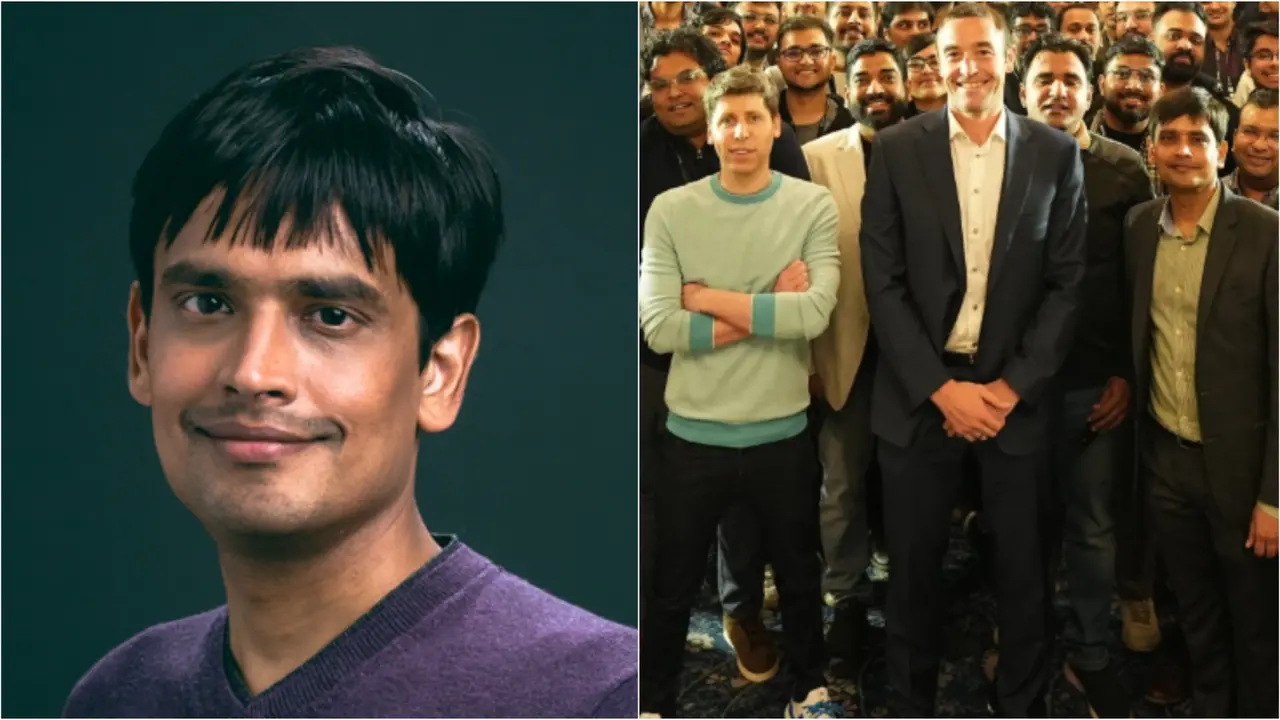
New Delhi: Srinivas Narayanan, the CTO of OpenAI's B2B Applications, has announced his decision to resign from the company next week. Notably, the executive, who is based in San Francisco, is looking forward to spend time with his aging parents in India.
The news of his exit comes along with the departure of two other senior OpenAI executives, marking one of the most consequential weeks of leadership change in the company's recent history.
Kevin Weil, who served as the VP of OpenAI for Science, and Bill Peebles, the researcher scientist behind AI video tool Sora, are the other two executives who have resigned.

‘3 Incredible Years At OpenAI’
Announcing his departure in a post on LinkedIn, Indian-origin tech executive Srinivas Narayanan said, “After 3 incredible years, I am leaving OpenAI at the end of next week. I shared my decision with the OpenAI leadership team at the start of the month.”
Advertisement
In an internal message to his team, Narayanan wrote, “The last three years have been an incredible journey that felt more like ten. Leading the B2B engineering team has been an enormous privilege. With the recent/upcoming product launches, this felt like the right time to step back.”
He added that he will “fondly” remember his prior role leading the Applied Engineering team at OpenAI. He recalled that when he started, it was 40 people on a single floor in the 575 office. "We shipped some of the fastest-growing products in history, like ChatGPT and the API, with no real playbook to guide us. This was only possible because of the incredible team we built - you are the most passionate, dedicated, and hard-working colleagues I have ever worked with. You all have inspired me so much, and I’m so proud of what we have built together. I can’t thank you enough!” he added.
Advertisement
Srinivas Narayanan further said, “I will cherish this time forever during this historic period for technology and society, and I wish you all the very best for the future…It has been a privilege to be on this journey with you.”
Narayanan's Future Plans
Srinivas Narayanan has stated that he is now looking forward to spending some “much-needed time” with his aging parents in India before deciding what’s next.
He has not yet revealed which company he will be joining next or if he will launch his own venture.
Who Is Srinivas Narayanan?
Srinivas Narayanan has been serving as the Chief Technology Officer (CTO) of B2B Applications at tech company OpenAI since September 2025. Born in India in 1974, Narayanan grew up in Chennai.
Narayanan is an alumnus of Indian Institute of Technology (IIT), Madras. He completed his B.Tech in Computer Science from the institute between 1991 and 1995, before moving to the United States of America (USA) to pursue a Master of Science degree in Computer Science from the University of Wisconsin-Madison.
Narayanan, who is presently based in San Francisco, USA, is credited with playing a pivotal role in the growth of OpenAI's chatbot ChatGPT from the ground up.
Before taking on the post of CTO of B2B Applications, he served as the VP of OpenAI's engineering efforts.
According to his LinkedIn profile, he started his career in 1997 as a software engineer at IBM Almaden Research Centre. In 2007, he founded a startup named Viralizr. A year later, he joined Facebook as the VP of Engineering.
Why The Sudden Resignations?
The multiple resignations at OpenAI comes amidst reports that the company is narrowing its focus on projects that make money. Many side projects are reportedly being deprioritised and shut down.
While announcing his exit from the company, Kevin Weil said, “Today is my last day at OpenAI, as OpenAI for Science is being decentralized into other research teams.”