
Chandra Grahan time in India: How to catch the celestial display live?
May 26 marks the first total lunar eclipse to occur since January 2019. Here's everything you need to know about Chandra Grahan time in India.
- Science News
- 2 min read

;'%3e%3cpath%20d='m8,15.99c4.41,0,7.99-3.58,7.99-7.99S12.41,0,8,0,0,3.59,0,8s3.58,7.99,7.99,7.99Z'%20style='stroke:%23fff;%20stroke-miterlimit:10;%20stroke-width:.02px;'/%3e%3cpath%20d='m3.08,3.37l3.82,5.11-3.84,4.15h.87l3.37-3.64,2.72,3.64h2.94l-4.04-5.39,3.58-3.87h-.86l-3.1,3.35-2.5-3.35h-2.94Zm1.27.64h1.35l5.97,7.99h-1.35l-5.97-7.99Z'%20style='fill:%23fff;'/%3e%3c/g%3e%3c/svg%3e)


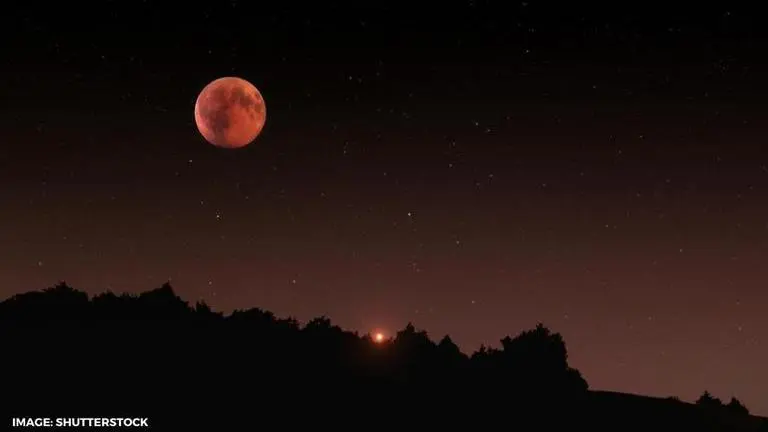
A Total Lunar Eclipse or Chandra Grahan is set to occur today, May 26, 2021. Due to the reddish tinge that the Full Moon takes on when fully eclipsed, the total lunar eclipse is sometimes called a Blood Moon. The term is often used to describe four total lunar eclipses that occur in a row. The upcoming Chandra Grahan will be the first one to occur since January 21, 2019. According to the reports by Time and Date, a total lunar eclipse happens when the Moon travels through the Earth's umbra and then blocks all direct sunlight from illuminating the Moon's surface.
Chandra Grahan time in India
According to Indian Standard Time, Chandra Grahan time, this year, will be at 2:17 pm and is expected to be visible until 7:19 pm. Folks from Australia, Southeast Asia, western South America, and parts of the western US will be able to catch the magnificent celestial display today. Unfortunately, Chandra Grahan won't be visible from many parts of the world including India. However, interested viewers can still watch Chandra Grahan in India by tuning in to the YouTube channel of the Griffith Observatory, which will broadcast the phenomenon live today.
What is a Lunar Eclipse?
Lunar eclipses occur when the Earth blocks Sun's light from directly reaching the Moon's surface, thus, covering the Moon with its shadow. There are three types of lunar eclipses, total, partial and penumbral, with the most dramatic being a total lunar eclipse. A penumbral lunar eclipse is one of the most common types and it occurs when the Sun, Earth, and the Moon are imperfectly aligned. The Earth blocks some of the Sun's light from directly reaching the Moon's surface, thus, covering all or part of the Moon with the outer part of its shadow, also known as the penumbra.
However, this isn’t the case during a total eclipse of the moon, the inner part of Earth’s shadow, known as the umbra, falls on the moon’s face. At the time of mid-eclipse, the entire moon is in shadow, hence, it appears as blood red. While during a partial eclipse, the umbra takes a bite out of only a fraction of the moon.