
Gravitation of sun and moon affect organisms' behavioural patterns: Study
The research team has reportedly compiled their data from follow-up studies over three previously published cases before arriving at their conclusion.
- Science News
- 2 min read

;'%3e%3cpath%20d='m8,15.99c4.41,0,7.99-3.58,7.99-7.99S12.41,0,8,0,0,3.59,0,8s3.58,7.99,7.99,7.99Z'%20style='stroke:%23fff;%20stroke-miterlimit:10;%20stroke-width:.02px;'/%3e%3cpath%20d='m3.08,3.37l3.82,5.11-3.84,4.15h.87l3.37-3.64,2.72,3.64h2.94l-4.04-5.39,3.58-3.87h-.86l-3.1,3.35-2.5-3.35h-2.94Zm1.27.64h1.35l5.97,7.99h-1.35l-5.97-7.99Z'%20style='fill:%23fff;'/%3e%3c/g%3e%3c/svg%3e)


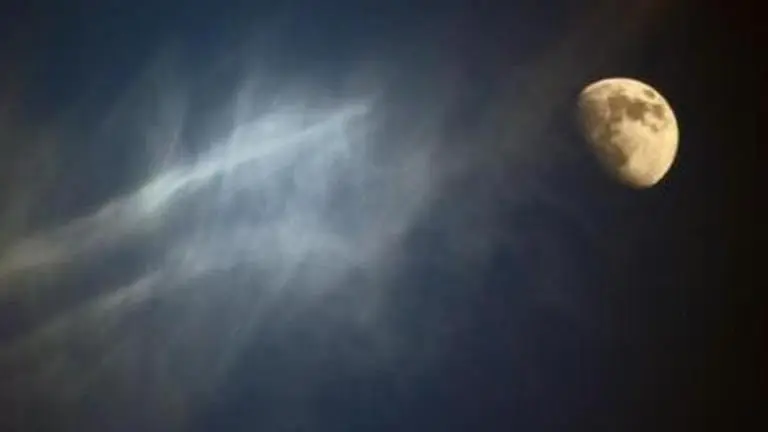
The trio of the Sun, the Moon and the Earth majorly influences the rhythms of activity in all biological organisms including plants and animals, says a new study. Conducted by the experts of an international team, the study claims that it is the gravitational tides created by the orbital mechanics of these entities which impact the rhythms, a fact that has been neglected until now.
"All matter on Earth, both live and inert, experiences the effects of the gravitational forces of the Sun and Moon expressed in the form of tides. The periodic oscillations exhibit two daily cycles and are modulated monthly and annually by the motions of these two celestial bodies", lead author Cristiano de Mello Gallep said as per ANI.
Gravitation has always had an influence, says Gallep
Shedding more light on the effects of gravity on the biological rhythms of organisms, Gallep said that have evolved to deal with the said periodic oscillations as gravity has always been a factor. "What we sought to show in the article is that gravitational tides are a perceptible and potent force that has always shaped the rhythmic activities of these organisms", says the expert.
The research team has reportedly compiled their data from follow-up studies over three previously published cases before arriving at their conclusion. These studies, barring gravitational causality, was focused on the swimming activity of isopods plus small shell-less crustaceans, reproductive effort in coral; and growth modulation in sunflower seedlings inferred from auto luminescence. An extensive analysis of data from these three studies revealed that local gravitational tides are sufficient to organize the cyclical behaviour of organisms in all three studies despite the absence of other rhythmic influences such as lighting or temperature.
Interestingly, some rhythmic cycles of the organisms were maintained even in the absence of light as a factor, the researchers noted in their study published in the Journal of Experimental Botany. Moreover, the experts say that the gravitational cycles not only affect simple organisms but can also establish a cyclical fluctuation in tandem with the lunar cycle that can last 24.4-24.8 hours. Although the effect of gravitational influence by the Sun and the Moon is only a millionth of Earth's gravity, the scientists said that it is enough to cause large-scale tidal fluctuations in oceans, rivers and lakes.