
Pompeii: Archaeologists unearth skeleton of two men died in volcano eruption in 79 A.D.
Officials in Pompeii, the archaeological park in Italy informed that the bodies were dug out from the primitive elegant villa with a panoramic view from 79 A.D.
- Science News
- 2 min read

;'%3e%3cpath%20d='m8,15.99c4.41,0,7.99-3.58,7.99-7.99S12.41,0,8,0,0,3.59,0,8s3.58,7.99,7.99,7.99Z'%20style='stroke:%23fff;%20stroke-miterlimit:10;%20stroke-width:.02px;'/%3e%3cpath%20d='m3.08,3.37l3.82,5.11-3.84,4.15h.87l3.37-3.64,2.72,3.64h2.94l-4.04-5.39,3.58-3.87h-.86l-3.1,3.35-2.5-3.35h-2.94Zm1.27.64h1.35l5.97,7.99h-1.35l-5.97-7.99Z'%20style='fill:%23fff;'/%3e%3c/g%3e%3c/svg%3e)


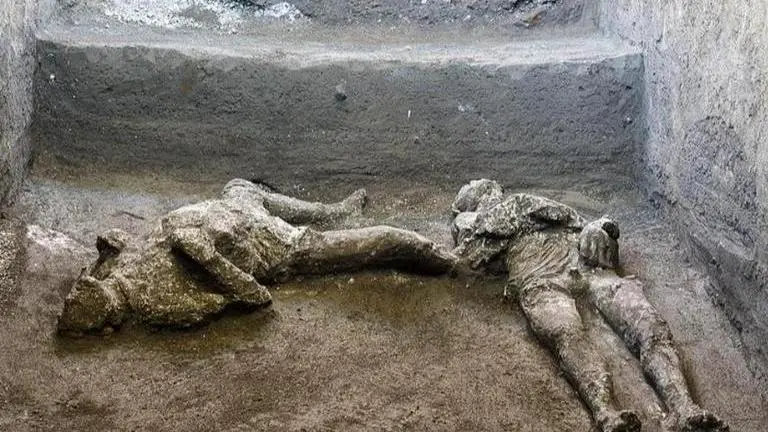
Scientsists have excavated the skeletal remains of what appears to be a wealthy man and his male slave who fell victim to the eruption of Mount Vesuvius nearly 2,000 years ago. Officials in Pompeii, the archaeological park in Italy informed that the bodies of the two were dug out from the primitive elegant villa with a panoramic view of the Mediterranean Sea located in the ancient Roman city. The structure was destroyed by the volcano eruption in 79 A.D. Skeletons of two harnessed horses were also excavated at the site in 2017 victim to the deadly volcanic blast.
According to a release by the Italian culture ministry, archaeologists predicted that the temperature in the ancient Roman city of Pompeii reached higher than 500 degrees Celsius, over 930 Fahrenheit that charred the bodies. One of the men appeared to be 23 years old at the time of the calamity and the other nearly 18 years of age.
The men were dressed in a tunic and upon inspection of their nearly crushed vertebrae, they seemed to be in a profession that involved human labour. The skeletons with their teeth and bones preserved were discovered in Civita Giuliana, 700 meters northwest of the center of ancient Pompeii.

+++ SCOPERTA A #POMPEI +++ Rivive a @pompeii_sites la tecnica di realizzazione dei calchi ideata nell'Ottocento da G. Fiorelli: portati alla luce un ricco pompeiano e il suo schiavo, morti nel 79 d.C. nell'eruzione del Vesuvio. @dariofrance @MassimoOsanna https://t.co/LISlkKIZwG pic.twitter.com/Y82BMTc6Kg
— MiBACT (@_MiBACT) November 21, 2020
Advertisement
Scope for 'cultural' research
"These two victims were perhaps seeking refuge when they were swept away by the pyroclastic current at about 9 in the morning," said Massimo Osanna, director of the archeological site. It is a death by thermal shock, as also demonstrated by their clenched feet and hands.
Advertisement
Culture Minister Dario Franceschini said in a statement that the discovery is integral to the cultural history of Rome and Pompeii provides scope for research. About 13,000 people may have inhabited the region at the time of the incident, scientists predicted. Archaeologists initiated the excavations around 1750 and previously had found 20 years old skeleton in the 1960s in Herculaneum, lying near charred wood face-down on a bed injured in the eruption.

(With AP Inputs)
Image Credit: AP)