
Russia launches 'Nauka' module after 14 years of delay; will reach ISS on July 29
On July 21, Russia launched a long-delayed Russian Multipurpose Research Module (MLM) for its segment on the International Space Station (ISS).
- Science News
- 2 min read

;'%3e%3cpath%20d='m8,15.99c4.41,0,7.99-3.58,7.99-7.99S12.41,0,8,0,0,3.59,0,8s3.58,7.99,7.99,7.99Z'%20style='stroke:%23fff;%20stroke-miterlimit:10;%20stroke-width:.02px;'/%3e%3cpath%20d='m3.08,3.37l3.82,5.11-3.84,4.15h.87l3.37-3.64,2.72,3.64h2.94l-4.04-5.39,3.58-3.87h-.86l-3.1,3.35-2.5-3.35h-2.94Zm1.27.64h1.35l5.97,7.99h-1.35l-5.97-7.99Z'%20style='fill:%23fff;'/%3e%3c/g%3e%3c/svg%3e)


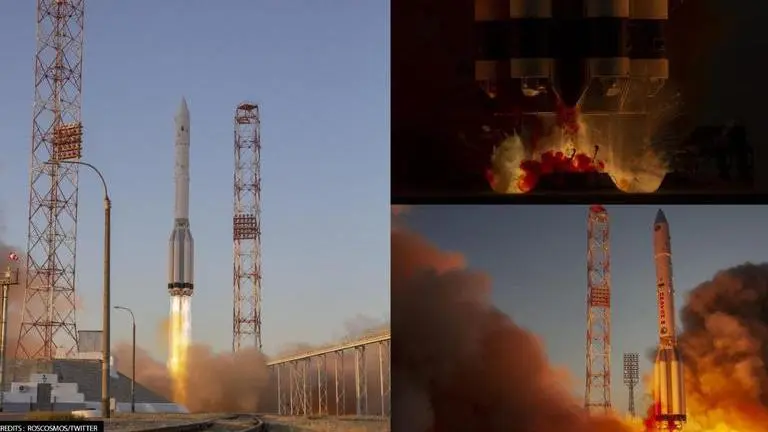
On July 21, Russia launched a long-delayed module for its segment on the International Space Station (ISS). The Russian Multipurpose Research Module (MLM) or ‘Nauka’ module was originally scheduled to be launched in 2007 but was delayed due to technical obstructions. However, at 10:58 EDT on Wednesday, Nauka blasted off, stationed atop a Proton-M rocket from Baikonur Cosmodrome in Kazakhstan.
“Engine start and lift-off. A module named Science takes flight to the International Space Station!” NASA commentator Rob Navias said just as the rocket lifted off the launch pad, sending the 22-ton (20-tonne) Nauka module toward the space station.
Пропустили сегодняшний запуск модуля #Наука? Мы подготовили для вас видео этого исторического события! 😉
— РОСКОСМОС (@roscosmos) July 21, 2021
Кстати, это был 425-й пуск для ракет-носителей семейства «Протон». pic.twitter.com/Q8ZMx0ktxm


According to Russia Space Agency Roscosmos, Nauka Multipurpose Laboratory Module separated from the Proton-M carrier rocket, 580 seconds after the liftoff. It has now begun its eight-day-long autonomous flight to the ISS. Roscosmos also confirmed the successful deployment of its solar panels and antennas. The module will now use its own engines to raise its orbit, the Russian news agency TASS reported.
По поступившей телеметрической информации, произошло раскрытие антенн и солнечных батарей модуля #Наука.
— РОСКОСМОС (@roscosmos) July 21, 2021
/
According to the telemetry data, antennas and solar panels of the #Nauka module have been deployed. pic.twitter.com/6h14KLixYf
What is Nauka carrying?
Nauka module is carrying the European Robotic Arm (ERA), a new appendage that is to be attached to the Russian Segment of the International Space Station. The arm is expected to join the ISS on July 29 and if successful, it will become the largest Russian component of the station. Over 42 feet (13 meters) long and with a maximum diameter of 14 feet (4.3 meters), the module will house research facilities but also provide a spare bed for a cosmonaut, as well as a toilet, oxygen regeneration system, and gear for recycling water from urine.
"The International Space Station already has two robotic arms; Canadian and Japanese robots play a crucial role in berthing spacecraft and transferring payloads and astronauts. However, neither arm can reach the Russian segment. RA is the first robot capable of ‘walking’ around the Russian parts of the orbital complex. It can handle components up to 8000 kg with 5 mm precision, and it will transport astronauts from one working site to another," the European Space Agency described the Russian Arm.


All Images: Roscosmos/Twitter