
Scientists discuss planetary colonies, say lack of preparedness could lead to cannibalism
Before attempting to colonise distant worlds, humans should first establish tester colonies on the Moon or Mars, that could be restocked, the scientists said.
- Science News
- 3 min read

;'%3e%3cpath%20d='m8,15.99c4.41,0,7.99-3.58,7.99-7.99S12.41,0,8,0,0,3.59,0,8s3.58,7.99,7.99,7.99Z'%20style='stroke:%23fff;%20stroke-miterlimit:10;%20stroke-width:.02px;'/%3e%3cpath%20d='m3.08,3.37l3.82,5.11-3.84,4.15h.87l3.37-3.64,2.72,3.64h2.94l-4.04-5.39,3.58-3.87h-.86l-3.1,3.35-2.5-3.35h-2.94Zm1.27.64h1.35l5.97,7.99h-1.35l-5.97-7.99Z'%20style='fill:%23fff;'/%3e%3c/g%3e%3c/svg%3e)


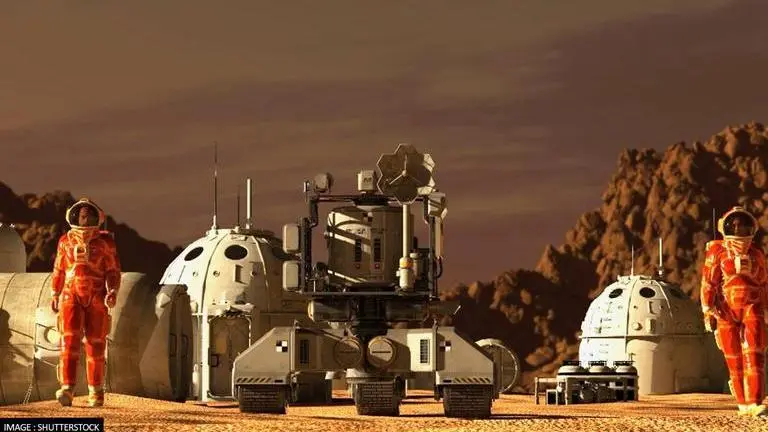
Even as several scientists believe that colonising other planets could be a smart option since it would act as an insurance policy against the possible extinction of life on Earth, two experts from the scientific community have expressed that such an endeavour may see human beings turning into cannibals.
According to a report by Russian state-owned Sputnik, two scientists - Charles Cockell, an astrobiologist at Edinburgh University, and Dr Cameron Smith, an anthropologist at Portland State University - told Metro that before attempting to colonise distant worlds, humans should first establish "tester colonies" on the Moon or Mars, that could be restocked from Earth with relative ease if required.
They added that in the future, when humans would try to create colonies on other planets, they should properly think about how these distant worlds' people would be able to feed themselves, otherwise, things would go tragically wrong. Food shortages, sickness, and a failure to become self-sufficient are all potential threats to Planetary Colonies that are unable to get support from Earth on short notice, the asserted.
'Isolated human communities can degenerate very quickly'
According to Charles Cockell, the possibility of the Earth becoming inhospitable may come from a climate catastrophe and is a "catastrophically bad" reason to establish a colony. However, he believes that colonising is a good option. Further, Cockell explained the entire colonising process along with the importance of food with an example in which he talked about the ill-fated 19th-century Franklin expedition.
Advertisement
Cockell stated that Franklin's ships were "the most sophisticated pieces of technology available at the time," and had tinned food, which was considered to be the "new technology" during the period. However, the expedition was "lost, stranded," and eventually they devolved "into cannibalism," Sputnik reported.
“So even with the best technology, isolated human communities can degenerate very quickly. If you put a group of people on Callisto, things start going wrong and the plant growth module breaks down, they are going to eat each other if there is no other way to survive,” Cockell was quoted by Metro as saying.
Advertisement
In addition to this, Dr Cameron Smith acknowledged that food security is a major concern. Smith has echoed Cockell's worry, saying that one of the first tasks for a planetary outpost would be to build a pretty effective agricultural system and put in a lot of stored food. He also emphasised the possibility of illness, advocating for the distribution of an as-yet-unknown planetary colony population among self-sustaining communities that might be isolated if things went wrong.