
Sweden: Study reveals astronauts staying in space for long time are prone to brain damage
Brain scans of astronauts revealed deteriorations in areas related to movement and processing of information along with changes in areas associated with ageing.
- Science News
- 2 min read

;'%3e%3cpath%20d='m8,15.99c4.41,0,7.99-3.58,7.99-7.99S12.41,0,8,0,0,3.59,0,8s3.58,7.99,7.99,7.99Z'%20style='stroke:%23fff;%20stroke-miterlimit:10;%20stroke-width:.02px;'/%3e%3cpath%20d='m3.08,3.37l3.82,5.11-3.84,4.15h.87l3.37-3.64,2.72,3.64h2.94l-4.04-5.39,3.58-3.87h-.86l-3.1,3.35-2.5-3.35h-2.94Zm1.27.64h1.35l5.97,7.99h-1.35l-5.97-7.99Z'%20style='fill:%23fff;'/%3e%3c/g%3e%3c/svg%3e)


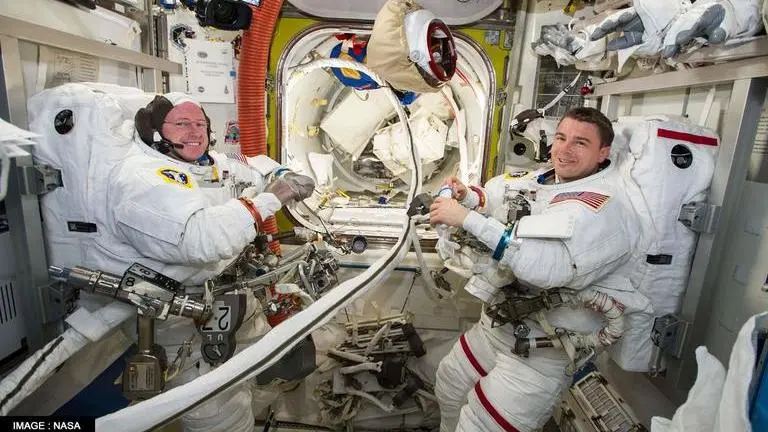
Staying in space for extended periods of time can lead to brain damage in astronauts, as per a new study conducted at the University of Gothenburg. A report by Daily Mail suggested that researchers of the university found the evidence after observing five Russian astronauts. All of these astronauts had reportedly stayed on the International Space Station (ISS) for over 150 days and were found with some anomaly following comparison of their blood samples prior to and after their stay.

Researchers found ‘concrete proof’ of brain cell damage
While speaking to Daily Mail, Henrik Zetterberg, professor of neuroscience and study author, said that they have acquired concrete evidence that proves that astronauts living for a considerable long time in space can result in brain cell damage. These results were produced from the blood samples taken between four years i.e. 2016 and 2020 when the cosmonauts arrived and left the ISS with an average stay of 169 days. As per Daily Mail, researchers took blood samples of the astronauts 20 days before their arrival at the ISS and after a maximum of 21 to 25 days when they landed back on Earth.
Spaceflight affects the brain
Following the analysis of the blood samples, the scientists found five biomarkers or five signs that hinted toward abnormal brain functioning. These five biomarkers reportedly were neurofilament light (NFL), glial fibrillary acidic protein (GFAP), total tau (T-tau), and two amyloid-beta proteins, reported Daily Mail. Although the effects occurred at different points in time, the astronauts were found to have a fluid shift in their brain that occurred during their time in space, said the study published in the journal JAMA Neurology.
Furthermore, the results of the study showed that the brain scans revealed deteriorations in the areas related to movement and processing of information along with changes in areas associated with ageing. Besides, the research team found that lack of gravity in space leads to the accumulation of brain fluids at the base of the cerebrum since the brain tries to float inside the skull. Experts say that this might even lead to a condition called Spaceflight Associated Neuro-Ocular Syndrome, which results in a change in vision.
Advertisement
To date, Russian cosmonaut Valeri Polyakov has a record for staying 437 days in space from followed by NASA's Scott Kelly who stayed 340 days in space between 2015 and 2016.