
Elections in the time of Deepfakes: What is at stake due to the disruptive technology?
60 countries, including the United States, United Kingdom and India are going into elections in 2024, in a time of deepfakes and misinformation triggered by AI
- Tech News
- 2 min read

;'%3e%3cpath%20d='m8,15.99c4.41,0,7.99-3.58,7.99-7.99S12.41,0,8,0,0,3.59,0,8s3.58,7.99,7.99,7.99Z'%20style='stroke:%23fff;%20stroke-miterlimit:10;%20stroke-width:.02px;'/%3e%3cpath%20d='m3.08,3.37l3.82,5.11-3.84,4.15h.87l3.37-3.64,2.72,3.64h2.94l-4.04-5.39,3.58-3.87h-.86l-3.1,3.35-2.5-3.35h-2.94Zm1.27.64h1.35l5.97,7.99h-1.35l-5.97-7.99Z'%20style='fill:%23fff;'/%3e%3c/g%3e%3c/svg%3e)


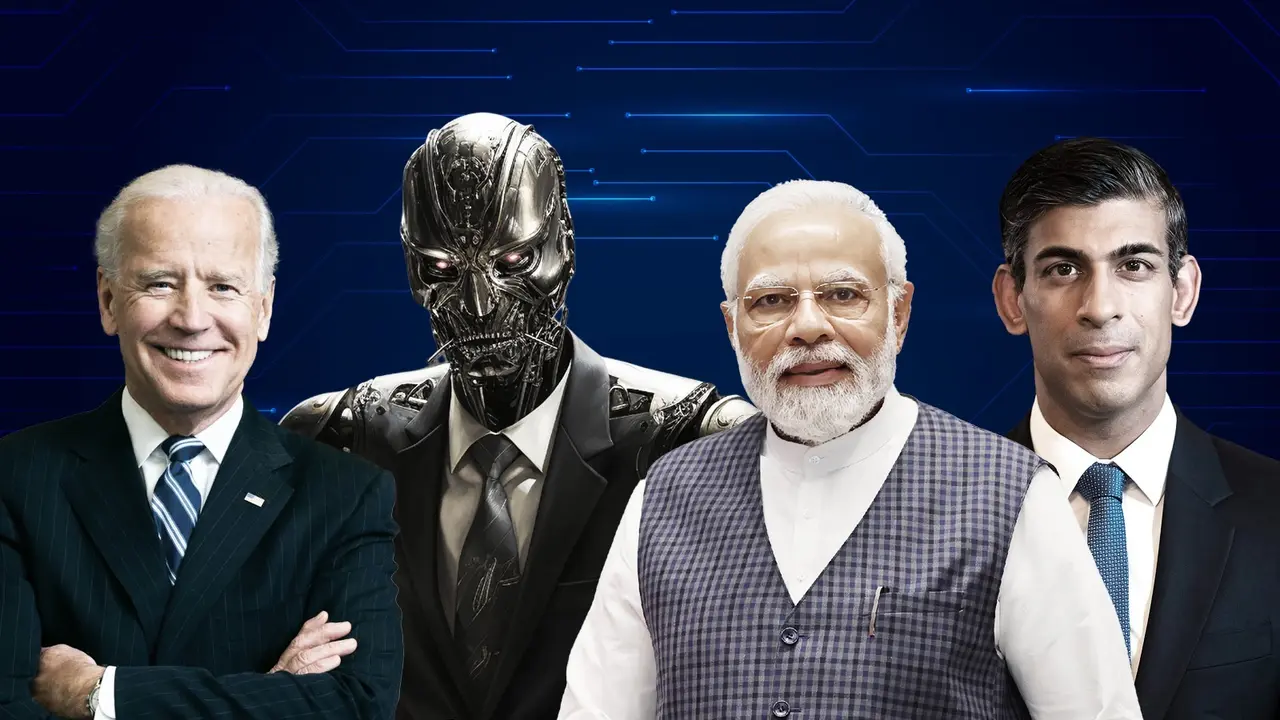
Cracking down on misinformation: The advent of generative intelligence as a subset of AI advancement has garnered global attention, since OpenAI piloted ChatGPT with other players like Google, Microsoft and Meta launching their own Large Language Models (LLMs).
While these technologies impact operations and the knowledge economy, on a mass level these pose an immediate threat to elections.
On a global level, recent cases of Taylor Swift, and back home Rashmika Mandanna’s deepfakes generated and circulated on social media show the dark side of these technologies.
Manipulating Elections
It is the election year for 60 nations in 2024, including the United States, the United Kingdom, and India. What changes things around this time’s elections is AI generating nuanced images, which are harder to differentiate from reality.
Advertisement
It is easier to spread misinformation using AI, with generated videos of leaders, like of former Pakistani President Imran Khan, or robocalls on behalf of American President Joe Biden.
In India, a recent case of BRS leader KT Rama Rao’s video supporting Congress right before the November 2023 elections in the state was circulated on social media, which later turned out to be a deepfake.
Deepfakes, or realistic synthetic media can be made using multiple apps and websites, some even freely available.
Advertisement
What’s the Solution?
Regulation is the way forward for ensuring misinformation generation, and dissemination is regulated.
Of late, 20 technology firms including Google, IBM, Amazon, Microsoft, Meta, OpenAI, and X have signed the Tech Accord to Combat Deceptive Use of AI at the Munich Security Conference a week ago.
While self-regulation by corporates is one way to tackle the challenge, government control and regulation is also required, according to OpenAI CEO Sam Altman.
The Indian government has also taken cognisance of the ongoing issue, with Prime Minister Narendra Modi flagging concerns over deepfake technology and AI misuse.
The Ministry of Electronics and Information Technology sent a second advisory to social media firms in December on regulating misinformation.
After a meeting with social media and technology companies as well as academicians and trade bodies, the IT Ministry last year started working on an IT framework to crack down on deepfake technologies.