
'Can't Believe': GenZ Employee's WhatsApp Message For Showing Up Late Goes Viral
This incident raises a bigger discussion about work culture, especially how Gen Z and Millennials are prioritizing work-life balance.
- Viral News
- 2 min read

;'%3e%3cpath%20d='m8,15.99c4.41,0,7.99-3.58,7.99-7.99S12.41,0,8,0,0,3.59,0,8s3.58,7.99,7.99,7.99Z'%20style='stroke:%23fff;%20stroke-miterlimit:10;%20stroke-width:.02px;'/%3e%3cpath%20d='m3.08,3.37l3.82,5.11-3.84,4.15h.87l3.37-3.64,2.72,3.64h2.94l-4.04-5.39,3.58-3.87h-.86l-3.1,3.35-2.5-3.35h-2.94Zm1.27.64h1.35l5.97,7.99h-1.35l-5.97-7.99Z'%20style='fill:%23fff;'/%3e%3c/g%3e%3c/svg%3e)


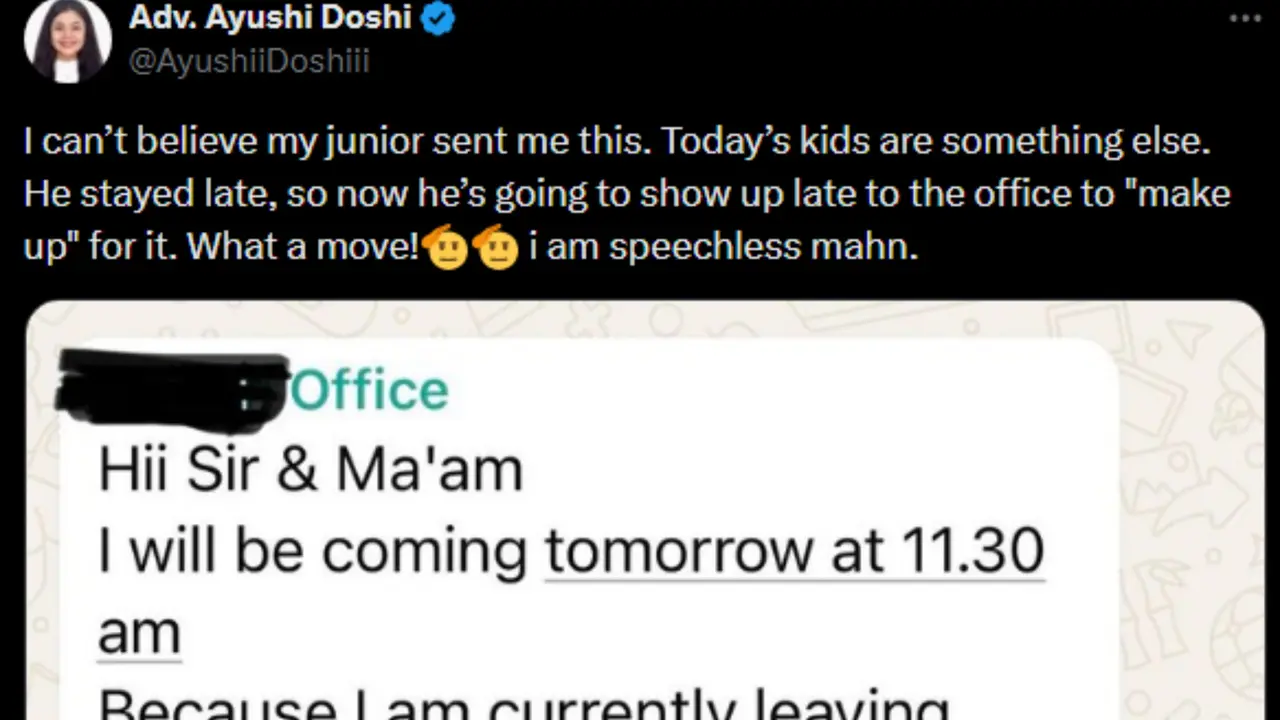
Viral News: A post on X recently went viral when an advocate shared a screenshot of a message from a junior employee. The employee's message reads, "Hi sir & Ma'am. I will be coming tomorrow at 11:30 AM as I am currently leaving the office at 8:30 PM."
The advocate captioned the tweet, "I can’t believe my junior sent me this. Today’s kids are something else. He stayed late, so now he’s going to show up late to the office to 'make up' for it. What a move!”
Gen Z's Work Culture Sparks Viral Debate After Advocate's Tweet
However, this did not sit well with many people online, who quickly criticised the advocate’s response. They argued that setting boundaries for work hours is important and that employees should be able to rest when they work late hours. One user commented, “That’s the right way—people need to follow office timing and respect personal boundaries.”
Advertisement
Another user defended the junior employee, saying, “Maybe he’s just trying to be productive without burning out. Younger employees sometimes bring new ideas on how to work efficiently.”
After being labeled as a ‘toxic senior’ and facing intense backlash, the advocate repeatedly posted explanations to defend herself. In these clarifications, she described the junior employee as “incompetent” and “not interested in work,” suggesting that his behavior showed a lack of commitment. She also pointed out that the employee didn't officially report to her, meaning she wasn’t even responsible for approving his time off.
Advertisement
The advocate claimed her original post wasn’t intended to shame anyone but was meant to highlight a professional issue. She hinted that the post was taken out of context, but many felt her public response was unnecessary and made to attract attention.
This incident has triggered a bigger discussion about work culture, especially how Gen Z and Millennials are prioritizing work-life balance. Many believe younger generations are challenging the “always available” culture and are advocating for healthier workplace expectations.