
10 Years In Jail For Calling Pak 'Terror' State? Who Is Imaan Mazari?
Human rights lawyer Imaan Zainab Mazari-Hazir and her husband, advocate Hadi Ali Chattha, were sentenced to 10 years in prison on Saturday by an Islamabad court over social media posts which were allegedly critical of Pakistan. According to the court, Mazari-Hazir’s posts accused Pakistan of being a “terrorist state” and damaged public confidence in state institutions, including the military forces.
- World News
- 4 min read

;'%3e%3cpath%20d='m8,15.99c4.41,0,7.99-3.58,7.99-7.99S12.41,0,8,0,0,3.59,0,8s3.58,7.99,7.99,7.99Z'%20style='stroke:%23fff;%20stroke-miterlimit:10;%20stroke-width:.02px;'/%3e%3cpath%20d='m3.08,3.37l3.82,5.11-3.84,4.15h.87l3.37-3.64,2.72,3.64h2.94l-4.04-5.39,3.58-3.87h-.86l-3.1,3.35-2.5-3.35h-2.94Zm1.27.64h1.35l5.97,7.99h-1.35l-5.97-7.99Z'%20style='fill:%23fff;'/%3e%3c/g%3e%3c/svg%3e)


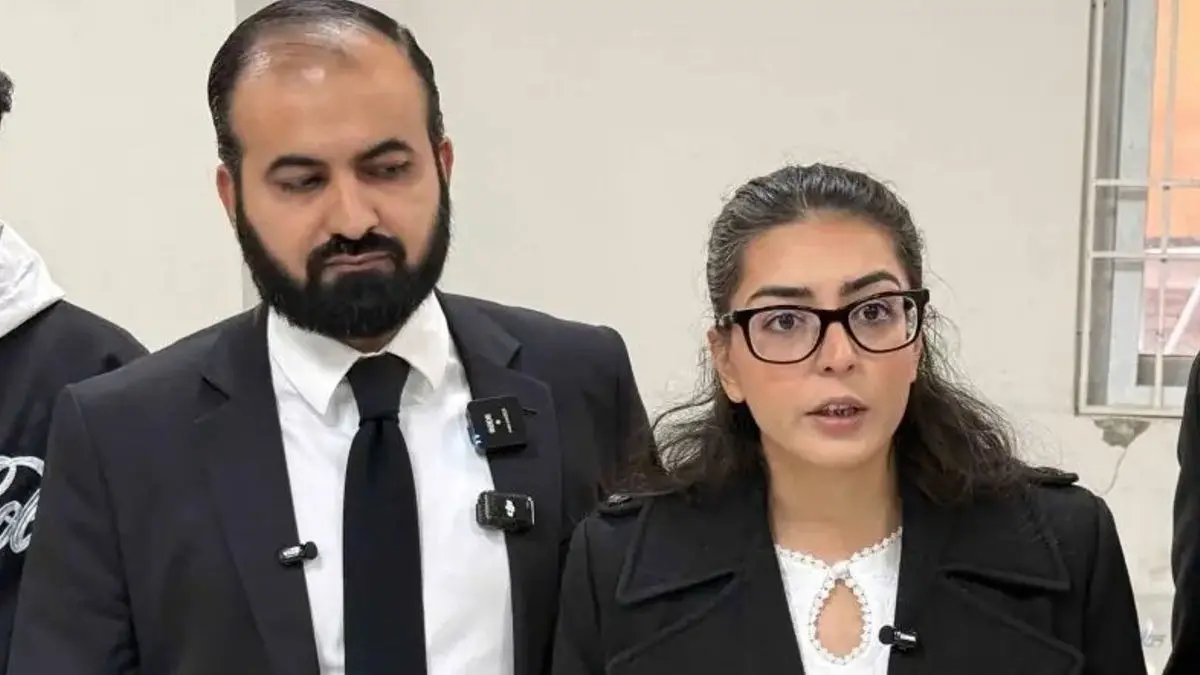
Islamabad: Human rights lawyer Imaan Zainab Mazari-Hazir and her husband, advocate Hadi Ali Chattha, were sentenced to 10 years in prison on Saturday by an Islamabad court over social media posts which were allegedly critical of Pakistan. The arrests were confirmed by Mazari-Hazir’s mother, Dr Shireen Mazari.
According to reports, the couple were arrested while heading to a court hearing connected to their online activity, which authorities said promoted banned groups and spread 'false information'.
Prior to the arrest, Mazari took to the social media platform X, where she wrote, "The police is literally following us into the bathroom in the High Court and the instruction is to arrest us today, no matter what."
Mazari-Hazir, 32, was born in Islamabad to Dr Shireen Mazari, former human rights minister, and the late Dr Tabish Hazir, a renowned paediatrician. She studied law at the University of Edinburgh and has become one of Pakistan’s most eminent activists, working on sensitive cases involving ethnic minorities, journalists accused of defamation, and individuals charged with blasphemy.
Advertisement
Accused of calling Pak a ‘terror state’
The court convicted the couple under Pakistan’s Prevention of Electronic Crimes Act (PECA), citing the spread of “disseminated highly offensive” content in connection with a post. The sentences of five, 10, and two years were ordered to run concurrently. According to the court, Mazari-Hazir’s posts accused Pakistan of being a “terrorist state” and damaged public confidence in state institutions, including the military forces.
Mazari-Hazir has a history of challenging state authorities. In August 2023, she was arrested during a protest by the Pashtun Tahafuz Movement for allegedly criticising the military and referring to them as 'terrorists'. She has faced multiple legal cases over her dedication towards civil rights, including allegations of cyberterrorism and hate speech.
Advertisement
Following the sentencing, police blocked roads around the Karachi Press Club, where journalists, lawyers, and civil society members had gathered to protest. Human Rights Commission of Pakistan chairperson Asad Iqbal Butt criticised both the verdict and the roadblocks, calling them a suppression of free speech.
Senior journalist Shahzeb Jillani reportedly told a Pakistani daily that the sentence of 10 years is a 'mockery of justice.' Speaking to the newspaper, he said, "To give somebody 10 years’ imprisonment over a tweet should not happen.”
International recognition
Mazari-Hazir has received international recognition for her work. In 2025, she won the Young Inspiration Award from the World Expression Forum for her courage and dedication to justice. The UN Special Rapporteur on human rights defenders described the cases against her as an arbitrary attempt of crackdown on activists.
Despite the prison term, Mazari-Hazir remains defiant. Referring to her sentencing, the UN Human Rights Council said they find it “deeply disturbing."
“The conviction & sentencing of Imaan Zainab Mazari-Hazir & Hadi Ali Chatha under the Prevention of Electronic Crimes Act (PECA), following fair trial concerns, is deeply disturbing. This case highlights the danger of this law being used to suppress dissent. We urge the Government to protect & uphold freedom of expression & the right to peaceful assembly in line with Pakistan’s int’l human rights obligations,” UN Human Rights said in a post on X.
According to reports, in court, she said, “Truth seems overwhelmingly difficult in this country. But we knew that when we got into this work, we were ready to face that. We will not back down.”
The case has sparked renewed debate in Pakistan over freedom of expression, and the use of cyber laws to target dissent and intimidate activists who criticise state policies.