
Sudan coup follows a grim trend of military takeovers in 2021; know all about them
As the world began eying normalcy after a tolling 2020 dominated by the COVID, grim trend of military coups was witnessed in the world in following year, 2021
- World News
- 5 min read

;'%3e%3cpath%20d='m8,15.99c4.41,0,7.99-3.58,7.99-7.99S12.41,0,8,0,0,3.59,0,8s3.58,7.99,7.99,7.99Z'%20style='stroke:%23fff;%20stroke-miterlimit:10;%20stroke-width:.02px;'/%3e%3cpath%20d='m3.08,3.37l3.82,5.11-3.84,4.15h.87l3.37-3.64,2.72,3.64h2.94l-4.04-5.39,3.58-3.87h-.86l-3.1,3.35-2.5-3.35h-2.94Zm1.27.64h1.35l5.97,7.99h-1.35l-5.97-7.99Z'%20style='fill:%23fff;'/%3e%3c/g%3e%3c/svg%3e)


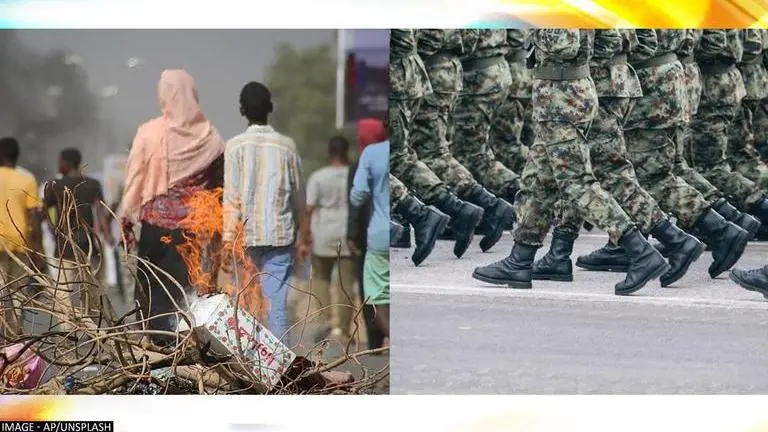
As the world began eying normalcy after a tolling 2020 dominated by the COVID-19 pandemic, a grim trend of military coups was witnessed across the globe in the year that followed, 2021. From Myanmar in Southeast Asia to Sudan in Africa, armies toppled the civilian governments and took over control. The international community has scrambled its efforts to assist the vulnerable nations but recently even United Nations (UN) chief Antonio Guterres raised concerns over the “epidemic of coups” citing military takeovers in 2021.
All militray coups in 2021
Myanmar
Myanmar was engulfed in chaos early on 1 February as its military, junta took over the power announcing a one-year state of emergency and detained State Counsellor Aung San Suu Kyi and other government leaders. They were later charged with criminal charges including Suu Kyi. In the run-up to the November 2020 elections, Army chief Min Aung Hlaing claimed that the civilian government was making "unacceptable mistakes".
While Suu Kyi’s party won the November elections and bagged 396 out of 476 seats in the combined lower and upper houses of Parliament, the military refused to accept the results and cited ‘irregularities’ in 314 townships that could have let voters cast multiple ballots or commit “voting malpractice”. However, the country’s Myanmar’s election commission has confirmed the victory and rejected the army’s claims that were floated without any proof.
Suu Kyi had even reacted to the crisis and urged the people to not be intimidated and her party, National League for Democracy (NLD) emerged victoriously. However, the military alleged that the elections were full of ‘irregularities’ and questioned the veracity of at least nine million votes cast in November 2020 even though the country’s election commission rejected the claims of fraud. Myanmar military stressed that it will protect and abide by its constitution.
Advertisement
Mali
The coup in Africa’s Mali began on 24 May 2021 when the country’s army led by Vice President Assimi Goïta captured President Bah N'daw, Prime Minister Moctar Ouane and Minister of Defence Souleymane Doucouré. Goïta, who is also the head of the junta and led the 2020 Malian coup, announced that both N'daw and Ouane did not hold their respective powers. Marking the nation’s third coup d'état in a decade, he also said that new elections would be held in 2022. Before 2021, the country previously witnessed coups in 2012 and 2020.
The May 2021 coup followed the removal of Malian President Ibrahim Boubacar Keïta by military alliance just nine months ago in August 2020. On 18 August 2020, members of the military led by Colonel Assimi Goïta and Colonel Major Ismaël Wagué in Kati, Koulikoro Region began a mutiny. Ultimately, then-President Keïta and Prime Minister Boubou Cissé were detained. Shortly after the same, Keïta resigned followed by Wagué announcing the formation of the National Committee for the Salvation of the People (CNSP) and promising to hold elections in the near future.
Advertisement
However, after CNSP agreed to a political transition to civilian rule on 12 September 2020 for 18 months, Bah N'daw was named interim president and Goïta as vice president. In January, the transitional government said CNSP has been disbanded. Since the handover from military to civilian rule, tensions remained high with an array of crises with things coming to a head-on 24 May when Goïta announced that key civilian leaders – N'daw, Ouane and Doucore were stripped of their powers and were detained in a military base in Kati.
Guinea
On 5 May 2021, Guinea’s military claimed to take over the country and that they dissolved the government after a video showed the country’s President Alpha Condé surrounded by soldiers. The following day, Col Mamady Doumbouya, the leader of the coup that ousted Condé’s government said that a new “union” government would be formed in the coming weeks. On 1 October, Doumbouya was sworn in as Guinea’s interim president.
As per The Associated Press report, Doumbouya has not given any timeline for holding the new election in the West African nation as the junta swore him in as president on Friday but he pledged not to run as a candidate once the vote is organised.
Notably, Condé’s popularity declined after he pursued a third term saying that term limits did not apply to him. Following Conde’s assertion for another term, the West African regional bloc called ECOWAS then suspended Guinea’s membership and called for the junta to release the 83-year-old Conde. As per AP, the exact whereabouts of the former Guinea’s president remain unknown.
Sudan
On Monday, 25 October, Sudan’s top general Abdel Fattah al-Burhan ousted the government of the country’s Prime Minister Abdalla Hamdok, saying that he was preventing a ‘civil war.’ In a televised news conference on Tuesday, Burhan said that the “dangers were in front of us” citing discrimination prevailing in the country that would lead to “fragmentation” of the country. It is pertinent to note that the coup came just less than a month before Burhan was slated to hand the leadership of the Sovereign Council that runs the nation to a civilian.
The move would have significantly reduced the military’s hold on power in Sudan. Initially, Sudanese Prime Minister Abdalla Hamdok was held at Burhan’s home, the general had said, adding that the PM was in good health. But later on Tuesday, Hamdok’s office confirmed that he was allowed to return to his home along with his wife.
The takeover came in the backdrop of escalating tensions between military and civilian leaders over the course and pace of Sudan’s transition to democracy, the process which now appears to be threatened.