
All Eyes on Historic Modi-Xi Meet, Here's a Look Back At All That Happened When PM Modi Visited China 7 Years Back
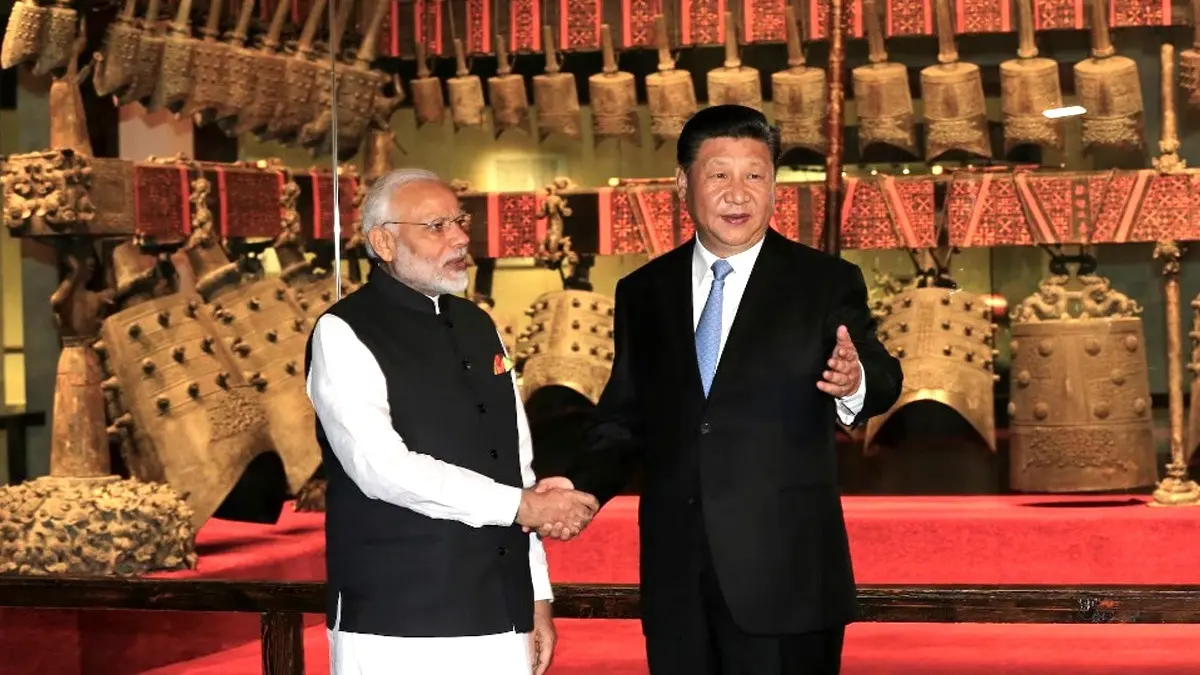
PM Modi’s last visit to China was in June 2018 for the SCO summit.
- World News
- 4 min read

;'%3e%3cpath%20d='m8,15.99c4.41,0,7.99-3.58,7.99-7.99S12.41,0,8,0,0,3.59,0,8s3.58,7.99,7.99,7.99Z'%20style='stroke:%23fff;%20stroke-miterlimit:10;%20stroke-width:.02px;'/%3e%3cpath%20d='m3.08,3.37l3.82,5.11-3.84,4.15h.87l3.37-3.64,2.72,3.64h2.94l-4.04-5.39,3.58-3.87h-.86l-3.1,3.35-2.5-3.35h-2.94Zm1.27.64h1.35l5.97,7.99h-1.35l-5.97-7.99Z'%20style='fill:%23fff;'/%3e%3c/g%3e%3c/svg%3e)


Prime Minister Narendra Modi will arrive in China shortly to attend the Shanghai Cooperation Organisation (SCO) summit in the port city of Tianjin. This marks his first visit to China since 2018. Before the summit, scheduled for August 31 to September 1, 2025, Modi is set to hold bilateral talks with Chinese President Xi Jinping.
Modi concluded a two-day visit to Japan from August 29–30, 2025, at the invitation of Japanese Prime Minister Shigeru Ishiba before heading to China.
This visit to Asian countries occurs amid the imposition of penal tariffs on India by the United States.
Modi’s last visit to China was in June 2018 for the SCO summit. Regarding the upcoming visit, the Ministry of External Affairs (MEA) recalled the first Informal Summit between Modi and Xi Jinping in Wuhan on April 27–28, 2018.
Advertisement

The MEA stated, “The leaders exchanged views on overarching issues of bilateral and global importance and elaborated their respective visions and priorities for national development in the context of the current and future international situation.”
In 2018, the Embassy of the People’s Republic of China in India noted, “President Xi Jinping welcomed India’s attendance at the Council of Heads of State as a full SCO member for the first time. China stands ready to work with India and other member states to uphold the ‘Shanghai Spirit’ and promote the SCO’s sound and stable development.”
Advertisement
Following the 2018 meeting, Modi and Xi witnessed the signing of bilateral cooperation agreements.
The MEA further stated that both nations are committed to handling differences through peaceful discussions. After the 2018 summit, the MEA noted, “Prime Minister Modi and President Xi reviewed India-China relations from a strategic and long-term perspective. They agreed to enhance efforts to build on convergences through established mechanisms to create the broadest possible platform for the future relationship. Both leaders affirmed their maturity and wisdom in managing differences through peaceful dialogue, respecting each other’s sensitivities, concerns, and aspirations.”
The MEA also highlighted their shared stance on terrorism: “Prime Minister Modi and President Xi recognized the common threat posed by terrorism and reiterated their strong condemnation of and resolute opposition to terrorism in all its forms. They committed to cooperate on counter-terrorism.”
Modi and Xi last met on the sidelines of the BRICS summit in Kazan, Russia, in 2024.
This visit comes amid improving India-China ties, strained since the 2020 Galwan Valley clash. Recent visits by Indian officials, including Defence Minister Rajnath Singh, External Affairs Minister S. Jaishankar, and National Security Advisor Ajit Doval, to China, as well as Chinese Foreign Minister Wang Yi’s visit to India, signal a thaw. India has resumed issuing visas to Chinese citizens and restarted the Kailash Mansarovar Yatra. Discussions on resuming direct flights, paused during the COVID-19 pandemic, are also underway.
Modi and Xi are expected to discuss the border issue and the situation along the Line of Actual Control (LAC), strained since the 2020 Galwan Valley clashes. They may also address U.S. President Donald Trump’s tariffs, which have brought India and China closer. Amid tensions in India-U.S. relations due to additional tariffs imposed on India for purchasing Russian oil, India is strengthening ties with Russia and China to safeguard its national and strategic interests. The three nations are part of BRICS.
China has supported India following the U.S. tariffs.
Chinese Ambassador to India Xu Feihong criticized the U.S. move, stating on X, “Give the bully an inch, he will take a mile."
"China firmly opposes the tariff move and will stand with India to uphold the multilateral trading system with the World Trade Organization (WTO) at its core,” he added.
Similarly, Chinese Embassy spokesperson Yu Jing posted on X, “The China-India economic and trade relationship is based on complementarity and mutual benefit. Facing the U.S. abuse of tariffs, the two largest developing countries should stand together to overcome difficulties. Trade and tariff wars have no winners. All countries should uphold extensive consultation, practice true multilateralism, and jointly oppose unilateralism and protectionism.”
Meanwhile, U.S. President Donald Trump has warned of tariffs on BRICS nations if they support a new currency challenging the U.S. dollar.