
Updated 12 August 2023 at 08:57 IST
Archaeologists find 17th century 'vampire child' with padlocked ankle in Polish necropolis
Archaeologists have unearthed the unusual remains of a child from the 17th century found buried with a padlock attached to the foot.
- World News
- 3 min read

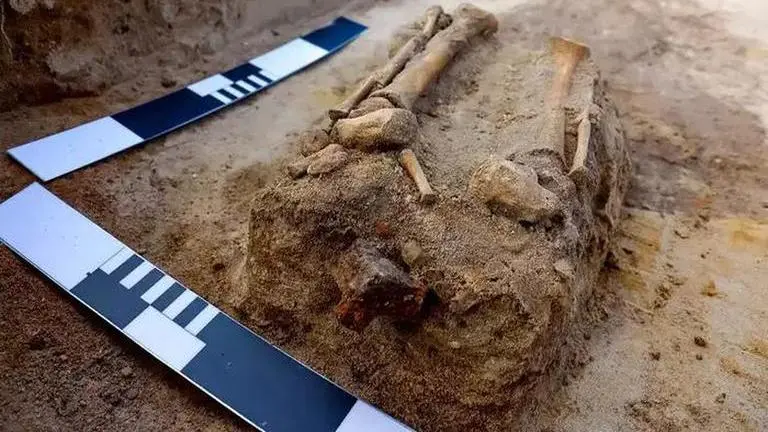
Archaeologists have discovered remains of a child from the 17th century with a padlock fixed to its foot that scientists said were suggestions of fears during medieval times that the dead may spring back to life as vampires, said reports. Researchers including Dariusz Poliński from the Nicolaus Copernicus University, excavated graves in a medieval 'necropolis' graveyard near Dąbrowa Chełmińska in Poland in search of unique burials.
Researchers reportedly made a breakthrough discovery of a young medieval woman’s burial last year, whose body was double protected from rising from the grave with a triangular padlock on the big toe at her left foot, and a sickle pointing down with a blade placed around her neck.
In their quest to find comparable burials in the vicinity, archaeologists have recently made an intriguing discovery. They have unearthed an unprecedented burial of a child, approximately 5-7 years old, from the 17th century.
The child’s remains were found buried with his face facing down towards the ground in the burial cavity suggesting the deceased and his activity was feared after death. According to scientists, such burials, with faces pointing downwards, were likely done in the region during medieval times to make the deceased bite into the ground and ensure they did not pose a threat to people.
Advertisement
Alongside the bones of the child, the archaeologists also discovered a triangular padlock, strikingly similar to the one found with the burial of a medieval woman at the same site last year. Analysis suggested the child’s grave was likely violated and a part of the corpse taken away, but it is not known when and why it occurred or what happened to the remains.
Researchers found a puzzling cluster of several children’s skeletons with a fragment of the jaw in one of them coloured green near the child's grave. A similar greenish tint was also seen on the palate of the woman unearthed last year, scientists said.
Advertisement
Researchers suspect there might have been an object made of copper alloy in this person’s mouth. During the field research, they also found the non-standard burial of a pregnant woman with the remains of her foetus seemingly preserved.
Scientists hope to conduct DNA tests of the remains in further lab studies to understand the woman’s eye colour, skin, hair and possible genetic diseases.
The site where numerous unusual graves with indications of peculiar medieval customs were found has led scientists to strongly believe that the people of that era were afraid of at least some of the deceased. It is speculated that this region possibly housed a cemetery that may have catered to the Protestant community, including those who were ostracized or excluded from the wider society.
Published By : Megha Rawat
Published On: 12 August 2023 at 08:56 IST