
Bangladesh Elections: BNP Inches Towards Big Victory, Tarique Rahman Wins Bogra-6; How Will It Impact India
What makes this election unique is that, two formidable leaders who have shaped the nation's politics ever since its birth since 1971, the late Begum Khaleda Zia and Sheikh Hasina, are both absent from the nation's political landscape.
- World News
- 4 min read

;'%3e%3cpath%20d='m8,15.99c4.41,0,7.99-3.58,7.99-7.99S12.41,0,8,0,0,3.59,0,8s3.58,7.99,7.99,7.99Z'%20style='stroke:%23fff;%20stroke-miterlimit:10;%20stroke-width:.02px;'/%3e%3cpath%20d='m3.08,3.37l3.82,5.11-3.84,4.15h.87l3.37-3.64,2.72,3.64h2.94l-4.04-5.39,3.58-3.87h-.86l-3.1,3.35-2.5-3.35h-2.94Zm1.27.64h1.35l5.97,7.99h-1.35l-5.97-7.99Z'%20style='fill:%23fff;'/%3e%3c/g%3e%3c/svg%3e)


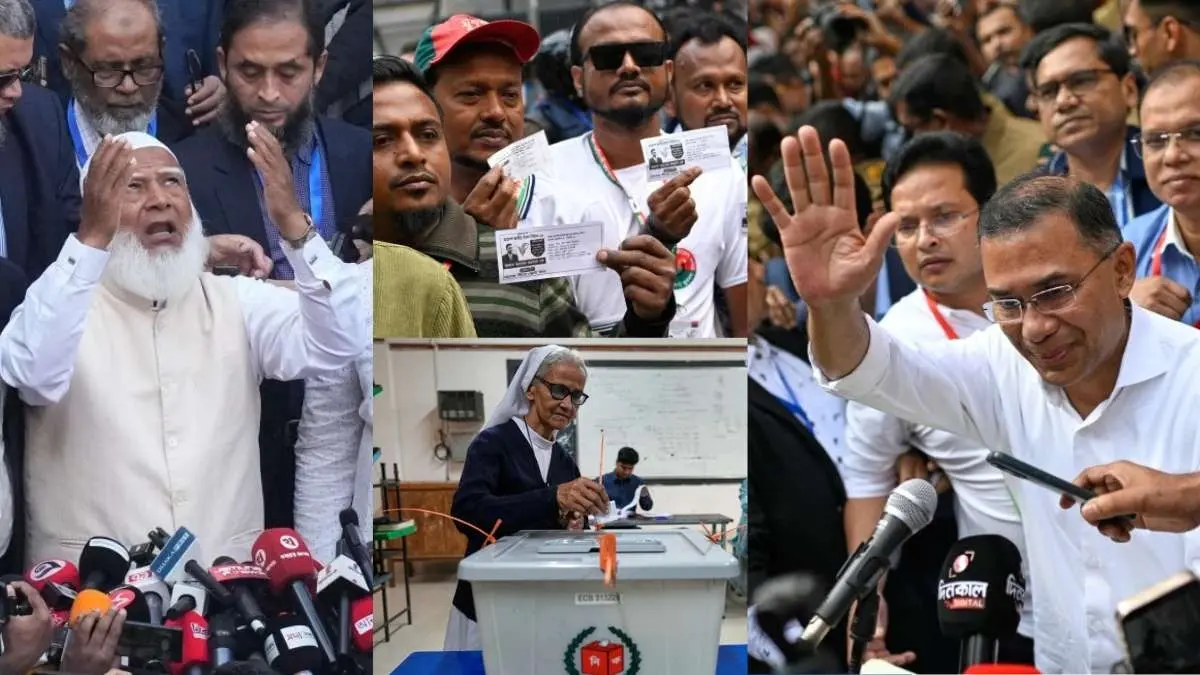
New Delhi: Bangladesh, India's long-standing friendly neighbour for decades, with whom our relationship has soured in recent times, went to polls this Thursday. While the counting is underway, as per latest trends, the Bangladesh Nationalist Party (BNP) has raced ahead of the Jamaat-e-Islami, with the BNP leading in 76 seats and the Jamaat leading in 19. Both these parties are the frontrunners in this election, and were earlier projected to be in close contest with each other.
BNP Chief Tarique Rahman has won the Bogra-6 constituency and has received more than 60,215 votes in Dhaka-17. Independent candidate Sheikh Mujibur Rahman, defeated the Jamaat's Md Ramzan Ali and the BNP's Syed Ehsanul Huda at Kishoreganj-5.
According to the latest reports from Desh Rupantor, in the nation's capital, Jamaat-e-Islami Ameer Shafiqur Rahman is leading with 41,390 votes at the Dhaka-15 seat. BNP candidate Shafiqul Islam Khan, who is Rahman's closest candidate has secured 30,326 votes.
Shafiqur Rahman mentioned that his party would accept the results, regardless of what others opine on it. "If voting continues the way it has so far, and if there is no major interference, then whether others accept the results or not, we will accept it, In sha Allah," he was quoted as saying by several publications.
Advertisement
Voting concluded at 4:30 pm, and the voter turnout reached 47.91% till 2 pm, which was significantly higher than the 42% recorded in the 2024 election which was boycotted by major opposition parties. This election had over 50 parties contesting, with more than 2,000 candidates in the fray. However, critics would still argue with its credibility, as Hasina's Awami League, one of the most formidable political parties in Bangladesh, was not allowed to contest.
However, the historic election was not without violence. According to a Prothom Alo report, at least nine people, including a BNP leader, a presiding officer and a polling officer, died in different parts of the country on Thursday.
Advertisement
No Hasina, Zia Factor
What makes this election unique is that, two formidable leaders who have shaped the nation's politics ever since its birth since 1971, Begum Khaleda Zia and Sheikh Hasina, are both absent from the nation's political landscape.
On voting day, Hasina accused the Mohammad Yunus government of seizing power illegally and unconstitutionally. "Gratitude from the People's Leader Sheikh Hasina to All Citizens, including Mothers, Sisters, and Minority Communities, for Rejecting the Farcical Election of the Murderous-Fascist Yunus," her statement read.
"From the evening of 11 February, this farce began with seizure of polling centers, gunfire, vote-buying, distribution of money, stamping of ballots, and agents signing result sheets. By the morning of 12 February, voter turnout was negligible in most polling centers nationwide, and in many centers across the capital and other areas, there were no voters at all," the statement added.
The election is also significant because it is being conducted after the July Uprising 2024, when Sheikh Hasina was ousted from power, with the nation's Chief Advisor Mohammad Yunus calling the polls “the beginning of an unprecedented journey toward a new Bangladesh.”
The nation also cast their votes on a referendum on the July Charter, through which the next government that comes to power will be able to bring about substantial changes to the Constitution and bring about alterations in its democratic institutions.
What The Polls Mean for India
According to various political observers, both the parties, the BNP, which is now headed by Khaleda Zia's son Tarique Rahman, and the Jamaat-e-Islami, have publicly stated that they seek good relations with India, however, on equal terms. Both parties have sought the return of Sheikh Hasina, who has taken refuge in India, which New Delhi has so far denied, making it a bone of contention between the two nations.
As per geopolitical experts, India had a rocky relationship with Bangladesh, when the BNP was in power. Though the Jamaat has never tested power before, it has received sufficient boost this time, from the student-led parties, who were not in favour of conventional family-led parties coming to power in the country, after the July Uprising. However, the Jamaat, has taken several positions in the past, which have mostly been against India. Hence, several observers believe, that the BNP coming to power, might be the best bet for India.
According to South Asian observers, India sending External Affairs Minsiter S Jaishankar to Dhaka, to offer condolences to Tarique Rahman when his mother, Khaleda Zia died, was a step in the right direction.