
Bolivia creates mobile crematory due to unprecedented COVID-19 pandemic
The rapid increase in deaths and infections from the coronavirus has motivated a group of entrepreneurs in Bolivia to manufacture mobile crematorium furnaces.
- World News
- 2 min read

;'%3e%3cpath%20d='m8,15.99c4.41,0,7.99-3.58,7.99-7.99S12.41,0,8,0,0,3.59,0,8s3.58,7.99,7.99,7.99Z'%20style='stroke:%23fff;%20stroke-miterlimit:10;%20stroke-width:.02px;'/%3e%3cpath%20d='m3.08,3.37l3.82,5.11-3.84,4.15h.87l3.37-3.64,2.72,3.64h2.94l-4.04-5.39,3.58-3.87h-.86l-3.1,3.35-2.5-3.35h-2.94Zm1.27.64h1.35l5.97,7.99h-1.35l-5.97-7.99Z'%20style='fill:%23fff;'/%3e%3c/g%3e%3c/svg%3e)


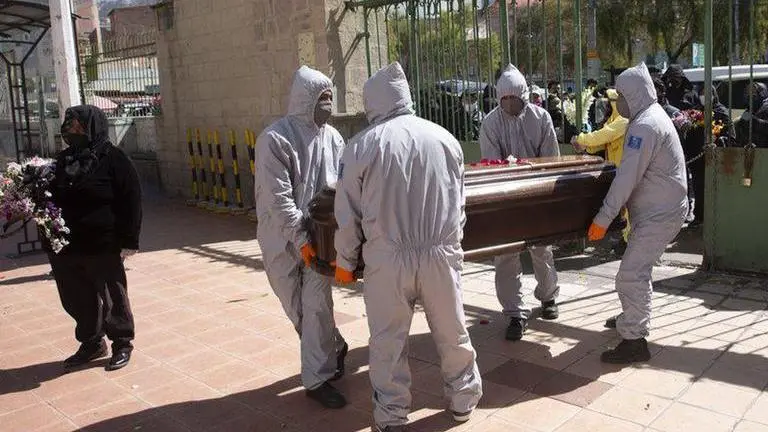
The rapid increase in deaths and infections from the coronavirus has motivated a group of entrepreneurs in Bolivia to manufacture mobile crematorium furnaces.
Carlos Ayo, an environmental engineer and part of the group of entrepreneurs, said the idea wasn't just to diversify but to do something for his country.
He said there have been instances in some locations in Bolivia where bodies were showing up in the streets because families either didn't have the resources or were unable to find places to bury or cremate them.
Ayo said his group were advertising the mobile crematory oven by hauling it through the streets of La Paz with a large sign reading: "Mobile crematory ovens."
Advertisement
This unique way of advertising is aimed at local authorities in cities that lack the equipment to meet the rising demands.
According to the Ministry of Health, in the last week of July, virus-linked deaths rose to over 80 per day reaching a cumulative of 3,064 and 78,793 contagions from the disease.
Advertisement
The entrepreneurs decided to venture into the manufacture of these furnaces with the idea of making it mobile, so it can be moved to the city that needs it the most.
Ayo said the initiative came up in March as the pandemic expanded and bodies were seen on the streets in China, Europe.
Then the same thing happened in Latin America.
Bolivia, one of the poorest countries in South America, has been hit with the disease against the backdrop of a precarious health system and a saturation of funeral services.
In Bolivia, only main cities have crematory ovens.
One of the most hard-hit cities is Cochabamba, in central Bolivia.
Here, families were keeping coffins in their homes for more than six days, and dead were being placed in the streets due to a collapse of their funeral services, as the main cemetery had only one obsolete crematorium oven.
The Ministry of Health, in the face of this emergency, activated a protocol in which it stated that bodies could be buried in the ground and in mass graves.
Cremation is still necessary in municipalities that have this service.