
‘Can't Demand My Return To Face My Political Assassination’: Sheikh Hasina
Sheikh Hasina said that her trust in Bangladesh's constitutional framework remains intact. "Our constitutional tradition is strong, and when legitimate governance is restored and our judiciary regains its independence, justice will prevail," she said.
- World News
- 5 min read

;'%3e%3cpath%20d='m8,15.99c4.41,0,7.99-3.58,7.99-7.99S12.41,0,8,0,0,3.59,0,8s3.58,7.99,7.99,7.99Z'%20style='stroke:%23fff;%20stroke-miterlimit:10;%20stroke-width:.02px;'/%3e%3cpath%20d='m3.08,3.37l3.82,5.11-3.84,4.15h.87l3.37-3.64,2.72,3.64h2.94l-4.04-5.39,3.58-3.87h-.86l-3.1,3.35-2.5-3.35h-2.94Zm1.27.64h1.35l5.97,7.99h-1.35l-5.97-7.99Z'%20style='fill:%23fff;'/%3e%3c/g%3e%3c/svg%3e)


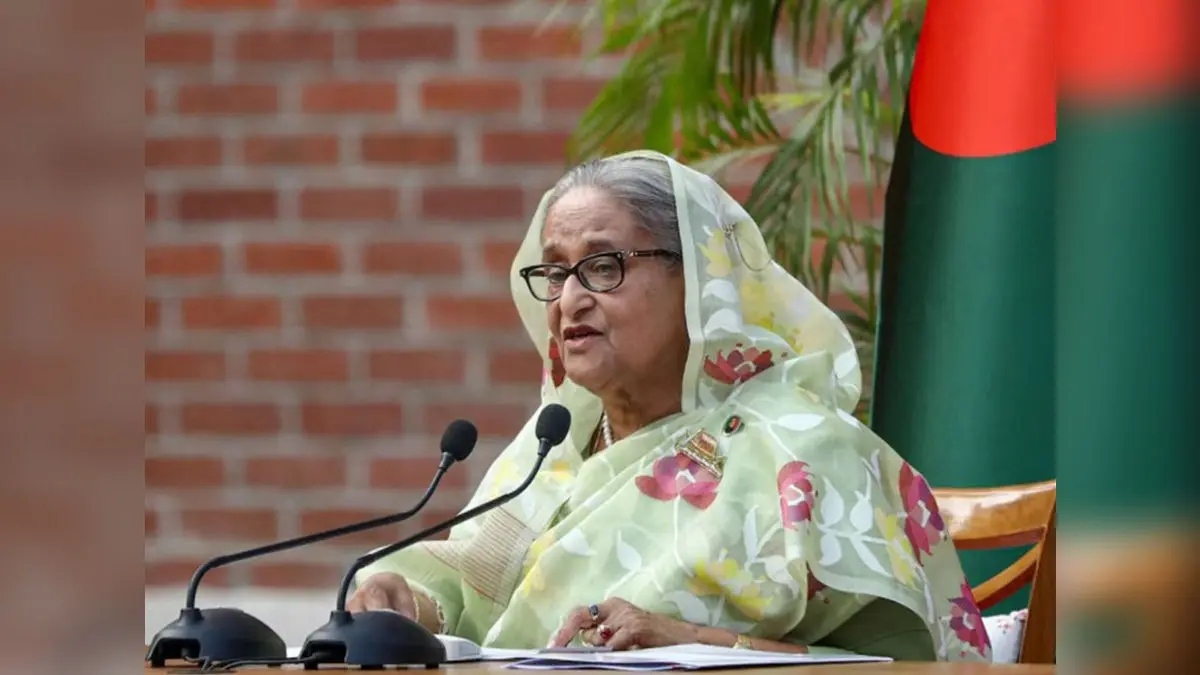
Former Bangladesh Prime Minister Sheikh Hasina on Monday dismissed calls for her return to the country amid ongoing legal proceedings, saying the action against her was politically driven and insisting she would not go back under the present circumstances, even as Bangladesh witnessed fresh unrest last week, including the killing of a Hindu man.
"You cannot demand my return to face my political assassination," Hasina said, reiterating that she has challenged Chief Adviser Muhammad Yunus to take the matter to The Hague, expressing confidence that an independent court would acquit her. She said she would return only when Bangladesh has a legitimate government and an independent judiciary.
Elaborating on her position in an email interview with ANI, Hasina said the verdict delivered by the International Crimes Tribunal (ICT) was not a judicial exercise but a political one, describing it as a “political assassination in judicial robes.”
She said she was denied the right to defend herself and to appoint lawyers of her choice, alleging that the tribunal had been used to conduct a “witch hunt of the Awami League.”
Advertisement
Despite the allegations, Hasina said her trust in Bangladesh's constitutional framework remains intact. "Our constitutional tradition is strong, and when legitimate governance is restored and our judiciary regains its independence, justice will prevail," she said.
Her comments follow a ruling by a Bangladesh court in November that found Hasina guilty of "crimes against humanity" in connection with the July-August 2024 uprising, with local media reporting that International Crimes Tribunal-1 imposed the death penalty. According to the Dhaka Tribune, the tribunal convicted the former Prime Minister on all five charges of crimes against humanity.
Advertisement
The report said the judgement concluded that Hasina, along with former police chief Chowdhury Abdullah Al-Mamun and former home minister Asaduzzaman Khan Kamal, had orchestrated and enabled atrocities during the July-August movement.
Against this backdrop of legal action and recent violence, Hasina accused the interim administration headed by Chief Adviser Muhammad Yunus of lacking democratic legitimacy and driving the country toward instability by weakening institutions and empowering extremist elements.
She also questioned the credibility of elections scheduled for February, citing the continued ban on the Awami League. "An election without the Awami League is not an election, but a coronation," she said, alleging that Yunus is governing "without a single vote from the Bangladeshi people" while attempting to bar a party that has won nine national mandates.
Hasina warned that voter participation historically collapses when people are denied the option to vote for their preferred party, leading to widespread disenfranchisement. Any administration formed under such circumstances, she said, would lack moral authority and squander an opportunity for genuine national reconciliation.
The ICT verdict, she said, has also triggered demands for her extradition, which she dismissed as coming from "an increasingly desperate and adrift Yunus administration," while others recognise the proceedings as a politically driven "kangaroo tribunal." She expressed gratitude for India's continued hospitality and the support extended by political parties across India.
Explaining her exit from Bangladesh, Hasina said she left to prevent further bloodshed and not because she feared accountability.
Placing developments within a regional context, Hasina addressed the worsening of India-Bangladesh relations, including Dhaka's decision to summon the Indian envoy. She blamed the interim administration for issuing hostile statements against India, failing to protect religious minorities and allowing extremists to influence foreign policy.
She underscored that India has been Bangladesh's most dependable partner for decades and said bilateral ties are deep-rooted and enduring, expressing confidence that relations would stabilise once legitimate governance is restored.
Turning to rising anti-India sentiment and concerns over the safety of Indian diplomats, Hasina said the hostility is being driven by extremists emboldened under the Yunus regime. She alleged that these groups had attacked the Indian embassy, media organisations and minorities, and that Yunus had elevated such elements to positions of authority while releasing convicted terrorists.
She said India's concerns over the safety of its personnel were justified, adding that a responsible government would safeguard diplomatic missions and prosecute those issuing threats, rather than shielding what she described as hooligans.
Referring to the killing of Sharif Usman Hadi, Hasina said the incident highlighted the breakdown of law and order following her removal, a situation she said has worsened under the interim government. Violence, she added, has become routine, destabilising Bangladesh internally and alarming neighbouring countries.
"When you cannot maintain basic order within your borders, your credibility on the international stage collapses," she said, describing this as “the reality of Yunus's Bangladesh.”
Hasina also raised concerns about the growing influence of radical Islamist groups, alleging that Yunus has appointed extremists to cabinet positions, released convicted terrorists and allowed organisations linked to international terror networks to operate in public life.
She warned that these groups were using Yunus to project a moderate image internationally while radicalising institutions domestically, cautioning that such developments should alarm not only India but all countries invested in South Asian stability.
On rhetoric surrounding India's Siliguri Corridor, often referred to as the "Chicken's Neck," Hasina described such statements as reckless, saying no responsible leader would threaten a neighbour on whom Bangladesh depends for trade and regional stability. She said these views do not reflect the will of the Bangladeshi people and would fade with the restoration of democracy.
Commenting on closer engagement between Pakistan and Bangladesh, Hasina said Dhaka has always believed in friendship to all, but described Yunus's approach as misguided and driven by desperation after alienating longstanding partners.
Reiterating her central contention, Hasina said Yunus lacks the authority to reshape Bangladesh's foreign policy, stressing that he was not elected and has no mandate to take decisions with long-term consequences. "Once Bangladeshis can vote freely again, our foreign policy will return to serving our national interests," she said, adding that ties with India would endure beyond the interim government.