
Updated 27 October 2022 at 18:49 IST
China demonstrates drone that drops robot dog armed with machine gun | WATCH
China has demonstrated a robot dog that is mounted with a machine gun and can be deployed via a drone. The demonstration was made by a Chinese defence company.
- World News
- 2 min read

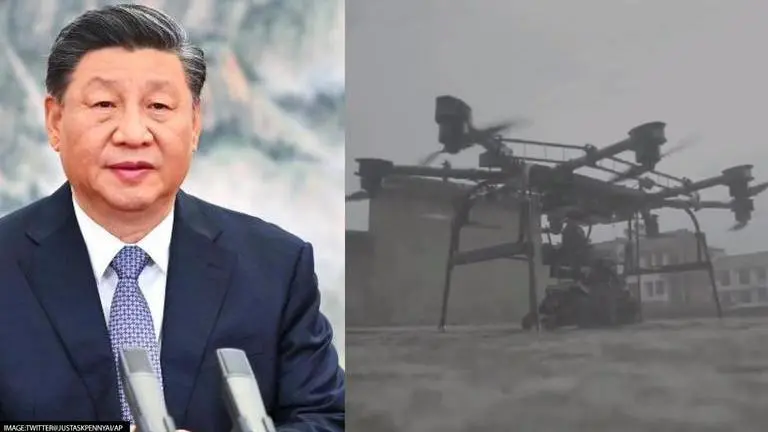
China has demonstrated a robot dog that is mounted with a machine gun and can be deployed via a drone. The demonstration was made by a Chinese defence company named “Kestrel Defense Blood-Wing". The Kestrel Defense Blood-Wing released a video on China's Twitter-like Weibo, which depicts a drone flying and then releasing a robot dog on the roof of a building. The drone flies away after dropping the robot dog that starts scanning potential targets using computer vision. The robot dog has an automated weapon attached on top of it.
Chinese robot attack dog with machine gun dropped by drone pic.twitter.com/QJwXatwJCB
— Austin Frisch (@FrischReport) October 27, 2022
As per a report by the New York Post, the gun is a light machine gun named Chinese QBB-97 which can fire 650 rounds per minute at a range of 400 meters. The defence contractor Kestrel Defense Blood-Wing has claimed that the weapon can launch a surprise attack. “War dogs descending from the sky, air assault, Red Wing Forward heavy-duty drones deliver combat robot dogs, which can be directly inserted into the weak link behind the enemy to launch a surprise attack or can be placed on the roof of the enemy to occupy the commanding heights to suppress firepower. And ground troops [can] conduct a three-dimensional pincer attack on the enemy in the building,” the description by the company reads as per the New York Post report.
Concerns regarding autonomous weapons
Tesla CEO Elon Musk and physicist Max Tegmark of MIT have voiced concerns about the use of autonomous weapons in the battlefield. The problem with attempting to restrict the deployment of autonomous weapons in the battlefield is that if nation A decides to not develop and deploy them, nation B will have an incentive to develop and deploy them, in the hope of a tactical advantage in the battlefield. BigTech companies have been hesitant to enter the field of autonomous weapons. Back in 2018 when Google entered the sector in collaboration with the Pentagon for project Maven, Google employees started protesting against their own company and as a result Google backed out from the project. Project Maven's aim was to use machine learning to make drone strikes more lethal and precise. China, under President Xi Jinping's vision, is working to become a tech superpower, which would include dominance in fields such as autonomous weapons, quantum computing, semiconductors and synthetic biology.
Published By : Sagar Kar
Published On: 27 October 2022 at 18:49 IST