
China Strikes Back, Imposes 34% Tariff on All US Imports Amid Escalating Trade War
The blanket tariff affects every major American export sector, from agriculture and manufacturing to technology and energy.
- World News
- 3 min read

;'%3e%3cpath%20d='m8,15.99c4.41,0,7.99-3.58,7.99-7.99S12.41,0,8,0,0,3.59,0,8s3.58,7.99,7.99,7.99Z'%20style='stroke:%23fff;%20stroke-miterlimit:10;%20stroke-width:.02px;'/%3e%3cpath%20d='m3.08,3.37l3.82,5.11-3.84,4.15h.87l3.37-3.64,2.72,3.64h2.94l-4.04-5.39,3.58-3.87h-.86l-3.1,3.35-2.5-3.35h-2.94Zm1.27.64h1.35l5.97,7.99h-1.35l-5.97-7.99Z'%20style='fill:%23fff;'/%3e%3c/g%3e%3c/svg%3e)


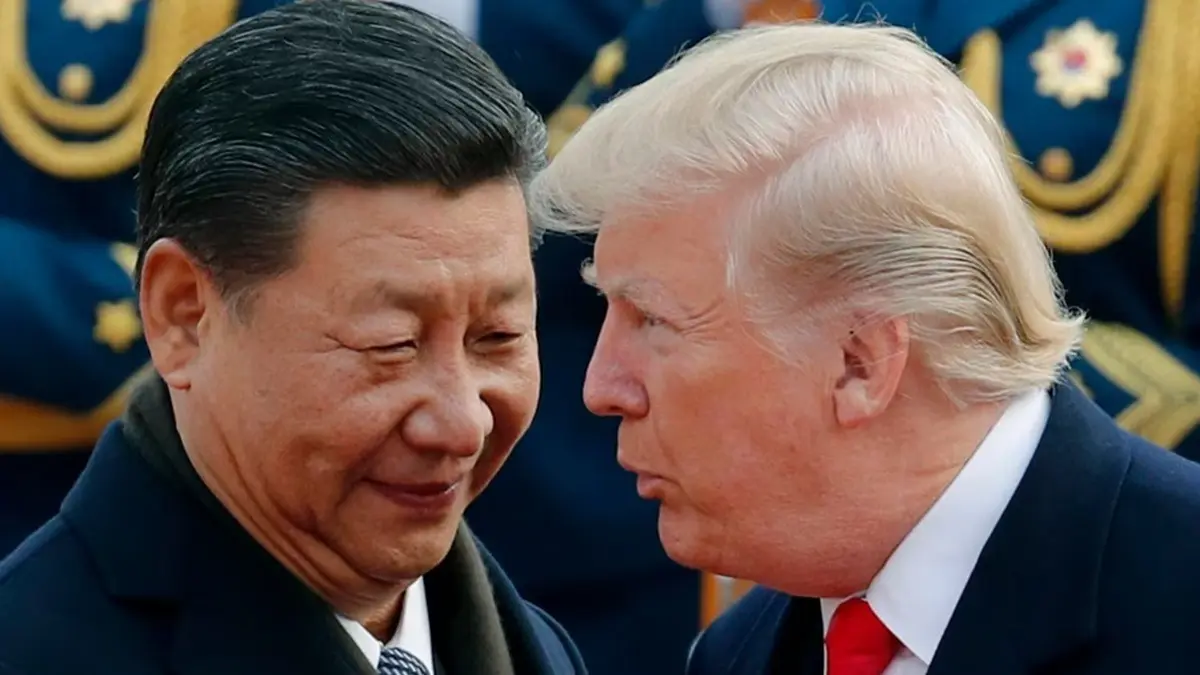
Beijing: In a dramatic escalation of trade tensions, China has imposed a sweeping 34% tariff on all American imports, effective April 10. The new tariff matches the rate of the U.S. "reciprocal" tariff imposed by Trump this week. The move, confirmed by China’s Ministry of Finance on Thursday, comes as a direct retaliation to US President Donald Trump ’s recent tariff hike on Chinese goods, rekindling fears of a full-scale trade war between the world’s two largest economies.

The blanket tariff affects every major American export sector, from agriculture and manufacturing to technology and energy. U.S. soybeans, semiconductor equipment, automotive parts, and even luxury goods are now firmly in Beijing’s crosshairs.
The Commerce Ministry in Beijing also said in a notice that it will impose more export controls on rare earths, which are materials used in high-tech products such as computer chips and electric vehicle batteries.
China Files Lawsuit With WTO
Furthermore, China announced that it has filed a lawsuit with the World Trade Organization (WTO) in response to the sweeping tariffs imposed by the United States on its exports. In an official statement, Beijing's commerce ministry said, “China has filed a lawsuit under the WTO dispute settlement mechanism.”
Advertisement
The announcement comes just a day after Beijing called on Washington to reverse its latest tariff hikes, cautioning that China would take necessary steps to defend its interests. “China strongly opposes this and will implement countermeasures to safeguard its legitimate rights and interests,” the Commerce Ministry said, as rising tensions between the world’s two largest economies threaten to spiral into a deeper trade war.
Under the revised U.S. tariff framework, Chinese exporters—along with others from various countries—will now face a baseline tariff of 10% on nearly all goods entering the U.S., starting Saturday. An additional layer of higher "reciprocal tariffs" is slated to be enforced beginning April 9.
Advertisement
In a parallel move, Trump also signed an executive order eliminating the “de minimis” loophole, which had previously allowed low-value shipments from China and Hong Kong to enter the U.S. without incurring duties.
This latest escalation comes as the Office of the U.S. Trade Representative continues its review of whether China has fulfilled its obligations under the 2020 “Phase 1” trade agreement.
As part of the deal, China had pledged to increase its purchases of American exports by $200 billion over two years—a target it missed, citing the disruptions caused by the COVID-19 pandemic.
According to Chinese customs data, China imported $154 billion worth of U.S. goods in 2017, prior to the onset of the trade war. That number climbed to $164 billion in 2023, highlighting the deeply interwoven trade relationship between the two nations, even amid ongoing disputes.
Trump’s Tariffs Rattle Global Markets
Global stocks extended their slide while U.S. futures dropped as investors braced for the fallout from President Donald Trump’s latest wave of tariffs, dubbed “Liberation Day” duties.
The impact rippled across asset classes—tech stocks, crude oil, and even traditionally safe bets like gold and the U.S. dollar all took a hit. Economists warn the move could trigger a harmful mix of slowing growth and rising inflation.
U.S. benchmark crude dropped $2.70 to $64.25 a barrel following news that major oil producers plan to ramp up output. Brent crude, the global standard, also slipped, falling $2.63 to $67.51 a barrel.
Currency markets saw turbulence, too. The dollar ticked up to 146.46 yen from 146.06, even as the Japanese currency remains a popular safe-haven in volatile times. Meanwhile, the euro weakened slightly to $1.0976 from $1.1055.