
Davos 2026 To Bring Together 3,000 Leaders From More Than 130 Countries; Check Who All Are Attending
This year's programme is shaped by ongoing geopolitical realignments, slowing global growth, trade frictions and accelerating technological change. Across sessions on geopolitics, growth and global governance, participants will explore how cooperation can be renewed amid strained alliances.
- World News
- 5 min read

;'%3e%3cpath%20d='m8,15.99c4.41,0,7.99-3.58,7.99-7.99S12.41,0,8,0,0,3.59,0,8s3.58,7.99,7.99,7.99Z'%20style='stroke:%23fff;%20stroke-miterlimit:10;%20stroke-width:.02px;'/%3e%3cpath%20d='m3.08,3.37l3.82,5.11-3.84,4.15h.87l3.37-3.64,2.72,3.64h2.94l-4.04-5.39,3.58-3.87h-.86l-3.1,3.35-2.5-3.35h-2.94Zm1.27.64h1.35l5.97,7.99h-1.35l-5.97-7.99Z'%20style='fill:%23fff;'/%3e%3c/g%3e%3c/svg%3e)


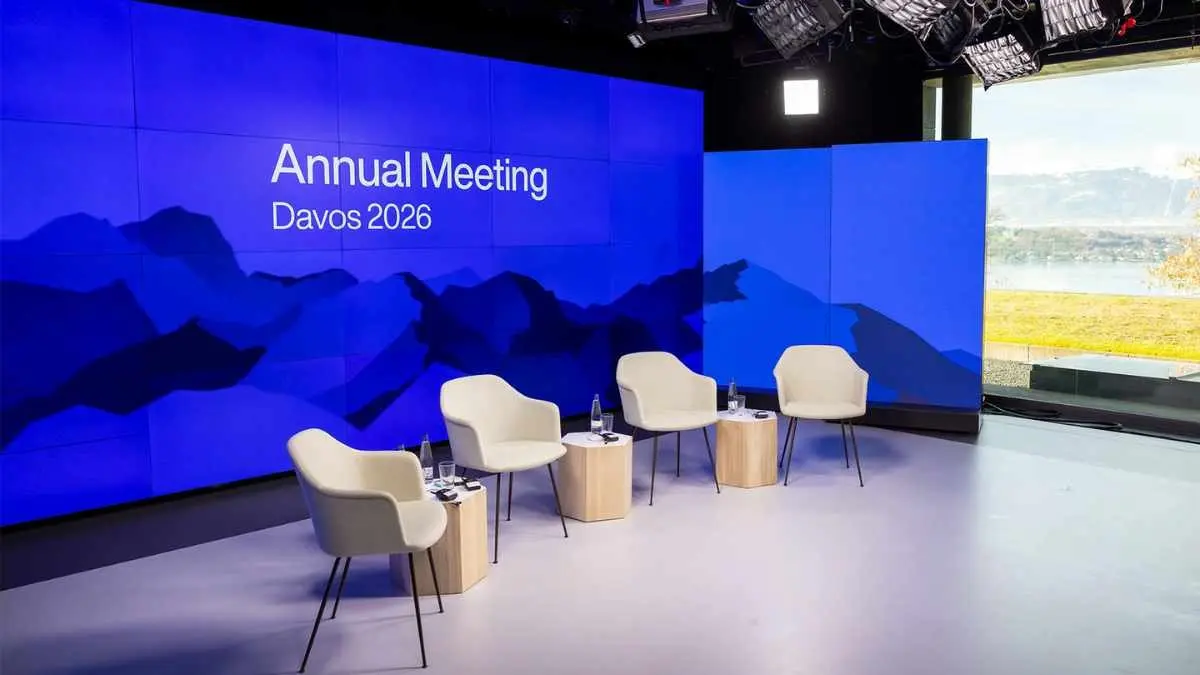
Davos: The World Economic Forum (WEF) will convene its 56th Annual Meeting in Davos from January 19 to January 23, 2026, bringing together nearly 3,000 leaders from more than 130 countries at a moment of heightened geopolitical tension, economic uncertainty and rapid technological transformation.
Held under the theme "A Spirit of Dialogue," Davos 2026 seeks to provide an impartial platform for global leaders from government, business and civil society to reconnect, rebuild trust and explore collaborative solutions to challenges that increasingly transcend borders.
The meeting builds on the Forum's mission to improve the state of the world through public-private cooperation, continuing a tradition that for more than five decades has positioned Davos as a central venue for shaping responses to global crises and long-term structural change.
This year's programme is shaped by ongoing geopolitical realignments, slowing global growth, trade frictions and accelerating technological change. Across sessions on geopolitics, growth and global governance, participants will explore how cooperation can be renewed amid contested norms, strained alliances and eroding trust.
Advertisement
Discussions are expected to examine new models of collaboration as long-standing assumptions around security, sovereignty and global integration are challenged. From managing geopolitical risk and economic fragmentation to navigating trade headwinds and financial volatility, leaders will focus on practical, solutions-oriented pathways to support resilience and competitiveness.
Innovation will feature prominently throughout the programme, particularly the responsible deployment of transformative technologies, including generative artificial intelligence, advanced computing and digital infrastructure.
Advertisement
Sessions will assess how technological breakthroughs can drive productivity and growth while addressing concerns around governance, ethics and inclusion.
Davos 2026 will place strong emphasis on the human dimensions of change. As industries evolve and technologies reshape work, leaders will examine how governments and businesses can better invest in people, build resilient labour markets and support skills transitions in an era of profound disruption.
Improving well-being, strengthening social cohesion and ensuring inclusive growth will be central to these discussions.
At the same time, participants will explore pathways to rebuilding prosperity within planetary boundaries, advancing secure energy, nature and water systems while addressing climate and environmental risks.
The Annual Meeting is expected to see record levels of government participation, with around 400 top political leaders, including nearly 65 heads of state and government and six leaders from the G7, taking part.
Acccording to the WEF website, the list of attendees include Donald Trump, President of the United States; Mark Carney, Prime Minister of Canada; Friedrich Merz, Federal Chancellor of Germany; and Ursula von der Leyen, President of the European Commission.
China will be represented by He Lifeng, Vice-Premier of the People's Republic of China. Other leaders expected in Davos include Javier Milei, President of Argentina; Prabowo Subianto, President of Indonesia; Pedro Sanchez, Prime Minister of Spain; Guy Parmelin, President of the Swiss Confederation for 2026; Kyriakos Mitsotakis, Prime Minister of Greece; Micheal Martin, Taoiseach of Ireland; and Shehbaz Sharif, Prime Minister of Pakistan. Leaders from across Europe, Africa and the Middle East will also attend, including Bart De Wever, Prime Minister of Belgium; Ilham Aliyev, President of Azerbaijan; Alexander Stubb, President of Finland; Aziz Akhannouch, Head of Government of Morocco; Daniel Francisco Chapo, President of Mozambique; Dick Schoof, Prime Minister of the Netherlands; Mohammed bin Abdulrahman Al Thani, Prime Minister and Foreign Minister of Qatar; Aleksandar Vucic, President of Serbia; Tharman Shanmugaratnam, President of Singapore; Isaac Herzog, President of Israel; Ahmad Al Sharaa, President of Syria; and Volodymyr Zelenskyy, President of Ukraine.
International Institutions will also play a prominent role, reinforcing the multilateral dimension of the meeting.
Participants include Antonio Guterres, Secretary-General of the United Nations; Ngozi Okonjo-Iweala, Director-General of the World Trade Organization; Ajay S. Banga, President of the World Bank Group; and Kristalina Georgieva, Managing Director of the International Monetary Fund. They will be joined by Mark Rutte, Secretary-General of NATO; Tedros Adhanom Ghebreyesus, Director-General of the World Health Organization; Mathias Cormann, Secretary-General of the OECD; Doreen Bogdan-Martin, Secretary-General of the International Telecommunication Union; Alexander De Croo, Administrator of the United Nations Development Programme; Barham Salih, UN High Commissioner for Refugees; and Jasem Al Budaiwi, Secretary-General of the Gulf Cooperation Council.
Around 1,700 business leaders will attend Davos 2026, including nearly 850 of the world's top CEOs and chairpersons from the Forum's Members and Partners, alongside close to 100 leaders of unicorn companies and technology pioneers.
Among the most prominent technology and innovation voices expected are Jensen Huang, CEO of NVIDIA; Satya Nadella, CEO of Microsoft; Dario Amodei, CEO of Anthropic; Demis Hassabis, CEO of Google DeepMind; Sarah Friar, CFO of OpenAI; Alex Karp, CEO of Palantir Technologies; Arthur Mensch, CEO of Mistral AI; Peggy Johnson, CEO of Agility Robotics; Bret Taylor, CEO of Sierra; and Peng Xiao, CEO of G42.
More than 200 sessions will be live-streamed as part of an open digital media experience, supported by extensive international media participation and public engagement through the Open Forum.
The WEF said this approach is designed to ensure transparency and allow global audiences to follow, question and engage with discussions taking place in Davos. As geopolitical tensions rise and economic and technological transformations accelerate, Davos 2026 aims to bring together a uniquely diverse mix of sectors, industries, governments and generations to surface long-term solutions, unlock new opportunities for growth and resilience, and help move the world forward together in the year ahead.