
Explained: Russia & China may seem closer but they don’t have identical interests
Russia and China may be closer than they have been in decades, but the two nations don’t have identical interests, said director of Kissinger Inst. on China, US
- World News
- 4 min read

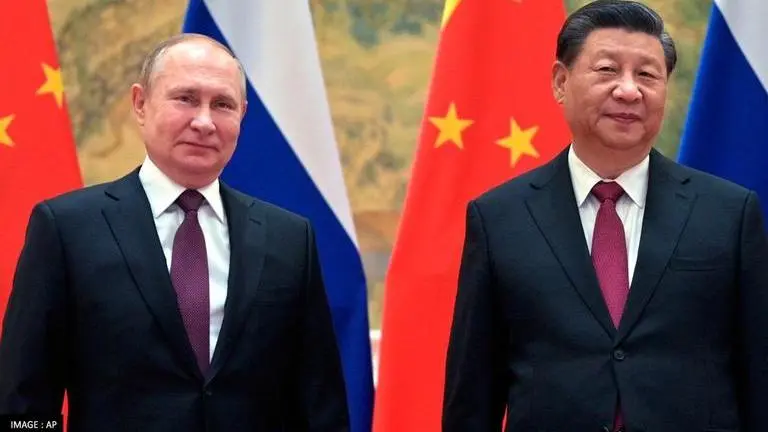
Russia and China may be closer than they have been in decades, however, the two nations don’t have identical interests, said Robert Daly, director of the Wilson Center’s Kissinger Institute on China and the US. Speaking to CNBC’s ‘Street Signs Asia’, Daly noted that Russian President Vladimir Putin and his Chinese counterpart Xi Jinping have shared interests coupled with “very different” diplomatic styles and some different goals. Daly said that the “no limits” partnership, announced by the two leaders on the day of the Winter Olympics opening ceremony in Beijing, may also be a milestone in the relationship between Russia and China.
“This came very close to being the announcement of a quasi-alliance,” Rober Daly said, adding that the two nations are “standing shoulder to shoulder” to counter the US, but that “China has a long-standing non-alliance policy, so they don’t want to use the word ally.”
“They (China and Russia) are now closer together than ever, probably than for the past 70 years,” he added.
However, Daly further went on to note that the alignment between Beijing and Moscow isn't complete as Russia sells arms to Vietnam and to India, both nations that have had territorial disputes with China in recent years. Daly also went on to note that Russia has not even supported China’s moves in the South China Sea, which is a body of water that is commercially critical for Vietnam, Japan, and others but most of which China claims as its own territory. For its part, China has also walked a fine line over Russia’s invasion and occupation of Crimea in 2014, Daly stated.
‘China’s relations won’t fracture even if Russia attacks Ukraine’
Beijing has promised to stand with Moscow in its demand that Kyiv not be allowed to join the NATO alliance, however, according to the director of the Wilson Center’s Kissinger Institute on China and the US, it is not Xi Jinping’s interest to be dragged into military tensions at the Ukrainian border. Daly said that China has good relations with Ukraine and would prefer that Russia does not invade the former Soviet nation.
Separately, Bonny Lin, director of the China Power Project at the Center for Strategic and International Studies, said that if China supports Russia, it would have a price to pay in the form of backlash from the US and its allies. Lin told CNBC that China, to the extent possible, would like to not bear the costs, which is why Beijing would prefer the ongoing Ukraine border crisis to continue as is, or de-escalate a bit. Moreover, she added that China’s relations with Russia won’t fracture even if Moscow attacks Kyiv.
Advertisement
Russia, China need ‘political and economic support’ from each other
Further, according to Bonny Lin, the “no limits” partnership between Beijing and Moscow opens up the possibility of a formal military alliance, however, she also added that neither side needs support on that front. Lin told the media outlet that both China and Russia have “incredible military power”. “What they need from each other is political and economic support,” according to Lin.
Lin said that China will look for ways to support Russia if the US imposes punishing sanctions on Moscow. She added that this could involve Beijing’s cooperation between banks or buying more Russian goods.
Advertisement
“China doesn’t want to really consider or really want to talk about this until Russia has made the move and until we’ve seen the United States and the West impose those sanctions,” she said.
“The actual strongest partner that China has is Russia,” Lin added.
She also went on to say that Russia also needs China’s help “quite a bit more” than Beijing needs Moscow’s support. However, Lin said that China would want Russia on its side if it decided to ramp up aggression toward Taiwan, a democratically self-governed island that China claims as part of its own territory.