
Explained: Who is Peru's first female president and why was Pedro Castillo ousted?
In just three hours, President Castillo went from decreeing the dissolution of Congress to being replaced by his VP, giving Peru its first female President.
- World News
- 7 min read

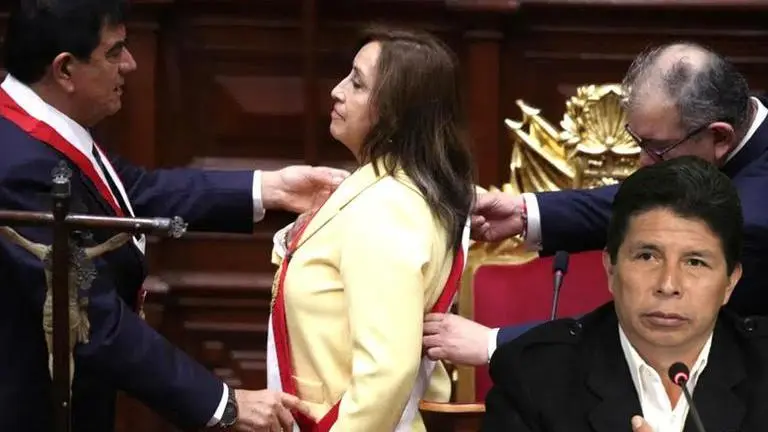
In an attempt to quell a vote of impeachment against him, Peru's President José Pedro Castillo Terrones was all set to declare rule by decree by installing a new emergency government, only for him to be ousted within hours by members of the Peruvian Congress. He was arrested on charges of rebellion and attempting to trigger a grave constitutional crisis. Following this, Castillo’s Vice President, Dina Boluarte was sworn in as the first female President in the history of the South American country.
Peru has been suffering through a massive political and economical crisis for the past few years. Apart from the continuous elimination of the country’s leaders, the Latin American nation is going through a nation-wide drought that is affecting the country’s food supply and leading to heightened prices. With Boluarte now at the helm, concerns are whether she will be able to pull Peru out of its economic downfall.
Why was Peru President Pedro Castillo impeached?
This was the third attempt to impeach Castillo by the Congress. Having survived the first two, the now former President was scheduled to dissolve the legislation and rule by decree in an attempt to halt the lawmakers from voting him out yet again. The first attempt at impeachment came last December after the opposition cited allegations of illicit financing of Castillo’s party. Requiring a two-third majority for impeachment of the 130 legislators, only 46 voted in favour.
Highlighting a term in the Peruvian constitution called “permanent moral incapacity” which has allegedly been unfairly used to remove presidents in the past, the second impeachment attempt in March this year failed with only 55 votes in favour. Third time being the charm, lawmakers voted 101 votes in favour to remove Castillo from office stating the same “constitutional” term. Six legislators opposed the move while ten abstentions were registered.
Advertisement
Castillo has regularly denied any allegations of corruption against him, saying they’re based on “hearsay statements by people who, seeking to lighten their own punishments for supposed crimes by abusing my confidence, are trying to involve me without evidence.” Federal prosecutors are investigating six cases against Castillo, most of them for alleged corruption. Allegations include him "using his power to profit from public works".
An elementary teacher by profession in rural Peru, with an attractive humble background, Castillo was pegged as a rising underdog from the very beginning. Experts stated his lack of political experience played a huge role in his departure, as he received opposition from the moment he stepped in. His choice of cabinet members was highly criticised as most of them had pending criminal charges against them and were being investigated.
Advertisement
Who is Dina Boluarte, the first female President of Peru?
Dina Boluarte is a 60-year-old lawyer who has taken over Castillo’s remaining term scheduled to last until July 2026. Boluarte served as Vice President in the Castillo administration. As Castillo’s running mate in the 2021 Peru general elections, the duo won the second of voting with 8,836,380 votes. This was not her first attempt at a major political seat, having failed to win twice when she ran for parliament in 2020 and for mayor of Surquillo district in Lima with the Peru Libre (Free Peru) party.
A lawyer by profession, she graduated in Law from the San Martín de Porres Private University in Lima where she obtained a Master’s degree in Notarial and Registry Law. She kicked off her political career in 2007 as an advisor at the National Registry of Identification and Civil Status in Surco district of Lima. She was later promoted to head the local office.
After winning the General Elections with Castillo, Boluarte was sworn in as Minister for Development and Social Inclusion on July 29, 2021. She resigned from this position on November 25 this year after yet another cabinet change by Castillo, while keeping her vice presidency. Two weeks later, now an Independent, she has now been sworn in as the first female leader of Peru, a move that experts are saying was carefully orchestrated.
The question is how long will Boluarte last?
The South American is now seeing its sixth President in six years. Suffice to say, the political history of Peru has been marred by instability with a constant power struggle amongst politicians, with Presidents trying to impeach one another. In 2020, it had three presidents within the space of five days. Links to corruption and illegal upheavals have led to many of its past leaders being investigated on charges of corruption. The seventeen-month term of former President Pedro Castillo saw more than five Premiers (Prime Ministers) resulting in him constantly changing the cabinet with no legislative work achieved.
In an attempt to reassure the Congress and the Peruvian public, Dina Boluarte called for a political truce and united government while asking for “space and time to rescue the government”. Peru is currently suffering through one of the worst hit droughts in the last century in addition to an onslaught of avian flu, and with farmers unable to plant food due to lack of rain, morale amongst the Peruvian people has been low. To top that, a surge in COVID-19 cases of infections has been registered as the fifth wave of the pandemic in the country. 217,000 people have died in Peru till date after infection from coronavirus.
Boluarte, formerly a member of Castillo’s political party ‘Free Peru’, now an independent, faces major challenges internally in the country and within her own government. While working towards bringing her country out of a major economic crisis, she has to stay vigilant politically in case of any backlash by her fellow lawmakers. A stable strategy with a solid cabinet is her only solution to last the remainder of Catillo’s term which will end in July 2026.
Former President Ollanta Humala’s five year term from 2011 to 2016 could debatedly be the last stable stretch of government that the Latin American country endorsed. However, he too is being investigated for corruption charges with links to illegal funding from a Brazilian multinational corporation to the tune of US$ 3 million. While Humala has denied any such allegations, prosecutors have recommended a prison sentence of twenty years.
Notably, Castillo was the first President to have been investigated while holding office. As reported by AP, Castillo on Wednesday became the second ex-president currently in custody in the country. A former Peruvian president, Alberto Fujimori, is serving a 25-year sentence for murder and corruption charges dating to his 1990-2000 rule.
How does the Peruvian Government function?
The Latin American country is led by a legislature comprising a single house of Congress that consists of 130 members that are elected for five years by proportional representation. These 130 lawmakers form the legislature of the government. The president is also elected for a five-year term from a multi-party system after gaining a clear majority (50%) from the public. The first round of elections are held and if no parties achieve a clear majority (50%), the top two parties go into a second round for a face-off. The president cannot be immediately re-elected.
The president of Peru is the head of state and government. The president is responsible for appointing their premier (Prime Minister) and the council of ministers (cabinet). The vice president and deputy (second) vice president are also elected by popular vote and are responsible for discharging presidential duties when the president is incapacitated. The president, vice president, second vice president and their appointees form the executive. However, the legislature is seen as more powerful than the executive as the Congress can impeach the president with a two-third majority vote.