
Bangladesh's First Female Prime Minister And BNP Chief Khaleda Zia Dies At 80, Funeral To Be Held On Dec 31
Former Bangladesh Prime Minister Khaleda Zia breathed her last at 6 am on Tuesday. The stalwart leader died at the age of 80. The BNP Chief was hospitalised on November 23 when she developed a chest infection that affected both her heart and lungs.
- World News
- 5 min read

;'%3e%3cpath%20d='m8,15.99c4.41,0,7.99-3.58,7.99-7.99S12.41,0,8,0,0,3.59,0,8s3.58,7.99,7.99,7.99Z'%20style='stroke:%23fff;%20stroke-miterlimit:10;%20stroke-width:.02px;'/%3e%3cpath%20d='m3.08,3.37l3.82,5.11-3.84,4.15h.87l3.37-3.64,2.72,3.64h2.94l-4.04-5.39,3.58-3.87h-.86l-3.1,3.35-2.5-3.35h-2.94Zm1.27.64h1.35l5.97,7.99h-1.35l-5.97-7.99Z'%20style='fill:%23fff;'/%3e%3c/g%3e%3c/svg%3e)


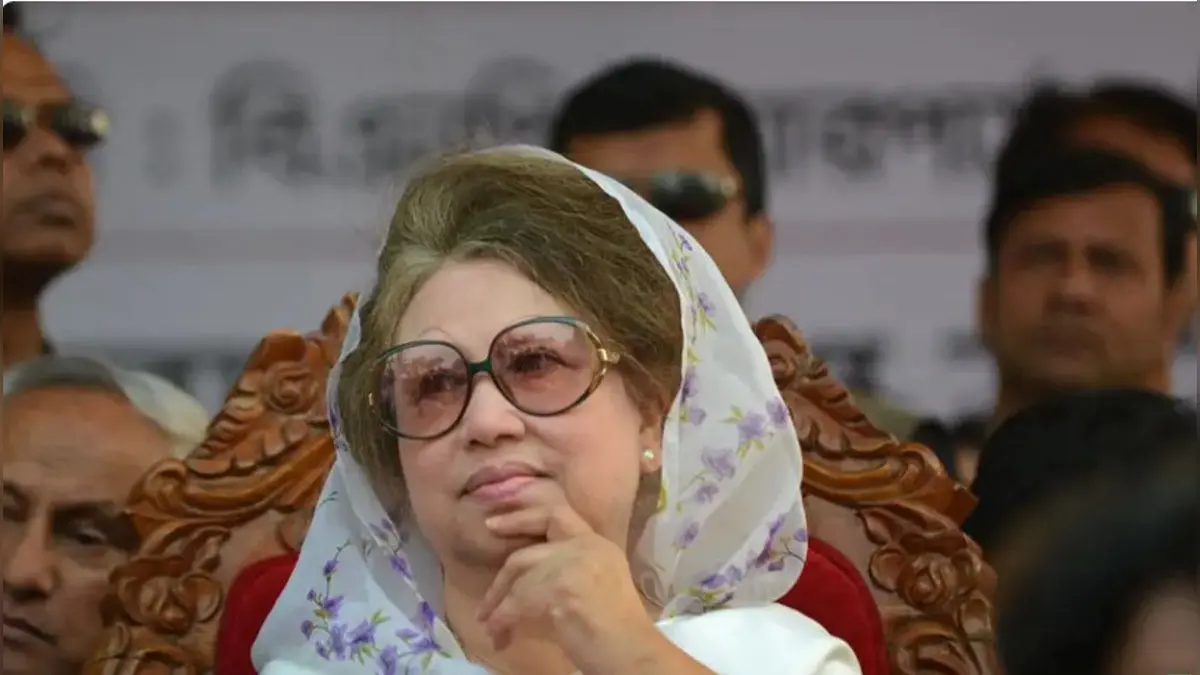
New Delhi: Bangladesh's first female Prime Minister Khaleda Zia breathed her last at 6 am on Tuesday. The stalwart leader who was the chief of the Bangladesh Nationalist Party (BNP) died at the age of 80.
"The BNP Chairperson and former prime minister, the national leader Begum Khaleda Zia, passed away today at 6:00 am, just after the Fajr (dawn) prayer," her party said in a statement.
"We pray for the forgiveness of her soul and request everyone to offer prayers for her departed soul," it added.
Begum Khaleda Zia was receiving treatment at Dhaka's Evercare Hospital where she was admitted for lung infection, ANI reports suggested. She had been "extremely unwell" for the last 36 days and was put on ventilator support. She has been suffering from various physical ailments, including heart disease, diabetes, arthritis, liver cirrhosis, and kidney complications, for a long time. Earlier this month, Zia was also sent to London for advanced medical treatment for her ailments.
Advertisement
Zia, was hospitalised on November 23 when she developed a chest infection that affected both her heart and lungs. Four days later, the three-time Prime Minister was shifted to the coronary care unit after several of her health complications worsened. Both local and international medical specialists were overseeing her treatment.
Zia's son, Tarique Rahman, who had recently returned to Bangladesh after decades also gave a tribute to his mother with a post on X.
Advertisement
Who Was Khaleda Zia?
Khaleda Zia had served as the Prime Minister of Bangladesh for three times since 1991. She was the first woman to be elected to the top post .
Born in 1946 in Jalpaiguri, in the then-undivided Dinajpur District, she was married to Ziaur Rahman, the former military dictator-turned-President of Bangladesh who was assassinated in 1981.
After Ziaur Rahman's death, Khaleda joined the BNP as a general member. She was later elevated to the vice-chairperson of the party in 1983 and then its chairperson a year later. She was credited to be the chief architect of forming a seven-party alliance in 1983 which successfully put an end to the former Chief of the Bangladesh Army General Hussain Muhammad Ershad's rule.
In 1986, Khaleda did not participate in the national elections. Her political rivals, the Awami League, Jamaat-e-Islami and Communist Party of Bangladesh joined the election under Jatiya Party-led rule. In 1991, Khaleda became the country's first woman prime minister through popular vote.
Her Legacy
Khaleda Zia has been credited for introducing the parliamentary form of government in Bangladesh. She had also introduced the system of having a caretaker government system in the country to oversee a free election whenever Bangladesh heads for polls. However, this was rolled back by her political rival, Sheikh Hasina during her tenure, which led to controversies.
Khaleda Zia had also introduced the system of value-added tax (VAT) on goods, had formulated the Bank Company Act in 1991 and the Financial Institutions Act in 1993, and established the privatisation board in 1993. She will also be remembered for her contributions towards making education accessible in her country.
Elected again in February 1996, Khaleda's second term as Prime Minister only lasted for a few weeks. The BNP then formed an opposition alliance in 1999 with the Jatiya Party, the Jamaat-e-Islami, and the Islami Oikya Jote. Zia had launched several campaigns against the Awami League, while in opposition.
Khaleda Zia was re-elected in 2001. This time she had come back to power on the promises of eliminating corruption and terrorism. She stepped down from office in 2006, completing her full term. She was arrested in 2007 on charges of corruption.
After Hasina took over in 2009, Khaleda continued her opposition against her, attacking her her undemocratic policies. With Hasina tightening her grip over the nation's administration, Khaleda was then expelled and put under house arrest twice. Khaleda Zia was honoured as 'Fighter for Democracy' by New Jersey's State Senate in 2011.
What's At Stake At Bangladesh Now
The death of the BNP Chief comes at the backdrop of political turmoil in Bangladesh as the nation heads for its first national elections after Shiekh Hasina's ouster.
Zia's son, Tarique Rahman, who is the Acting Chairman of the party, retured to Dhaka last week after 17 years in exile. According to reports, Rahman is expected to steer the party into the elections, the outcome of which will have a wide imprint across the South Asian region.
Funeral To Be Held On December 31
Khaleda Zia's funeral will be held on December 31. Bangladesh will observe a three days of state mourning and one-day holiday. As per reports, Khaleda Zia will be laid to rest beside her husband, former President Ziaur Rahman.