
Updated 20 February 2025 at 19:37 IST
Germany Elects New Parliamnet on Sunday: Will it Reshape Europe's Response to Trump Administration?
Germany votes on Sunday to elect a new parliament, shaping country's leadership for next four years and influencing Europe's response to Trump administartiom.
- World News
- 4 min read

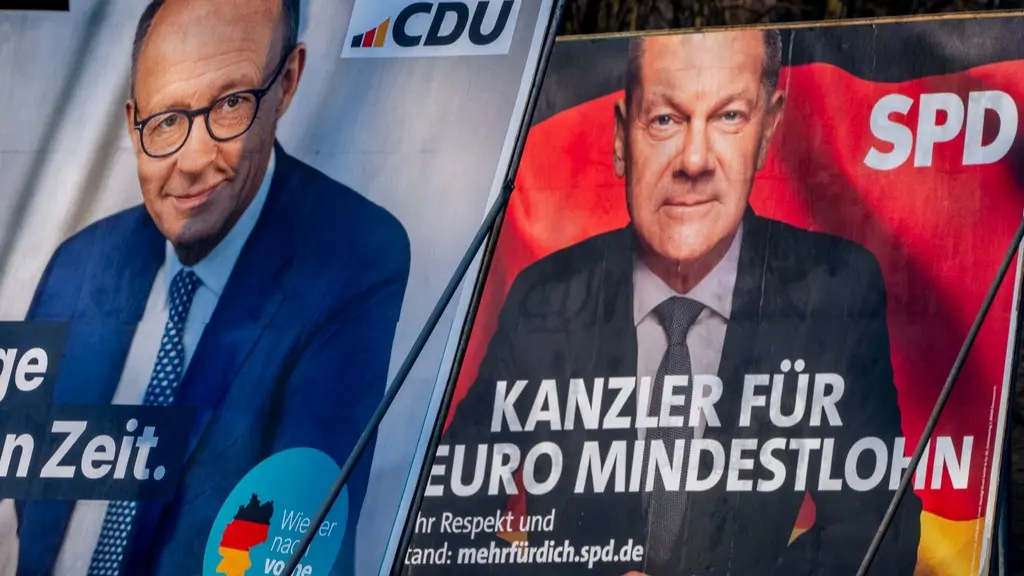
Berlin: Europe's biggest economy, Germany, votes on Sunday to elect a new parliament that will shape the country's leadership for the next four years.
Being the second-largest weapons supplier to Ukraine after the US since Russia's 2022 invasion, Germany will play a key role in Europe's response to a more assertive Trump administration.
Here's what to expect from German elections and the potential outcomes in the coming days.
What Happens on the Day of Election?
Polls in Germany are set to open at 8 a.m. and close at 6 p.m. Voters can also cast their ballots via postal voting, but their ballots must reach the polling stations by the close of voting on election day to be counted.
Advertisement

Exit polls will be released shortly after voting concludes, with vote-counting beginning immediately. The general outcome should become clear quickly, and the final official result is expected by early Monday.
From Olaf Scholz to Far-Right Weidel: Meet the Key Contenders
Four candidates are vying for the position of Germany’s next leader: incumbent Chancellor Olaf Scholz from the center-left Social Democrats, Friedrich Merz of the conservative Christian Democratic Union (CDU), current Vice Chancellor Robert Habeck from the environmentalist Greens, and Alice Weidel from the far-right, anti-immigration Alternative for Germany (AfD).
Advertisement
Pre-election polls show Merz’s CDU bloc leading with about 30% support, followed by AfD with around 20%. Scholz’s Social Democrats and Habeck’s Greens are trailing behind in the polls.
Merz is currently the frontrunner to replace Scholz as chancellor, but the formation of a new government remains uncertain. The ease of forming a coalition will largely depend on the number of parties that make it into parliament, with opinion polls indicating three parties just reaching the 5% threshold required to win seats.
Center-left Social Democrats, conservative party have said that they won’t work with Alternative for Germany (AfD).
What to Expect After Polls Close
Germany’s electoral system rarely results in any single party securing an absolute majority, and current opinion polls indicate no party is close to achieving one this time. With no tradition of minority governments at the national level, it’s highly likely that two or more parties will need to form a coalition.
The process of forming a new government is not overseen by any formal referee, and there is no set deadline. After the election, parties engage in exploratory talks to identify potential partners with whom they share common ground, leading to formal coalition negotiations.
These negotiations generally result in a detailed coalition agreement, outlining the new government’s agenda. The agreement typically requires approval from the conventions of the parties involved, and in some cases, it may be put to a vote by the parties' entire membership.
After all the processes are done with, the Bundestag can elect the new chancellor.
Germany's Role in Europe's Response to Trump Administration
A strong German government is crucial for Europe’s response to the new U.S. administration and the ongoing turmoil in Ukraine and other regions. Germany's leadership will play a pivotal role in shaping Europe's future direction amid global challenges.
Germany and neighboring France have long been the driving forces behind the EU, but both countries have recently been plagued by domestic political instability. This has left a leadership vacuum that needs to be addressed.
Friedrich Merz, if he wins, has expressed hopes to form a new government by mid-April. Until then, Chancellor Scholz’s outgoing government will remain in office on a caretaker basis, with the Bundestag set to elect a new chancellor.
This election has been moved forward by seven months, as Scholz’s three-party coalition collapsed in November over disagreements on how to revive the economy, which has been shrinking for the past two years.
(with AP inputs)
Published By : Snehal Jaiswal
Published On: 20 February 2025 at 19:37 IST