
Greece puts faith in remote schooling during lockdown
All Greek schooling and university classes are now online, abandoning an earlier model that used remote learning only as a supplementary tool.
- World News
- 3 min read

;'%3e%3cpath%20d='m8,15.99c4.41,0,7.99-3.58,7.99-7.99S12.41,0,8,0,0,3.59,0,8s3.58,7.99,7.99,7.99Z'%20style='stroke:%23fff;%20stroke-miterlimit:10;%20stroke-width:.02px;'/%3e%3cpath%20d='m3.08,3.37l3.82,5.11-3.84,4.15h.87l3.37-3.64,2.72,3.64h2.94l-4.04-5.39,3.58-3.87h-.86l-3.1,3.35-2.5-3.35h-2.94Zm1.27.64h1.35l5.97,7.99h-1.35l-5.97-7.99Z'%20style='fill:%23fff;'/%3e%3c/g%3e%3c/svg%3e)


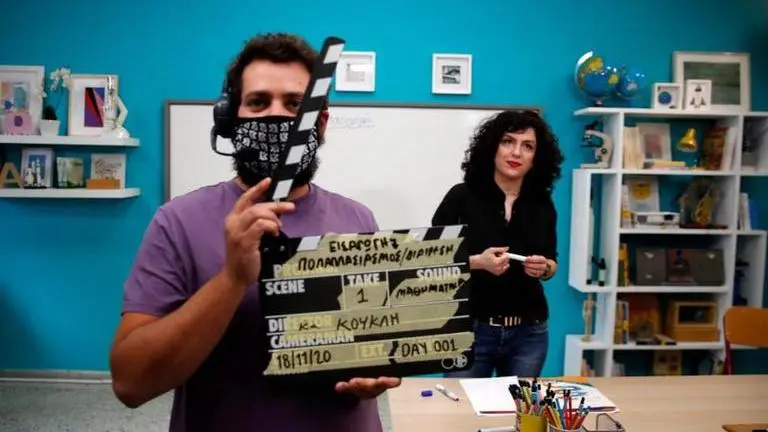
Instead of waiting for the school bell to ring, grade school teacher Rania Koukli now waits for a clapper board to start her class. Koukli is one of the teachers recruited to film a series of lessons in empty classrooms. They're broadcast on public television as part of the government's drive to shift education online to cope with an alarming rise in COVID-19 infections.
All Greek schooling and university classes are now online, abandoning an earlier model that used remote learning only as a supplementary tool. Teachers hold classes live in empty classrooms or from home, or use class-recorded programs on state television.
A series of about 200 episodes for primary school students on a range of topics from languages to maths and history were filmed during the first lockdown in the spring. New episodes began filming when elementary schools shut on Nov. 16. Classrooms have been converted to studios.
Lights, cameras and monitors fill the space normally occupied by desks, chairs and students. The episodes air in the morning before online classes, which start midday for primary school students. The lessons mean that ratings on a seldom-watched state television channel have skyrocketed to rival popular talk shows and live sporting events.
Advertisement
The priority for most European Union governments has been to keep schools running through the winter, typically just using online material for middle-schoolers or to help reduce crowding. But Greek policymakers say the shutdown reduces daily movement for an estimated 2.3 million people - children, teachers and parents - out of a population of 10.7 million, providing a vital pause for the overwhelmed state-run health system.
The pandemic has hit Greece hard in recent weeks following a successful lockdown in the spring. Daily infection levels in November are up to 30 times more than the previous peak recorded in April, based on rolling average data, and the fatality rate is currently about 15 times higher.
Advertisement
The overnight project to modernize its education system with online classes has been a challenge for the government, but Education Minister Niki Kerameus said she believed the positive effects would be long-lasting. However, the jump to online learning in a country lagging behind the EU average in use of online services has not been without problems.
An online platform used for live lessons suffered crashes in the first days it was used, and some households with more than one child reported bandwidth problems or lacked the necessary number of networked devices. Through it all, teachers try their best to keep children interested.
At Ioanna Kabouri's school, two teachers put on a show and let the puppets, Jo the hedgehog and Joo the squirrel, greet their preschool students but the desks in front of them are all empty with the children watching them live from home instead. Eleni Vasilopoulou, mother of four-and-a-half-year-old twins Marina and Panos said her kids were thrilled with their online courses. A second nationwide lockdown was imposed earlier this month until the end of November but the government extended it until Dec. 7 on Thursday.
(Image Credits: AP)