
‘Guardian of Transition’: Bangladesh Interim Chief Adviser Yunus Casts Ballot in Historic Poll
Bangladesh's interim Chief Adviser, Professor Muhammad Yunus, voted in the 13th General Election and nationwide referendum, symbolizing democratic transition after years of political unrest.
- World News
- 3 min read

;'%3e%3cpath%20d='m8,15.99c4.41,0,7.99-3.58,7.99-7.99S12.41,0,8,0,0,3.59,0,8s3.58,7.99,7.99,7.99Z'%20style='stroke:%23fff;%20stroke-miterlimit:10;%20stroke-width:.02px;'/%3e%3cpath%20d='m3.08,3.37l3.82,5.11-3.84,4.15h.87l3.37-3.64,2.72,3.64h2.94l-4.04-5.39,3.58-3.87h-.86l-3.1,3.35-2.5-3.35h-2.94Zm1.27.64h1.35l5.97,7.99h-1.35l-5.97-7.99Z'%20style='fill:%23fff;'/%3e%3c/g%3e%3c/svg%3e)


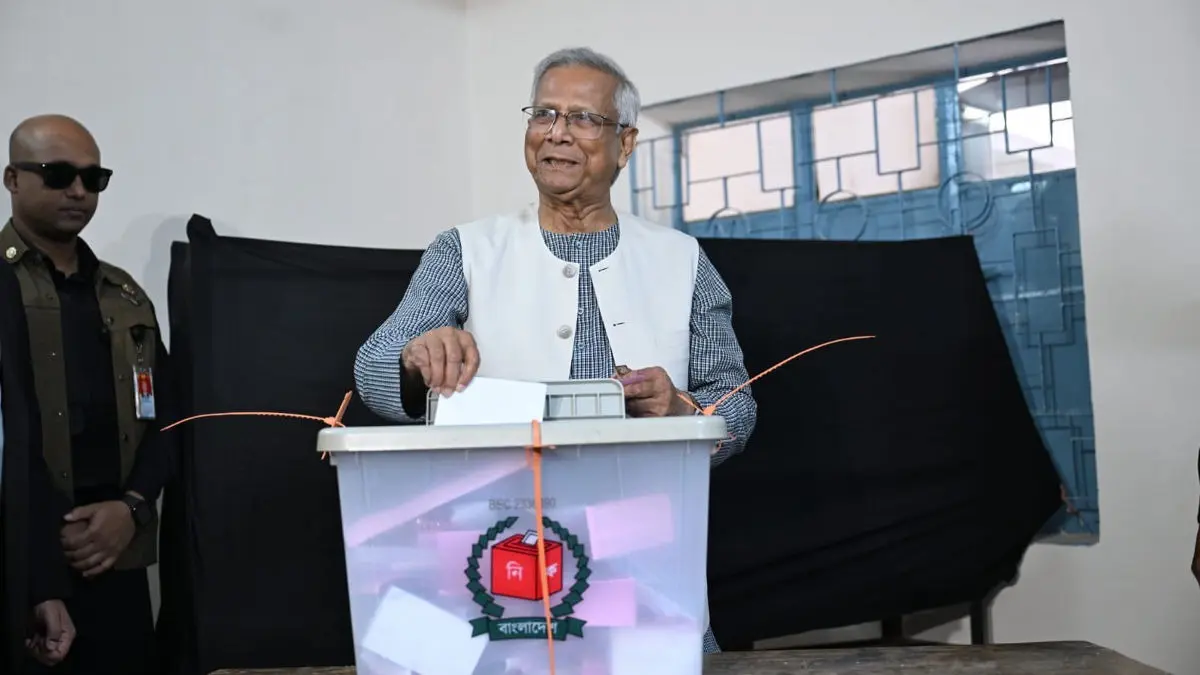
Dhaka: In a rare moment in global politics, Bangladesh’s interim Chief Adviser Professor Muhammad Yunus cast his vote Thursday in 13th General Election and nationwide referendum whose outcome he will not govern, a striking symbol of democratic transition in a country emerging from years of political turbulence.
The Nobel laureate, tasked only with overseeing the restoration of an elected government, arrived at the Gulshan Model School and College polling centre in Dhaka at around 10:25 a.m., where he quietly joined voters in line and cast his ballot in the 13th General Election and the referendum on the July National Charter.
Unlike most leaders who vote while seeking power or defending it, Yunus is presiding over a process designed to end his own administration. As interim head of government since August 2024, he has defined his role repeatedly as that of an “interim guardian of transition”, whose mandate extends only to stabilisation, reform, and ensuring that the country steps back into electoral democracy with integrity.
The election marks the first nationwide vote since the political upheaval which brought an end to former Prime Minister Sheikh Hasina’s 15-year rule and ushered in Yunus’s caretaker administration. For millions of voters, his appearance at the polling station served as a visual assurance that the transition process - long demanded by protesters and civil society groups had reached its decisive phase.
Advertisement
Across Bangladesh, polling stations opened early under tight security, with authorities deploying large numbers of security personnel to ensure peaceful voting.
Twin Ballots: Election and Referendum
What sets this election apart is its dual nature. Citizens are not only choosing members of parliament but also voting in a referendum on July National Charter - a set of ambitious constitutional reforms, if approved by voters, would mandate sweeping institutional changes including the creation of a bicameral legislature, limits on prime ministerial tenure, and constitutional recognition of the 2024 uprising.
Advertisement
Political Context and Contenders
This election also marks a turning point in Bangladesh’s competitive political landscape. The Bangladesh Nationalist Party (BNP), now led by Tarique Rahman, returned from years of exile and emerged as the frontrunner in an intensely contested race. Rahman, a polarising figure with deep roots in Bangladesh’s political history, has vowed to usher in an era of “clean politics” and break from the country’s past patterns of corruption and authoritarianism should his party secure a majority.
Other major contestants include an 11-party coalition led by Islamist party Jamaat-e-Islami, which has also gained traction after being re-legalised following political reforms. This coalition’s rise has sparked debate and concern among civil society groups and minority communities, particularly over issues of religious tolerance and civil liberties.
What Next for Muhammad Yunus?
Yunus, who has repeatedly described his administration as temporary rather than a governing authority, has urged citizens to vote responsibly and peacefully. After the Election Commission finalizes results, his priority will be a peaceful power transfer to the new government, while ensuring stability amid competing political forces like the BNP and Jamaat-e-Islami.
Polling is scheduled to continue until late afternoon, after which ballots will be counted under the supervision of election authorities and observers. Results from both the parliamentary races and the referendum are expected to determine not only who governs Bangladesh next but also how the country will be governed in the years ahead.