
How China is Quietly Cushioning Iran?
For China, Iran is not just another diplomatic partner - it is a strategic linchpin. Tehran sits at the heart of the Belt and Road Initiative, connecting Asia to Europe through critical land and maritime corridors.
- World News
- 6 min read

;'%3e%3cpath%20d='m8,15.99c4.41,0,7.99-3.58,7.99-7.99S12.41,0,8,0,0,3.59,0,8s3.58,7.99,7.99,7.99Z'%20style='stroke:%23fff;%20stroke-miterlimit:10;%20stroke-width:.02px;'/%3e%3cpath%20d='m3.08,3.37l3.82,5.11-3.84,4.15h.87l3.37-3.64,2.72,3.64h2.94l-4.04-5.39,3.58-3.87h-.86l-3.1,3.35-2.5-3.35h-2.94Zm1.27.64h1.35l5.97,7.99h-1.35l-5.97-7.99Z'%20style='fill:%23fff;'/%3e%3c/g%3e%3c/svg%3e)


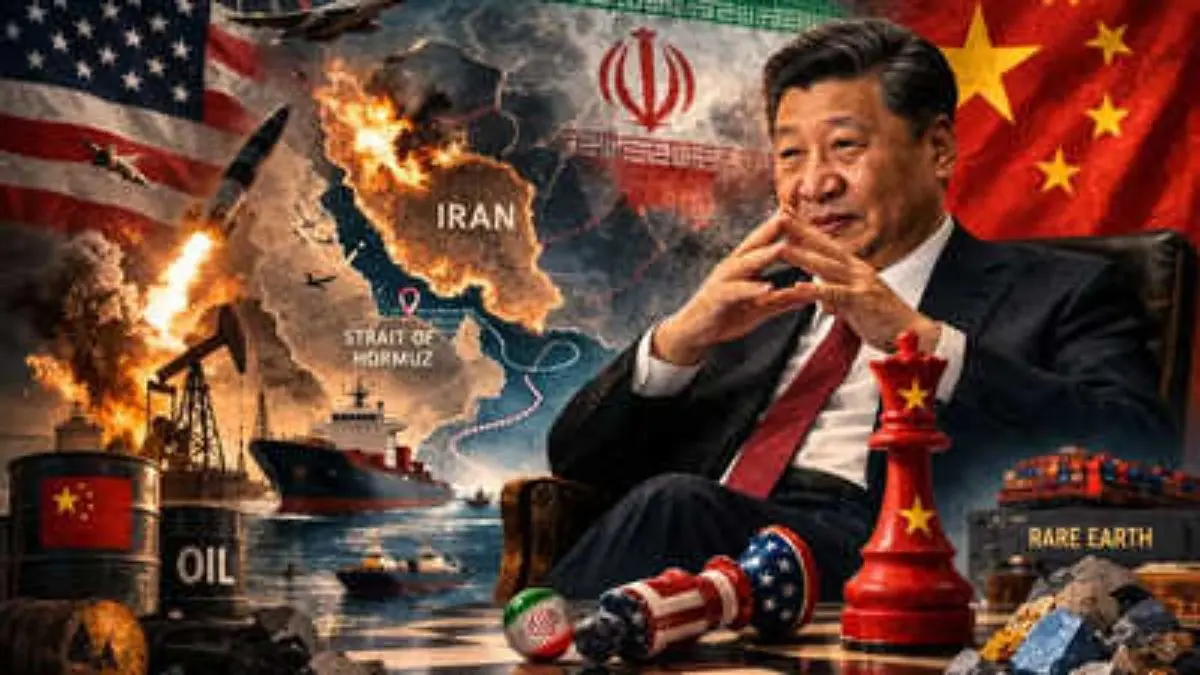
There is a silent war unfolding in the Middle East - one that does not always make headlines, does not involve tanks rolling across borders, and yet may determine the balance of power for decades to come. At the heart of this shadow contest lies an unlikely axis of cooperation: China and Iran. While global discourse remains obsessed with the visible confrontation between Iran and Israel, the real story is far more nuanced, far more strategic, and far more consequential. Beijing is not merely watching events unfold - it is actively shaping them, quietly cushioning Tehran from systemic vulnerability and ensuring that Iran does not collapse under the combined pressure of sanctions, sabotage, and strategic isolation.
At the centre of this silent intervention is one of China’s most secretive intelligence arms - the Ninth Bureau of the Ministry of State Security. Unlike conventional intelligence agencies that operate through overt geopolitical signalling, this bureau functions in the shadows, focusing on counter-espionage, cyber defence, and the protection of strategic assets. Its primary mandate is to monitor and neutralise foreign intelligence operations, particularly those linked to the United States and Israel.
In the Middle East, its role has expanded significantly, with a clear focus on safeguarding Chinese investments and ensuring that key partners like Iran remain insulated from destabilising intelligence penetrations. The target of much of this activity is the highly capable Mossad, whose operations inside Iran have historically exposed vulnerabilities in Tehran’s security architecture. China’s response has not been loud, but it has been methodical - building layers of defence that make such operations increasingly difficult and costly.
For China, Iran is not just another diplomatic partner - it is a strategic linchpin. Tehran sits at the heart of the Belt and Road Initiative, connecting Asia to Europe through critical land and maritime corridors. More importantly, Iran’s geographical position near the Strait of Hormuz gives it enormous leverage over global energy flows, a factor Beijing cannot afford to ignore. At a time when China seeks to reduce its dependence on Western-controlled supply chains and energy markets, Iran offers both a solution and an opportunity. Discounted oil, strategic geography, and a shared resistance to Western pressure make Iran indispensable to China’s long-term ambitions. A weakened or destabilised Iran would not just be a regional setback - it would be a strategic failure for Beijing’s global vision.
Advertisement
This is precisely why China has moved beyond traditional diplomacy into the realm of operational support. The Ninth Bureau has increasingly engaged in intelligence sharing with Iranian agencies, offering insights into foreign infiltration networks and helping Tehran plug critical gaps in its counter-intelligence framework. More importantly, China is believed to be providing advanced technological systems - from cyber defence platforms to surveillance networks - that enhance Iran’s ability to detect and deter covert operations. These are not symbolic gestures; they are practical tools that directly impact Iran’s ability to defend its nuclear facilities, military installations, and critical infrastructure. By strengthening Iran’s internal security mechanisms, China is effectively raising the cost of every foreign operation conducted on Iranian soil.
China’s strategy, however, is not limited to Iran alone. It extends westward into Egypt, creating a broader regional architecture designed to protect Chinese interests. Egypt’s strategic importance lies in its control of the Suez Canal and its role as a gateway between Africa, the Middle East, and Europe. By enhancing intelligence coordination with Cairo, China ensures that its Belt and Road investments remain secure while simultaneously limiting the reach of Israeli and Western intelligence networks in the region. This dual-layered approach - strengthening both Iran and Egypt - creates a buffer zone that protects Chinese economic and strategic interests from multiple directions. It is not an alliance in the traditional sense, but rather a carefully constructed web of interdependence.
Advertisement
Perhaps the most intriguing aspect of China’s strategy is its ability to operate within Israel itself while simultaneously countering Israeli intelligence elsewhere. Chinese investments in infrastructure projects in cities like Haifa and Tel Aviv highlight Beijing’s pragmatic approach to geopolitics. China is not interested in ideological alignments; it is interested in strategic advantage. The same Ninth Bureau that works to counter Mossad operations in Iran is also tasked with protecting Chinese technological assets within Israel from scrutiny and potential compromise by both Israeli and American agencies. This duality is not contradictory - it is emblematic of China’s broader geopolitical philosophy, which prioritises flexibility, discretion, and long-term gain over short-term alliances.
Beyond intelligence and surveillance, China’s most significant contribution to Iran may well lie in the realm of technology transfer. In modern warfare and statecraft, resilience is built not just through military strength but through systems - secure communications, advanced monitoring capabilities, and robust cybersecurity frameworks. China has emerged as a global leader in these domains, and its willingness to share elements of this expertise with Iran is a game-changer. By equipping Iran with the tools needed to protect its infrastructure and anticipate threats, Beijing is enabling Tehran to transition from reactive defence to proactive resilience. This shift fundamentally alters the strategic equation, making Iran a far more difficult target for external disruption.
At a broader level, China’s actions send a clear message to the United States. Beijing is demonstrating that it has both the capability and the willingness to operate within regions traditionally dominated by American influence. By supporting Iran, China is not just safeguarding its own interests - it is challenging the existing geopolitical order. It is signalling that the era of unipolar dominance is over and that new centres of power are willing to assert themselves in subtle but significant ways. Iran, in this context, becomes more than just a partner; it becomes a proving ground for China’s ability to project influence beyond its immediate neighbourhood.
What emerges from this evolving dynamic is not a formal alliance but a relationship defined by mutual necessity. Iran needs China for economic stability, technological advancement, and strategic backing. China needs Iran for energy security, regional leverage, and the ability to counterbalance Western influence. This convergence of interests creates a durable, if understated, partnership that is likely to shape the future of the Middle East in profound ways.
The real story, therefore, is not just about conflict - it is about control. Control over information, control over infrastructure, and control over the unseen mechanisms that define modern power. China understands that the most decisive battles are no longer fought on open battlefields but in the shadows, within networks, systems, and intelligence frameworks. By embedding itself within Iran’s strategic architecture, Beijing is not merely cushioning Tehran - it is redefining the very nature of geopolitical competition. And in doing so, it is ensuring that the balance of power in the Middle East will no longer be dictated solely by those who operate in the open, but increasingly by those who master the art of the unseen.