
In Jerusalem, unearthed ceramic jars may belong to 1000 -year-old hand grenade, says study
Archaeologists have discovered traces from the inner surface of an antique ceramic shard that probably belonged to a 1000-year-old hand grenade in Jerusalem
- World News
- 3 min read

;'%3e%3cpath%20d='m8,15.99c4.41,0,7.99-3.58,7.99-7.99S12.41,0,8,0,0,3.59,0,8s3.58,7.99,7.99,7.99Z'%20style='stroke:%23fff;%20stroke-miterlimit:10;%20stroke-width:.02px;'/%3e%3cpath%20d='m3.08,3.37l3.82,5.11-3.84,4.15h.87l3.37-3.64,2.72,3.64h2.94l-4.04-5.39,3.58-3.87h-.86l-3.1,3.35-2.5-3.35h-2.94Zm1.27.64h1.35l5.97,7.99h-1.35l-5.97-7.99Z'%20style='fill:%23fff;'/%3e%3c/g%3e%3c/svg%3e)


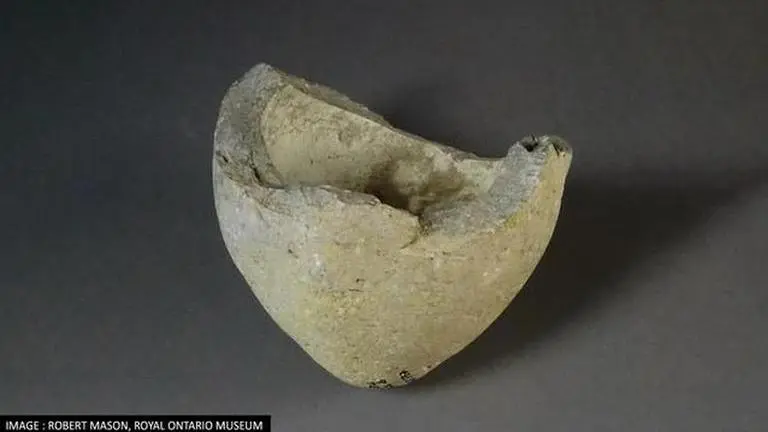
In a recent analysis, archaeologists have uncovered traces from the inner surface of an antique ceramic shard that probably belonged to a '1000-year-old' hand grenade. As per latest research, the historic ceramic jars are expected to be from the 11th-12th centuries in Jerusalem which might have been used as hand grenades. According to a Sky News report, four shards have been discovered in Jerusalem's Armenian Garden, which was once home to an ancient royal palace, where archaeologists have uncovered a huge number of Byzantine artefacts.
Further, this new study, headed by Griffith University's Associate Professor Carney Matheson, found that some of the ceramic jars did indeed carry oils and medications and that some of them carried scented oils. His observations, however, revealed that several of the containers contained a combustible and likely explosive element, indicating that they were formerly employed as ancient hand grenades, according to a Griffith News report.
In addition to this, the Byzantine Empire was known to deploy early thermal weaponry based on the development of a flammable compound known as 'Greek fire,' which was used to set fire to enemy ships and was thought to be based on naphtha and quicklime, Sky News reported. Byzantine warriors would load the mixture into stone, ceramic, and subsequently, glass vessels to produce medieval grenades to target their opponents even before gunpowder was invented in China.
Explosive substance within containers may have been locally manufactured: Researchers
According to a Griffith News report, the Associate Professor Matheson of the University's Australian Research Centre for Human Evolution stated that the explosive substance that he examined within the containers may have been a locally manufactured ancient explosive. He clarified, “This research has shown the diverse use of these unique ceramic vessels which include ancient explosive devices”.
Advertisement
Matheson went on to say that during the Crusades, these vessels were described as grenades launched at Crusader castles, causing loud sounds and blinding flashes of light. He added, “Some researchers had proposed the vessels were used as grenades and held black powder, an explosive invented in ancient China and known to have been introduced into the Middle East and Europe by the 13th century,” Griffith News reported. Black powder may have been imported to the Middle East earlier, as early as these containers from the 9th-11th centuries, according to certain theories.
However, the Professor has said, “This research has shown that it is not black powder and likely a locally invented explosive material.”
Advertisement
Furthermore, the analysis also indicated that some of these ceramic jars had been sealed with resin, Professor Matheson noted.
(Image: Rober Manson, Royal Ontario Museum)