
India’s ‘Told You So Moment’: FATF Report Confirms India’s Claim That Pakistan Sponsors Global Terrorism
The FATF report exposes the sophisticated mechanisms through which Pakistan-based terror groups sustain their operations.
- World News
- 5 min read

;'%3e%3cpath%20d='m8,15.99c4.41,0,7.99-3.58,7.99-7.99S12.41,0,8,0,0,3.59,0,8s3.58,7.99,7.99,7.99Z'%20style='stroke:%23fff;%20stroke-miterlimit:10;%20stroke-width:.02px;'/%3e%3cpath%20d='m3.08,3.37l3.82,5.11-3.84,4.15h.87l3.37-3.64,2.72,3.64h2.94l-4.04-5.39,3.58-3.87h-.86l-3.1,3.35-2.5-3.35h-2.94Zm1.27.64h1.35l5.97,7.99h-1.35l-5.97-7.99Z'%20style='fill:%23fff;'/%3e%3c/g%3e%3c/svg%3e)


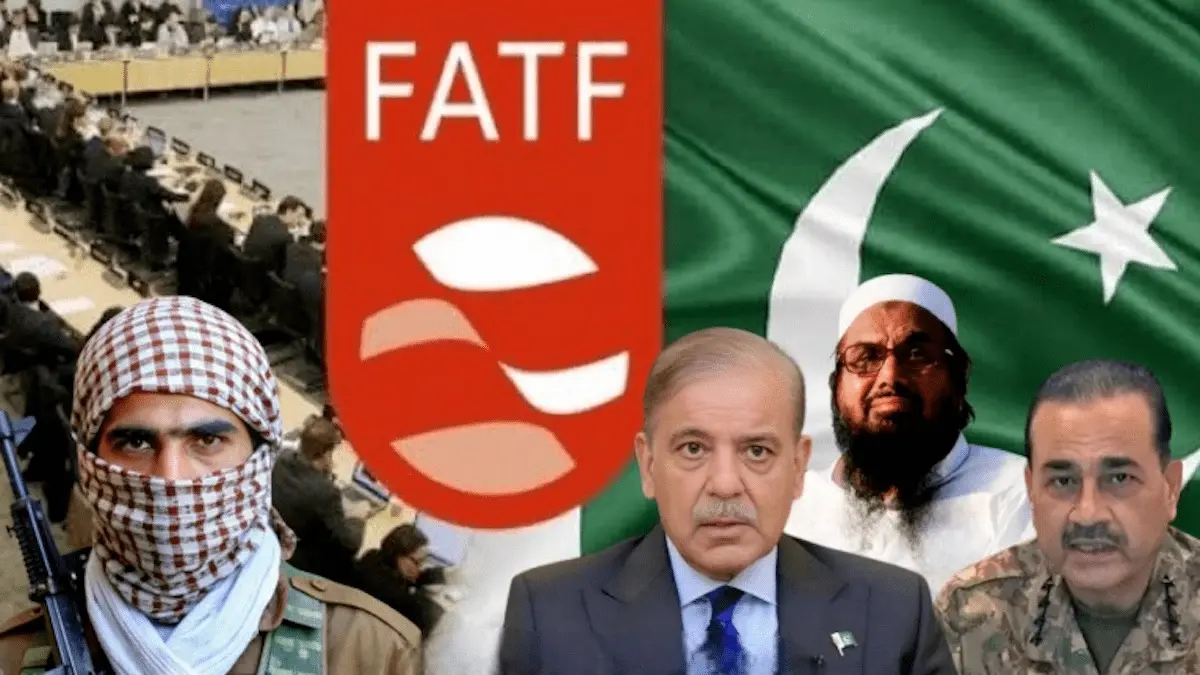
Islamabad: For years, India has been the lone voice in the wilderness, warning the world about Pakistan’s role as a breeding ground for terrorism. The Financial Action Task Force’s (FATF) 2025 report is India’s resounding “told you so” moment, as it unequivocally validates New Delhi’s long-standing claims. By identifying state-sponsored terrorism as a critical threat to the global financial system, the FATF has thrust Pakistan’s complicity into the spotlight, spotlighting its sheltering of UN-designated terrorists like Hafiz Saeed, Masood Azhar, and Dawood Ibrahim. This is not just a vindication for India, it’s a wake-up call for the world to finally act.
While stopping short of explicitly naming Pakistan, the report’s pointed references to terrorist groups like Lashkar-e-Taiba (LeT) and Jaish-e-Mohammed (JeM)—both of which operate with impunity from Pakistani soil—leave little room for ambiguity.
This marks a pivotal moment in the global fight against terrorism, as the FATF’s findings align closely with India’s warnings about Pakistan’s illicit financial networks, sham charities, and state-backed terror infrastructure.
What the FATF Report stated objectively
The FATF report exposes the sophisticated mechanisms through which Pakistan-based terror groups sustain their operations. It highlights how “sham non-profit organisations (NPOs)” are established under the guise of charitable causes to raise, store, and move funds for terrorist activities. Specifically, the report notes that groups like JeM and LeT, both linked to Al-Qaeda, exploit humanitarian donation programs to divert funds for operational purposes, a tactic previously employed by entities like Al-Rashid Trust and Al Furqan.
Advertisement
The FATF further details how these groups leverage social media, crowdfunding platforms, and direct messaging to solicit donations, often from unwitting donors, which are then funneled through banks, unlicensed money transfer services, and even virtual assets to conflict zones.
The report’s findings echo India’s long-standing evidence, particularly in the context of the 2019 Pulwama attack, where a JeM-orchestrated suicide bombing killed 40 Indian security personnel. The FATF confirms India’s investigation, noting the cross-border movement of explosives and the use of materials like aluminum powder, procured via platforms like Amazon, to enhance the attack’s impact. This acknowledgment of cross-border terror financing directly implicates Pakistan, as the report underscores how terrorist organizations receive “financial and other forms of support from several national governments.”
Advertisement
Pakistan’s Grey List Legacy: A Pattern of Complicity
Pakistan’s repeated FATF Grey List placements in 2008, 2012–2015, and 2018–2022 reflect its persistent failure to combat money laundering and terror financing, particularly involving UN-designated groups like LeT and JeM. The 2018 listing curbed Pakistan’s access to global financial institutions like the IMF and World Bank. Despite its 2022 removal, India’s Arindam Bagchi warned Pakistan must take credible action against terrorism. The FATF’s 2025 report suggests Pakistan’s progress remains superficial.
India’s Warnings Validated
India has long pressed the world to scrutinize Pakistan’s terror links, especially after the 2019 Pulwama and 2024 Pahalgam attacks, which killed 26. Post-Pahalgam, India’s Operation Sindoor targeted a JeM camp in Muridke, and delegations to 32 countries exposed Pakistan as a terror haven. Leaders like Rajnath Singh warned that Pakistan may divert aid, like the $7 billion IMF loan (July 2024) and $1 billion bailout (May 2025), to terrorism. The FATF’s 2025 report confirms these concerns, highlighting Pakistan’s sham NPOs and hawala networks, run by the Islamic State’s Maktab al-Siddiq, funding attacks across South Asia.
Pakistan’s Denial in the Face of Evidence
Pakistan’s denials of terrorism ties are crumbling. Former Foreign Minister Hina Rabbani Khar’s claim that a viral image of terrorist Abdul Rauf’s funeral—attended by senior Pakistan Army officers—was a case of mistaken identity was debunked when the Army confirmed his identity, matching the US sanctions list. Punjab Assembly Speaker Malik Muhammad Ahmad Khan and Food Minister Malik Rasheed Ahmad Khan were seen with LeT-linked figures, including Hafiz Saeed’s son, Talha Saeed, blurring lines between Pakistan’s establishment and terror groups. Past leaders like Pervez Musharraf admitted to training LeT, while Imran Khan, Khawaja Asif, and Bilawal Bhutto acknowledged Pakistan’s history of harboring terrorists. Osama bin Laden’s hideout near the Pakistan Military Academy in Abbottabad further exposed this complicity.
A Global Call to Action
The FATF’s damning findings expose Pakistan’s playbook: sham charities, illicit financial networks, and state-backed terror groups like Lashkar-e-Taiba (LeT) and Jaish-e-Mohammed (JeM) thriving under its protection. The report’s revelation of misused humanitarian aid, corroborated by PPP leader Bilawal Bhutto’s admission of misappropriated $400 million in World Bank flood relief funds, underscores Pakistan’s betrayal of global trust. India has long cautioned that financial aid—be it the IMF’s $7 billion loan in 2024 or the Asian Development Bank’s $500 million package—risks being funneled into Pakistan’s terror machinery. The FATF’s report proves India was right all along.
Indian leaders like Shashi Tharoor and Priyanka Chaturvedi have repeatedly stressed that Pakistan’s terrorism is not just India’s burden but a global menace. Operation Sindoor, India’s precision strike on a JeM camp in Muridke, was a bold assertion of this truth. The FATF’s acknowledgment of state-sponsored terror financing, including the cross-border mechanics of attacks like Pulwama, confirms what India has been shouting from the rooftops: Pakistan’s denials are a sham, and its establishment is complicit. From senior army officers attending terrorists’ funerals to Punjab ministers sharing stages with LeT-linked figures, the evidence is undeniable.
The world can no longer turn a blind eye. The IMF, World Bank, and Asian Development Bank must tighten scrutiny to ensure their funds don’t fuel violence. The FATF’s report is a turning point, handing the international community a mandate to hold Pakistan accountable. For India, this is more than validation—it’s a call to double down on its relentless fight against terrorism. Pakistan’s days of dodging accountability are over. The world is finally listening, and India’s warnings have been proven right.