
Iran Allows 2 Indian Tankers To Pass Through Strait Of Hormuz After Jaishankar Dials Tehran
Iran allows India-bound vessels, Pushpak and Parimal, to transit the Strait Of Hormuz after talks between External Affairs Minister S Jaishankar and his Iranian counterpart Abbas Araghchi, even as shipping from the US, Europe and Israel faces restrictions amid the escalating Iran-Israel-US war.
- World News
- 5 min read

;'%3e%3cpath%20d='m8,15.99c4.41,0,7.99-3.58,7.99-7.99S12.41,0,8,0,0,3.59,0,8s3.58,7.99,7.99,7.99Z'%20style='stroke:%23fff;%20stroke-miterlimit:10;%20stroke-width:.02px;'/%3e%3cpath%20d='m3.08,3.37l3.82,5.11-3.84,4.15h.87l3.37-3.64,2.72,3.64h2.94l-4.04-5.39,3.58-3.87h-.86l-3.1,3.35-2.5-3.35h-2.94Zm1.27.64h1.35l5.97,7.99h-1.35l-5.97-7.99Z'%20style='fill:%23fff;'/%3e%3c/g%3e%3c/svg%3e)


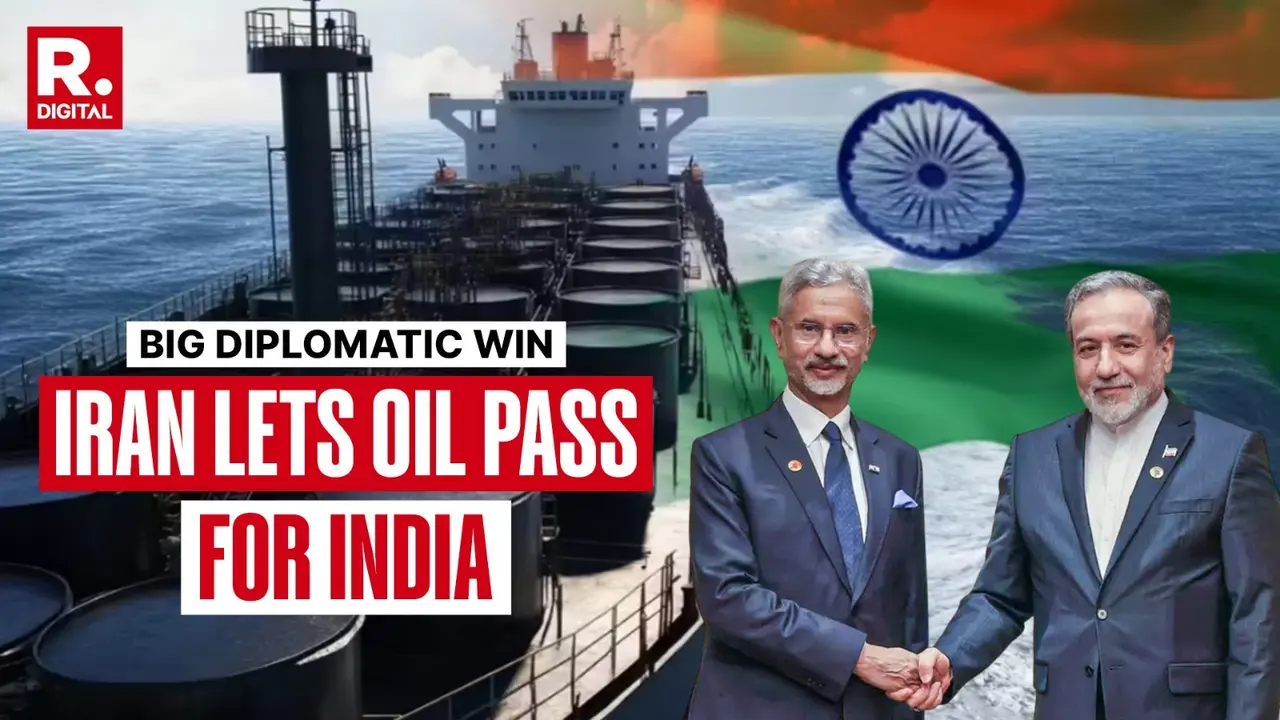
New Delhi: In a major relief for New Delhi amid mounting global energy concerns, Iran has allowed two India-flagged oil tankers to safely pass through the Strait of Hormuz. The breakthrough reportedly came following diplomatic intervention by External Affairs Minister S Jaishankar with his Iranian counterpart Abbas Araghchi.
The development comes at a time when maritime traffic through the crucial global energy corridor has largely stalled amid the escalating war involving Iran, Israel and the United States.
The two Indian oil tankers, Pushpak and Parimal, are currently reported to be transiting the Strait safely. Their passage comes even as vessels linked to the US, Europe and Israel continue to face restrictions amid heightened tensions.
In another related development, a Liberia-flagged tanker carrying Saudi crude and captained by an Indian successfully crossed the Strait two days ago and has since berthed at the port of Mumbai. It is believed to be the first India-bound vessel to safely navigate the Strait since maritime traffic in the region was severely disrupted following recent attacks on Iran by the US and Israel.
Advertisement
The diplomatic engagement reflects New Delhi’s efforts to maintain stable relations across competing blocs in West Asia while safeguarding India’s critical energy interests.
‘Take Permission Or Become A Target’: Iran's Warning
Advertisement
Earlier, the commander of Iran's Islamic Revolutionary Guards Corps' (IRGC) Naval Force said that vessels seeking to sail through the strategically critical Strait of Hormuz must obtain Iran's approval; otherwise, they could become targets of Iranian attacks.
Rear Admiral Alireza Tangsiri said that two ships that had ignored Iran's warnings were targeted in the Strait on Wednesday.
"Were the ships assured of safe passage through the Strait of Hormuz? This should be asked of the crews of the vessels Express Rome and Mayuree Naree, who today, trusting in empty promises, ignored the warnings and intended to cross the Strait, but were caught. Any vessel intending to pass must obtain permission from Iran," the Iranian general said in a post on X.
According to Iranian state media, Iran intensified its restrictions on the passage of ships through the Strait of Hormuz and Tehran has said that vessels not serving the interests of the United States and Israel can sail through safely through the strait.
Strait Of Hormuz Traffic Disrupted Amid War Tensions
Shipping movement through the Strait of Hormuz has come under severe strain as tensions escalate following military exchanges involving Iran, Israel and the United States. Reports indicate that Iran has tightened monitoring and restrictions across the waterway, effectively slowing or halting the passage of many international vessels.
Several global shipping companies have either delayed voyages or rerouted vessels amid fear of attacks, seizures or military escalation in the narrow shipping corridor.
The situation has raised concerns in global energy markets as prolonged disruption in the waterway is triggering sharp spike in oil prices and supply shocks across Asia and Europe.
Why The Strait Of Hormuz Matters
The Strait of Hormuz is widely regarded as one of the most strategically important maritime chokepoints in the world. Located between Iran and Oman, the narrow passage connects the Persian Gulf to the Gulf of Oman and the Arabian Sea.
More than 20 million barrels of crude oil pass daily through the narrow channel separating the Iranian coast from Oman. That volume represents roughly a fifth of global oil consumption and nearly a quarter of all seaborne oil trade. A significant share of the world's liquefied natural gas also moves through the same passage. When that flow falters even briefly, the consequences cascade across financial markets, supply chains and household budgets around the world.
For India, which imports more than 80 per cent of its crude oil requirements, the waterway is a critical energy lifeline. A significant portion of the country’s oil imports from West Asian suppliers must transit through this route before reaching Indian ports.
Any disruption in the Strait has immediate implications for India’s energy security, freight costs and domestic fuel prices.
Rising Tensions In West Asia
The current disruption comes against the backdrop of an intensifying confrontation involving Iran, Israel and the United States. The war intensified after coordinated strikes targeted Iranian military and strategic infrastructure, prompting retaliatory actions.
The hostilities have already triggered missile exchanges, attacks on shipping lanes and heightened military deployments across the Persian Gulf region.
With tensions continuing to rise, the security of key maritime routes, particularly the Strait of Hormuz, may remain fragile in the coming weeks.
India Monitoring Situation Closely
Meanwhile, India's Shipping Ministry on Wednesday said that at present, 28 Indian-flagged vessels are operating in the Persian Gulf region. Of these, 24 vessels are located west of the Strait of Hormuz carrying 677 Indian seafarers, while four vessels are east of the Strait with 101 Indian seafarers onboard. The Ministry said that their safety and security are being actively monitored.
A 24-hour control room has been operational in the Ministry and the Directorate General of Shipping since 28 February 2026 to monitor developments and coordinate assistance. Authorities, ship managers and recruitment agencies are coordinating closely with Indian embassies and local authorities to ensure safety and provide assistance to Indian seafarers wherever required.
The Ministry said it is closely monitoring the evolving maritime situation in the Persian Gulf region with a focus on the safety of Indian seafarers and Indian-flagged vessels. The Ministry further stated that the Government remains committed to ensuring the safety and welfare of Indian seafarers and protecting India's maritime interests.