
Iran-Israel War: Could Hormuz Strait Closure Spike India's Fuel Prices and Inflation?
50% of India’s crude oil and 60% of its LNG transit through the Hormuz Strait. Every $1 increase in oil prices adds approximately $2 billion to India’s annual import bill. Higher fuel costs threaten to spike domestic inflation, potentially forcing the RBI to maintain high interest rates.
- World News
- 4 min read

;'%3e%3cpath%20d='m8,15.99c4.41,0,7.99-3.58,7.99-7.99S12.41,0,8,0,0,3.59,0,8s3.58,7.99,7.99,7.99Z'%20style='stroke:%23fff;%20stroke-miterlimit:10;%20stroke-width:.02px;'/%3e%3cpath%20d='m3.08,3.37l3.82,5.11-3.84,4.15h.87l3.37-3.64,2.72,3.64h2.94l-4.04-5.39,3.58-3.87h-.86l-3.1,3.35-2.5-3.35h-2.94Zm1.27.64h1.35l5.97,7.99h-1.35l-5.97-7.99Z'%20style='fill:%23fff;'/%3e%3c/g%3e%3c/svg%3e)


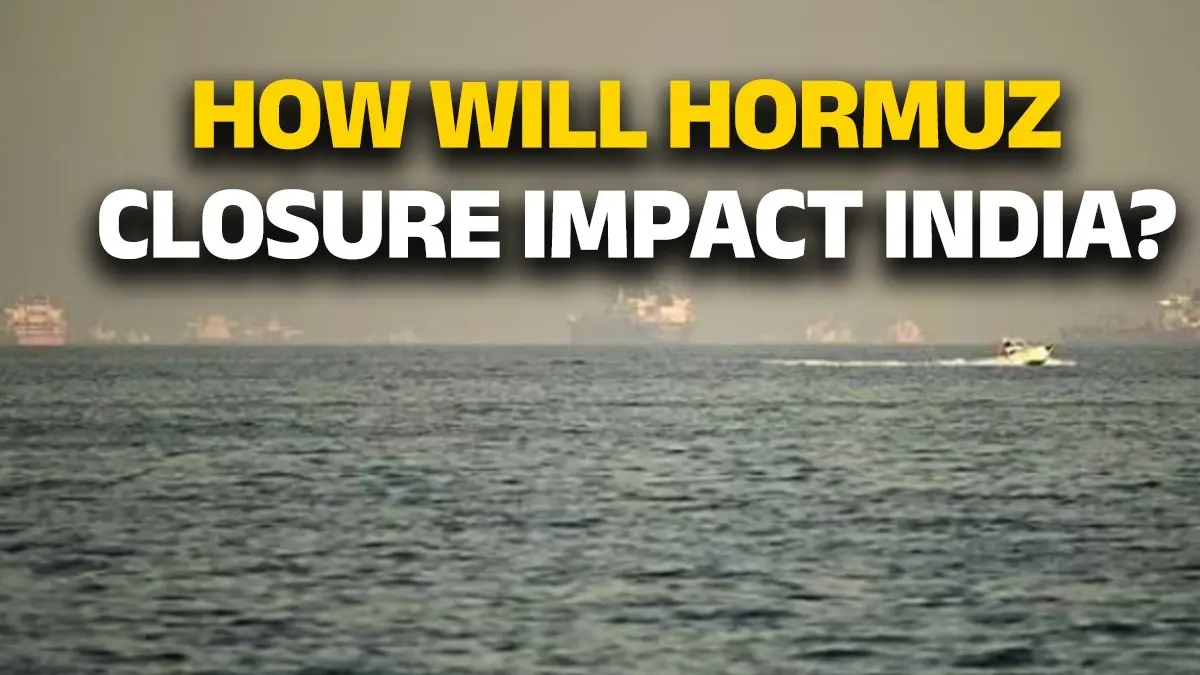
New Delhi: The global energy landscape is teetering on the edge of a historic crisis following the effective closure of the Strait of Hormuz, a move triggered by the rapid escalation of the Israel-Iran war. As of March 1, 2026, maritime traffic through the world’s most vital energy chokepoint has ground to a halt after a series of joint U.S.-Israeli strikes targeted Iranian leadership and infrastructure, prompting Tehran to "weaponize" the narrow waterway.
For India, the world’s third-largest oil consumer, the implications are both immediate and severe.
The Chokepoint: Why Hormuz Matters?
The Strait of Hormuz is a 21-nautical-mile wide artery through which nearly 21 million barrels of oil and 20% of global Liquefied Natural Gas (LNG) pass daily.
Iran has historically used the threat of closure as a "nuclear option" in geopolitics. Current reports indicate significant military activity and the suspension of shipments by major trading houses.
Advertisement
Brent crude, which began the year at $61, has already surged past $73 per barrel. Analysts warn that a prolonged blockade could send prices "ballistic," with worst-case scenarios projecting $130 to $300 per barrel.
Implications for India: An Economic Tightrope
India’s energy security is uniquely vulnerable due to its heavy reliance on Middle Eastern crude and the specific geography of its supply chain.
Advertisement
--50% of India’s crude oil and 60% of its LNG transit through Hormuz.
--Every $1 increase in oil prices adds approximately $2 billion to India’s annual import bill.
--Higher fuel costs threaten to spike domestic inflation, potentially forcing the RBI to maintain high interest rates.
--Increased demand for dollars to pay for oil is putting downward pressure on the Indian Rupee (INR).
India’s Survival Strategy
Despite the grim outlook, New Delhi is activating several "contingency layers" to prevent a total energy collapse:
-India currently holds enough crude in underground caverns (at Visakhapatnam, Mangaluru, and Padur) to cover roughly 9.5 days of national demand. Combined with oil company stocks, the country has a buffer of about 60-74 days.
-Under U.S. pressure, India had recently reduced Russian oil buys. However, officials suggest a rapid return to Moscow’s Urals grade--which bypasses Hormuz--could be the primary "relief valve," provided insurance and shipping hurdles are cleared.
-India is negotiating for increased allocations from the East-West Pipeline (Saudi Arabia) and the Abu Dhabi Crude Oil Pipeline (UAE), which terminate at ports outside the Persian Gulf. However, these pipelines have finite capacity and are already in high demand by other Asian giants like China and Japan.
The "LPG" Crisis: The Hidden Danger
While crude oil can be sourced from the U.S. or Africa (albeit at higher freight costs), India’s LPG (Cooking Gas) supply is almost entirely dependent on the Gulf. A sustained closure of Hormuz would immediately threaten the "Pradhan Mantri Ujjwala Yojana" and household energy security across the country, as there are few viable alternative sources for the scale of LPG India requires.
Following the effective closure of the Strait of Hormuz on March 1, 2026, the focus in New Delhi has shifted from immediate energy logistics to the broader economic and geopolitical fallout.
India’s Diplomatic Tightrope: "Strategic Autonomy" Under Fire
The crisis is particularly awkward for India, occurring just 48 hours after Prime Minister Modi’s high-profile visit to Israel, where ties were elevated to a "Special Strategic Partnership for Peace."
The "Equidistance" Policy: External Affairs Minister S. Jaishankar has engaged in "shuttle diplomacy," speaking to both Iranian and Israeli counterparts. India’s official statement notably calls for the “respect of sovereignty and territorial integrity of all states”--a carefully worded phrase that critiques both the US-Israeli strikes on Tehran and the Iranian blockade of international waters.
The Iran Connection: Despite the tilt toward Israel, India cannot abandon Tehran. The Chabahar Port--India’s gateway to Central Asia--and the International North-South Transport Corridor (INSTC) are now in a zone of active conflict. Furthermore, the reported death of Iranian leadership in recent strikes has created a power vacuum that threatens India’s long-term regional investments.
The Diaspora Factor: With nearly 10 million Indians living in the Gulf, the MEA’s primary focus is now "Operation Sindhu-II"—contingency plans for large-scale evacuations should the conflict spread to Bahrain, Qatar, or the UAE.